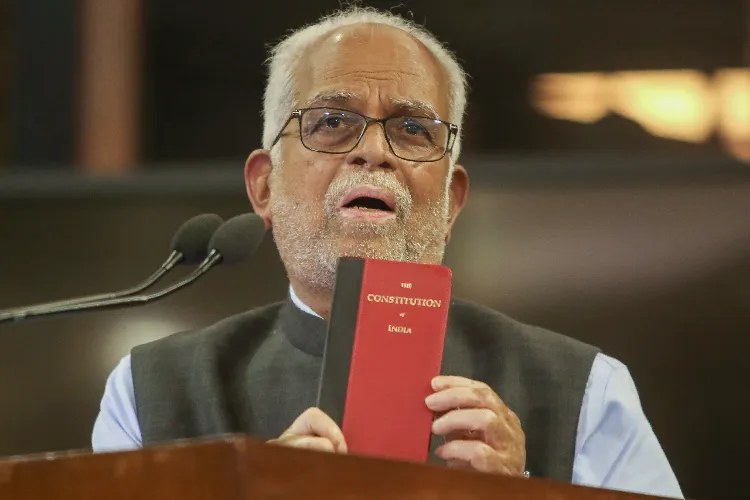
The upcoming Vice Presidential election on September 9 has brought renewed attention to Justice (retired) B Sudershan Reddy, the Opposition’s candidate, as political debates intensify over his 2011 Supreme Court judgment on Salwa Judum. The judgment, delivered during his tenure on the Supreme Court bench alongside Justice Surinder Singh Nijjar, declared the Salwa Judum movement in Chhattisgarh unconstitutional and a violation of human rights. This decision has resurfaced as a central point of contention, with the BJP accusing Justice Reddy of being lenient toward Maoists and allegedly weakening India’s counterinsurgency measures. Meanwhile, the retired judges and legal experts defending Reddy have emphasized that the verdict strictly adhered to constitutional principles and did not favor any extremist ideology. The controversy reflects the intersection of judicial decisions, political discourse, and the ideological debates shaping India’s highest offices.
Salwa Judum Judgment and Its Legal and Social Implications
Salwa Judum, launched in 2005, was a state-backed militia comprising tribal youth in Maoist-affected areas of Chhattisgarh. The movement aimed to counter the growing influence of Naxalite insurgents by recruiting local tribal youth as Special Police Officers (SPOs). These recruits, often minimally educated, were armed and given temporary assignments to combat the Maoist threat. While the government and supporters hailed Salwa Judum as an effective tool against insurgency, activists and human rights organizations consistently criticized it for rampant human rights violations. Allegations included forced recruitment, intimidation of villagers, and violent operations targeting both civilians and suspected insurgents. The movement generated widespread controversy, highlighting the tension between state security measures and constitutional rights.
On July 5, 2011, a Supreme Court bench led by Justice B Sudershan Reddy and Justice Surinder Singh Nijjar issued a landmark judgment, declaring Salwa Judum unconstitutional. The judgment highlighted that arming tribal youth, who lacked formal education and training, posed significant risks to human rights and societal safety. The court emphasized that effectiveness in fighting insurgency could not be the sole measure to assess constitutional permissibility. It directed the state and central governments to halt support for the SPOs and recall all firearms issued under the program. This decision had far-reaching implications, effectively dismantling a key component of the government’s counterinsurgency strategy in Maoist-affected regions.
Following the ban on Salwa Judum, Maoist attacks surged in certain areas, most notably the Darbha Valley ambush in 2013, which resulted in the deaths of former Congress minister Mahendra Karma, state Congress chief Nand Kumar Patel, and 26 others. The Maoists later acknowledged that Mahendra Karma, the founder of Salwa Judum, was their primary target. The BJP has frequently cited these events to argue that Justice Reddy’s judgment weakened India’s ability to combat insurgency, positioning the opposition candidate as ideologically sympathetic to left-wing extremism. Union Home Minister Amit Shah, in particular, linked the choice of Justice Reddy as the opposition candidate to Rahul Gandhi’s ideological leanings, asserting that the judgment inadvertently protected Naxal insurgents and deprived Adivasis of a right to self-defense.
Veteran BJP leader Ravi Shankar Prasad echoed these sentiments, suggesting that the Salwa Judum judgment revealed Justice Reddy’s alleged inclination toward Maoism and highlighting concerns about the ideological stance of an individual chosen for India’s second-highest constitutional office. The BJP’s criticism frames the election as a question not only of political support but also of assessing the philosophical and constitutional outlook of candidates aspiring to occupy the vice-presidency.
Defense of Justice Reddy and Broader Judicial Perspectives
The political attacks on Justice Sudershan Reddy have been met with strong pushback from a coalition of 18 retired judges, including former Supreme Court justices Kurien Joseph, Madan B Lokur, Abhay Oka, and J Chelameswar. The retired jurists issued a public statement condemning the misrepresentation of the 2011 judgment by high-ranking political figures, emphasizing that the verdict did not support Naxalism in any manner. They underscored that such prejudicial misinterpretations could undermine judicial independence and have a chilling effect on the functioning of the judiciary. According to the retired judges, while political campaigns may carry ideological undertones, the civil and dignified treatment of judicial decisions must be maintained to preserve the separation of powers and respect for constitutional principles.
Justice Reddy, in interviews responding to the BJP’s criticisms, clarified that his only guiding principle was adherence to the Constitution and the rule of law. He firmly denied supporting Naxal ideology and questioned why his judgment had not faced legal challenge in the twelve years since its delivery if it truly favored Maoists. By framing the 2011 verdict as a constitutional judgment rather than a political statement, Justice Reddy reinforced the independence of the judiciary and underscored the importance of legal reasoning over partisan interpretation.
The Salwa Judum case highlights broader issues in India’s governance and legal system, particularly the balance between security imperatives and fundamental human rights. While the movement was designed as a counterinsurgency measure, the Supreme Court’s judgment pointed to systemic risks posed by state-sanctioned militias composed of inadequately trained civilians. The court recognized that the short-term effectiveness of such forces could not justify the violation of constitutional protections, including the right to life and personal liberty, and the ethical responsibility to avoid endangering innocent civilians.
The debate around Justice Reddy’s judgment also raises questions about the legacy of judicial decisions and their political exploitation. Opponents have interpreted the verdict through a partisan lens, while supporters argue that the ruling reaffirmed the principles of constitutional morality, human rights, and rule of law. By preventing the government from using inadequately trained tribal youth as instruments of state-sanctioned violence, the Supreme Court reinforced that the protection of fundamental rights remains paramount, even in regions facing insurgency and security challenges.
As Justice Reddy prepares for the Vice Presidential election, his campaign strategy involves outreach to MPs and a focus on his constitutional credentials and judicial record. The opposition has positioned him as a candidate with a proven commitment to upholding constitutional values, while critics continue to question the ideological implications of his past judgments. This tension reflects the broader political narrative in India, where the legacies of judicial decisions are increasingly invoked in high-stakes electoral contests.
Furthermore, the Salwa Judum debate illustrates the enduring complexities of India’s fight against Naxal insurgency, where legal, ethical, and security considerations often intersect. While the BJP frames the judgment as detrimental to national security, legal scholars and retired judges emphasize that the court’s reasoning was grounded in constitutional principles and not political ideology. The discourse around Justice Reddy thus serves as a case study in how judicial interpretations can become flashpoints in political debates, shaping narratives about governance, ideology, and the rule of law.
The controversy also underscores the unique pressures faced by individuals nominated to high constitutional offices in India. Candidates for positions like the Vice President must navigate scrutiny not only of their professional achievements but also of past decisions that may be politically sensitive. Justice Reddy’s experience demonstrates how judicial independence can be politicized, creating an environment where interpretations of past rulings are leveraged for electoral advantage.
Beyond the immediate election context, the debate around Justice Reddy’s Salwa Judum judgment invites reflection on India’s constitutional architecture and the role of courts in arbitrating between human rights and state security. It raises fundamental questions about the extent to which the judiciary can intervene in state-led security initiatives, the limits of government authority in conflict zones, and the ethical responsibilities of the state toward vulnerable populations, particularly tribal communities.
The retired judges’ defense of Justice Reddy emphasizes the need for nuanced understanding of judicial decisions. By mischaracterizing the ruling as pro-Maoist, political actors risk eroding public trust in judicial processes and diminishing the perceived impartiality of the courts. This dynamic highlights the delicate interplay between law, politics, and public perception, especially when legal interpretations intersect with issues of national security and ideological contestation.
Justice Reddy’s candidacy also brings into focus the broader discourse on counterinsurgency strategies in India. While the Salwa Judum program aimed to mobilize local populations to combat Maoist influence, the Supreme Court’s intervention highlighted constitutional limits on such mobilization, emphasizing safeguards against human rights violations. This jurisprudential approach provides a benchmark for future policymaking, balancing security objectives with the rights of citizens.
The debate surrounding Justice Reddy, his judicial philosophy, and the 2011 Salwa Judum judgment will likely remain central to political discussions as the Vice Presidential election approaches. Supporters highlight his commitment to constitutional principles and protection of fundamental rights, while opponents continue to question the broader ideological implications of his rulings. The discourse captures the intersection of law, politics, and ideology in contemporary India, illustrating how past judicial decisions can influence perceptions of leadership, governance, and ethical responsibility at the highest levels of the state.