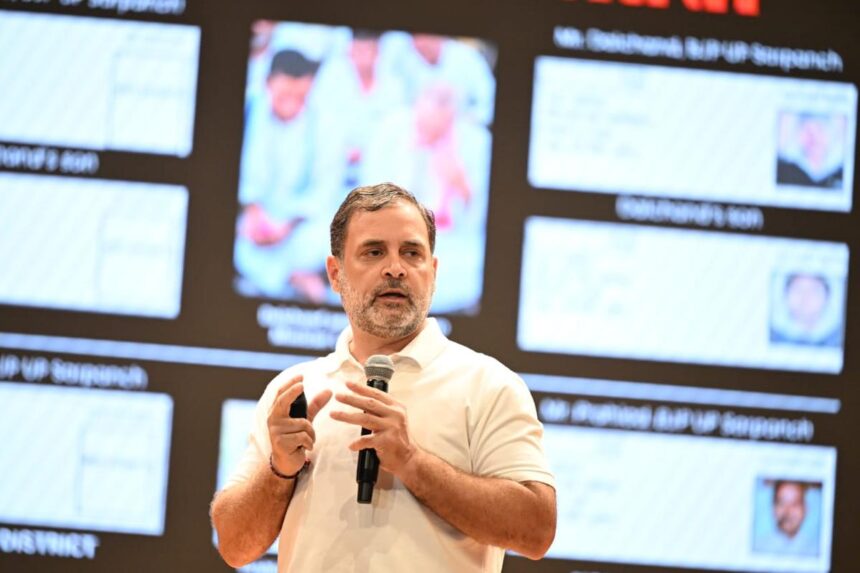
In a major twist to Congress leader Rahul Gandhi’s recent allegations of voter fraud, a Haryana woman whose voter ID card was showcased as evidence in his claim has come forward to reject the accusation. Pinky Juginder Kaushik, a resident of Haryana, clarified that she personally went to cast her vote and denied any foul play. Her statement has cast doubt on Gandhi’s assertions of large-scale voter identity manipulation, which he had described as a “tragedy for democracy.” The incident has sparked a heated political debate, as it touches on one of the most sensitive aspects of India’s democratic process — the integrity of electoral rolls and the fairness of elections.
Haryana Woman Counters Rahul Gandhi’s Claim
The controversy began when Rahul Gandhi, during his campaign trail, alleged that voter fraud had taken place on a massive scale, citing examples of fake or mismatched voter identities. He even pointed to instances where, according to him, photographs of a Brazilian model appeared multiple times on voter ID cards in Haryana. However, one of the women whose voter card was used in these claims, Pinky Juginder Kaushik, has now come forward to deny any wrongdoing or impersonation.
Speaking to the media, Pinky explained that the confusion was caused by a simple misprint on her voter ID card. “Yes, I went to cast my vote myself at the village school,” she said. “The names are the same, but there was a mistake with the photo. They used someone else’s picture. Nevertheless, I did vote. No one pressured me to vote. I showed my slip and then cast my vote.”
Her clarification directly contradicts Rahul Gandhi’s assertion that fake identities were used to manipulate the election results. Pinky’s testimony also underlines the need to verify such claims before they are amplified in political discourse, especially in the midst of an election season where misinformation can influence public opinion.
According to Pinky, while her photograph on the voter card was indeed incorrect, she had no trouble voting as the rest of the details matched, and she possessed the official voter slip. She emphasized that no one prevented her from voting or influenced her choice. “There was confusion about the photo, but I personally cast my vote. The Election Commission officials verified my name, and I was allowed to vote. I exercised my right freely and proudly,” she stated.
Her statement has gone viral, with many questioning the veracity of Rahul Gandhi’s claims and criticizing him for allegedly spreading misinformation without due verification. Several political commentators have pointed out that such errors — though unfortunate — are not uncommon in voter ID cards, which sometimes contain clerical mistakes during data entry or photo uploads.
Rahul Gandhi’s Broader Allegation of ‘Vote Theft’
Rahul Gandhi’s original statement, however, was not limited to Haryana. He also accused the ruling National Democratic Alliance (NDA) government, led by the Bharatiya Janata Party (BJP), of voter list manipulation in Bihar’s Jamui district. Gandhi claimed that hundreds of voters — particularly from Dalit, backward, and minority communities — were removed from electoral rolls without any prior notice. Describing the alleged incident as a “heartbreaking and shameful tragedy for democracy,” he called it an example of “vote theft.”
In a detailed post on social media platform X, Gandhi said he had personally met villagers from Dharampur in Jamui whose names were missing from the voter list. “Today, I introduced the world to some people from Dharampur village in Jamui district of Bihar — what’s happening to them is the most heartbreaking and shameful tragedy for democracy. Despite submitting forms and necessary documents, the names of many villagers were removed from the voter list without any notice or reason,” he wrote.
He went on to cite individual cases to support his claims. “Dilip Yadav, a differently-abled citizen who struggles even to move around — his name was struck off along with his entire family, marked as ‘absent.’ Sunita Devi, Bunty Kumar, Qayam Ansari — all their stories are the same: no hearing, no action,” he alleged.
Rahul Gandhi further accused the BJP-led NDA of deliberately manipulating voter rolls to exclude citizens who are unlikely to support the ruling coalition. “Hundreds of people have been pushed out of democracy because they are Dalits, backward classes, or minorities. Because they probably won’t vote for the BJP and its NDA allies,” he claimed. “This is the real vote theft — erasing people’s voices, rights, and very presence.”
These remarks have ignited a fierce political confrontation, with the BJP dismissing Gandhi’s allegations as unfounded and politically motivated. Party leaders argued that the Congress was attempting to discredit the Election Commission and undermine public faith in India’s electoral system ahead of crucial state polls. BJP spokespersons also highlighted Pinky Kaushik’s statement as evidence that Gandhi’s claims were exaggerated and lacked factual grounding.
Meanwhile, the Election Commission has not issued any direct response to Rahul Gandhi’s accusations but has reiterated that the process of updating and verifying voter lists is done transparently, involving multiple checks and public notifications. Officials have also clarified that any citizen who finds their name missing from the voter roll has the right to file a complaint and seek redress through the proper administrative channels.
The entire episode reflects the heightened political tensions in the lead-up to upcoming elections, where narratives around voter suppression, manipulation, and democratic fairness are dominating political rhetoric. While Rahul Gandhi continues to position himself as a defender of the disenfranchised, incidents like the Pinky Kaushik episode risk undermining his credibility if his claims are not supported by verifiable evidence.
Analysts point out that Gandhi’s political strategy increasingly revolves around portraying the BJP as an authoritarian force eroding democratic norms. However, instances like this highlight the delicate balance between legitimate activism and misinformation, particularly in a country with an electorate as vast and diverse as India’s.
Electoral experts note that voter roll errors, though problematic, often stem from administrative inefficiencies rather than political malice. In a system managing over 900 million registered voters, instances of missing names or incorrect photos are bound to occur, but these typically get corrected upon formal complaint. However, such technical lapses become politically explosive when linked to narratives of intentional exclusion or discrimination.
In the broader context, the issue of voter disenfranchisement continues to be a recurring concern across multiple states. Civil society groups and election watchdogs have often highlighted the need for more transparency and accountability in how electoral rolls are maintained, particularly in rural and marginalized communities where awareness and access to grievance mechanisms remain limited.
The political fallout from this controversy is likely to continue as both sides attempt to frame the narrative to their advantage. For the Congress, Rahul Gandhi’s activism underscores his image as a leader fighting for the rights of the poor and marginalized. For the BJP, the counter-narrative emphasizes the reliability of India’s democratic institutions and paints Gandhi’s claims as yet another attempt to delegitimize the system for electoral gain.
As debates rage on social media and television panels, the story of Pinky Juginder Kaushik has become emblematic of the larger clash between political rhetoric and ground reality. Her straightforward denial of fraud — “I went to cast my vote myself” — has been seen by many as a quiet but powerful rebuttal to sweeping generalizations made in the heat of political campaigns.
While it remains to be seen whether Rahul Gandhi’s allegations will trigger any formal investigation or policy response, the episode serves as a reminder of how easily misinformation or half-verified claims can distort public perception during election season. It also highlights the importance of voter awareness, administrative transparency, and responsible political communication in preserving the sanctity of India’s democratic process.
Ultimately, the Pinky Kaushik controversy is not merely about one mistaken voter ID — it has evolved into a symbol of the larger battle over truth, accountability, and political integrity in contemporary Indian politics. As the electoral season progresses, it is likely that both the Congress and BJP will use this incident to advance their respective narratives — one about the suppression of democracy, and the other about the resilience of democratic institutions.