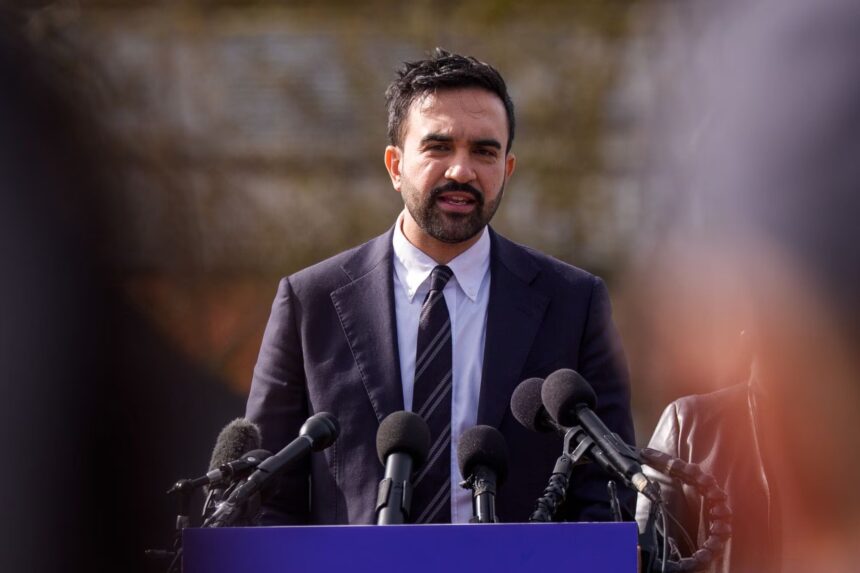
In a fresh escalation of political tension between Washington and New York, US President Donald Trump has lashed out at newly elected New York City mayor Zohran Mamdani, calling his victory speech “very angry” and warning that he is “off to a bad start.” Donald Trump’s reaction came just hours after Zohran Mamdani, who scripted history by becoming the first Muslim and the youngest-ever mayor-elect of New York City, directly addressed the president in his fiery post-victory remarks. The exchange marks the beginning of what appears to be a politically charged relationship between the White House and New York’s new leadership.
Donald Trump’s sharp response to Zohran Mamdani’s remarks
During a media interaction, Donald Trump described Zohran Mamdani’s tone as unnecessarily hostile, implying that his administration’s support for the city could depend on the mayor’s attitude toward Washington. “I thought it was a very angry speech. Certainly angry toward me, and I think he should be nice to me. I’m sort of the one that has to approve a lot of things coming to him, so he’s off to a bad start,” Donald Trump said.
Zohran Mamdani, of Indian and Ugandan descent, had made global headlines after his historic victory on Wednesday, becoming the first Muslim and South Asian-origin person to be elected mayor of New York City. In his celebratory address, he appeared to take a direct swipe at Donald Trump, saying, “So, Donald Trump, since I know you’re watching, I have four words for you: Turn the volume up.” The crowd erupted in applause as he continued, “New York will remain a city of immigrants — a city built by immigrants, powered by immigrants and, as of tonight, led by an immigrant.”
Donald Trump, however, was quick to hit back, warning that New York might face consequences if its leadership followed what he described as a “communist” path. “The decision facing all Americans could not be more clear: we have a choice between communism and common sense,” Donald Trump said during an event in Florida. “Florida will soon be the refuge for those fleeing communism in New York,” he added, suggesting that Zohran Mamdani’s policies might push the city into economic decline.
Donald Trump went a step further by claiming that the United States had “lost sovereignty” after New Yorkers voted for Zohran Mamdani. “We’ll take care of it,” he remarked vaguely, implying federal intervention without clarifying his plan. His comments quickly drew criticism from political analysts who argued that Donald Trump was attempting to politicize a local election victory.
Donald Trump’s warnings and Zohran Mamdani’s measured response
Donald Trump’s opposition to Zohran Mamdani’s candidacy was not new. Even before election day, he had voiced his apprehensions about the Democratic candidate, branding him a “communist” and hinting that New York City might lose federal funding under Zohran Mamdani’s leadership. In a post on Truth Social, Donald Trump wrote, “If Communist Candidate Zohran Mamdani wins the election for Mayor of New York City, it is highly unlikely that I will be contributing Federal Funds, other than the very minimum as required, to my beloved first home.”
His warning was viewed by many as a veiled threat — an attempt to pressure city voters against electing a progressive candidate. However, despite the president’s disapproval and criticism from conservative media outlets, Zohran Mamdani went on to secure a decisive victory, signaling a shift in voter sentiment across one of America’s most influential cities.
Following Donald Trump’s renewed criticism after the election, Zohran Mamdani responded with restraint, choosing to focus on governance rather than confrontation. In an interview, he said he was willing to work with the federal government on shared goals such as reducing the cost of living and making groceries more affordable for working families. “We will work with President Donald Trump where we can, but if he takes punitive action against New York for exercising its democratic choice, we will use the courts to defend our city,” Zohran Mamdani said firmly.
Zohran Mamdani’s victory has not only reshaped New York’s political landscape but also energized the Democratic base nationwide. His win, alongside the Democratic Party’s successes in Virginia and New Jersey’s gubernatorial races, has been widely interpreted as an indication of a changing political mood ahead of next year’s midterm elections. For many Democrats, Mamdani’s triumph represents a generational and ideological shift — one that could signal growing public support for inclusive and progressive leadership.
Donald Trump, however, remained defiant. In his subsequent Truth Social post, he dismissed suggestions that his influence had waned following Republican losses across key states. Citing unnamed “pollsters,” he argued that GOP setbacks were due to the government shutdown and the absence of his own name on the ballots. He refused to take any responsibility for the defeats, continuing to portray himself as the central figure of American conservatism.
Despite his harsh words for Zohran Mamdani, Donald Trump later adopted a slightly more conciliatory tone during an economic conference in Miami. “We will help him. We want New York to be successful. We’ll help him, a little bit maybe,” he said, suggesting a limited willingness to cooperate. Analysts interpreted this as a tactical move to appear statesmanlike while maintaining pressure on Zohran Mamdani’s administration.
Political observers have noted that Donald Trump’s criticism of Zohran Mamdani’s “angry” tone may reflect deeper political anxieties. As the first Muslim and South Asian-origin mayor of America’s largest city, Zohran Mamdani represents a new generation of leaders who challenge traditional power structures. His progressive platform, centered around affordable housing, immigrant rights, and social justice, contrasts sharply with Donald Trump’s conservative nationalism. The resulting ideological clash between the two could become a defining feature of US urban politics in the coming years.
Meanwhile, Zohran Mamdani’s victory speech, though celebratory, was also defiant — positioning New York as a symbol of resistance against divisive politics. By declaring that the city would remain “led by an immigrant,” he reinforced the identity of New York as a global and inclusive metropolis, distancing it from Donald Trump’s rhetoric of exclusion. Supporters have hailed Zohran Mamdani’s words as emblematic of America’s multicultural ethos, while critics have accused him of politicizing identity.
The brewing conflict between Donald Trump and Zohran Mamdani also underscores the evolving relationship between federal power and city governance. Donald Trump’s suggestion that New York could face reduced funding raises questions about whether partisan politics will once again interfere with urban development and welfare. Experts warn that withholding federal support could have significant consequences for critical sectors like housing, public transport, and infrastructure.
Zohran Mamdani’s readiness to “utilize the courts” if needed signals his intent to defend New York’s autonomy. Legal scholars note that while the federal government can control discretionary grants, it cannot arbitrarily cut funding to states or cities based on political disagreements — a principle upheld in previous court rulings.
The exchange between Donald Trump and Zohran Mamdani has also captured international attention, given Zohran Mamdani’s South Asian roots and the symbolic importance of his election. As the son of an Indian mother and Ugandan father, Zohran Mamdani’s rise to one of America’s most powerful municipal offices has been hailed as a milestone for immigrant representation in US politics. His emphasis on social equity, diversity, and anti-discrimination policies resonates strongly among younger voters and minority communities, many of whom see him as a voice for the marginalized.
Donald Trump’s repeated warnings about “communism” and “economic nightmares” under Zohran Mamdani’s administration mirror his broader campaign strategy, which frames Democrats as radicals intent on dismantling traditional American values. However, analysts argue that such rhetoric could backfire, alienating moderate voters who are weary of ideological extremism.
For now, both leaders appear to be setting the stage for a prolonged political confrontation — one that could influence national debates on immigration, economic reform, and federalism.Zohran Mamdani’s challenge will be to navigate the pressures of federal politics while delivering on his promises to the people of New York. Donald Trump, on the other hand, will likely continue using Zohran Mamdani’s policies as a rallying point for his conservative base as he eyes the 2026 midterm elections and beyond.
While it remains uncertain how the working relationship between the White House and City Hall will unfold, one thing is clear — Zohran Mamdani’s historic win has not only altered New York’s political landscape but also reignited national discussions about inclusion, democracy, and leadership in America’s future.