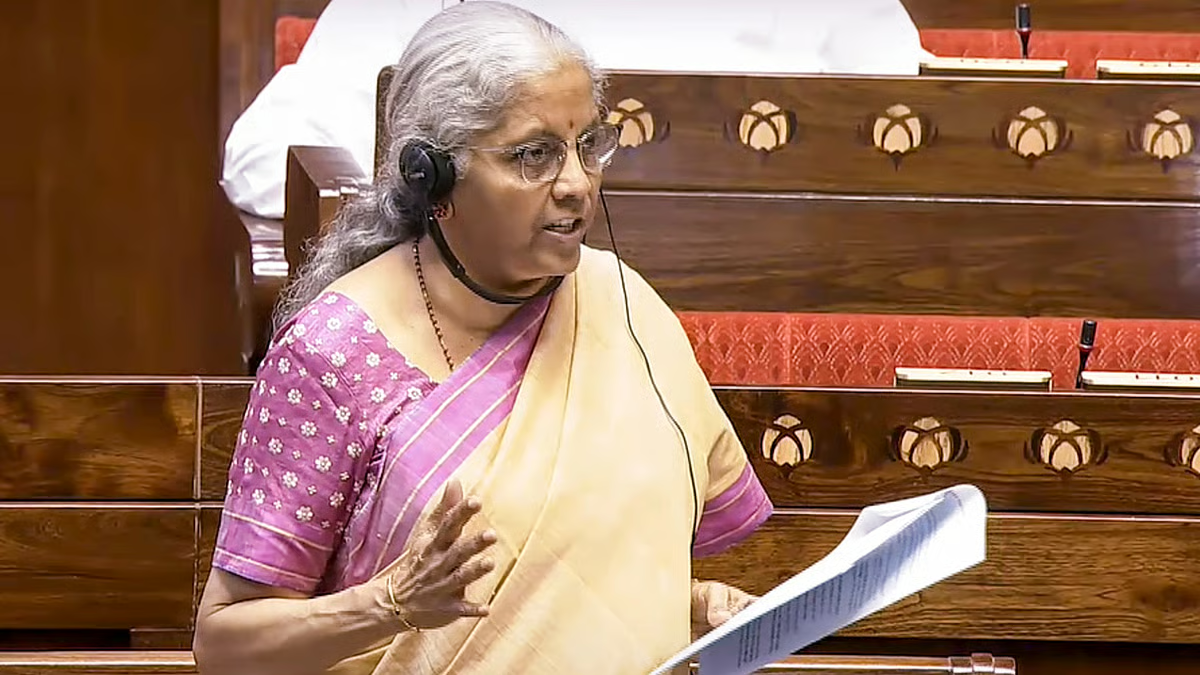
The Lok Sabha has recently cleared the Income Tax (No 2) Bill, which aims to replace the decades-old Income Tax Act of 1961 with a simplified, more transparent, and efficient tax framework. This landmark legislation is designed to make tax laws easier to understand and follow, reduce litigation, and provide clearer definitions and provisions that benefit individual taxpayers and businesses alike. The bill introduces key reforms while maintaining the existing tax slabs, signaling a significant modernization of India’s tax regime effective from April 1, 2026.
Simplification and Streamlining: The Core of the New Income Tax Bill
The Income Tax (No 2) Bill embodies the government’s commitment to making the tax system ‘S.I.M.P.L.E,’ an acronym coined by Finance Minister Nirmala Sitharaman to represent the guiding principles: Streamlined structure and language; Integrated and concise; Minimised litigation; Practical and transparent; Learn and adapt; and Efficient tax reforms. This bill aims to overhaul the old, complex 1961 Income Tax Act, which has undergone over 4,000 amendments and spans more than half a million words, making it difficult for taxpayers to navigate.
One of the key objectives of the bill is to simplify tax provisions by nearly 50%, making it easier for individuals and Micro, Small, and Medium Enterprises (MSMEs) to comply. To achieve this, the bill clarifies existing deductions, strengthens cross-referencing across different sections, and addresses ambiguities, especially regarding income from house property such as standard deductions and pre-construction home loan interest.
The bill also refines critical definitions, including ‘capital asset,’ ‘micro and small enterprises,’ and ‘beneficial owner,’ ensuring uniformity and reducing legal uncertainties. It also aligns tax treatments for pension contributions and expenses related to scientific research, reflecting an effort to modernize tax norms in tune with evolving economic activities.
Some notable simplifications include allowing taxpayers to claim refunds even if returns are filed late and waiving penalties for late Tax Deducted at Source (TDS) filings. Additionally, taxpayers with no tax liability can apply in advance for ‘nil-TDS certificates,’ easing compliance for both resident and non-resident taxpayers. This is a significant step towards reducing procedural burdens.
The bill reinstates deductions for inter-corporate dividends under Section 80M, which had been omitted in earlier drafts. This reinstatement is crucial for companies operating in multi-tiered structures, as it prevents double taxation and encourages corporate investments.
Key Provisions and Practical Changes in the New Law
Apart from simplification, the bill introduces important clarifications and new rules, particularly related to property income and MSME definitions. Regarding property income, the bill fixes the standard deduction at 30% for rental income under Section 21, and allows deductions for interest paid on loans taken for purchase, construction, or repair of property. A significant change is in the method of calculating annual value for tax purposes, which will now consider the higher of ‘reasonable expected rent’ or the actual rent received or receivable when the property or any part of it is let. This change brings uniformity and reduces ambiguity in property income taxation.
The bill aligns MSME classifications with those in the MSME Act revised in 2020, defining micro and small enterprises based on investment in machinery and turnover thresholds. For example, a micro-enterprise has investment below Rs 1 crore and turnover below Rs 5 crore, while a small enterprise has investment below Rs 10 crore and turnover below Rs 50 crore. This alignment aims to reduce discrepancies between tax and other regulatory frameworks, facilitating easier compliance and clearer categorization for businesses.
A significant conceptual change in the bill is the introduction of the ‘tax year,’ which replaces the simultaneous use of ‘financial year’ and ‘accounting year.’ Under the current system, income earned in one year is taxed in the next year. The new provision intends to tax income in the same year it is earned, potentially improving transparency and reducing confusion.
Furthermore, the bill has done away with redundant sections such as those concerning fringe benefit tax, streamlining the law by removing obsolete provisions.
For ease of use, the bill includes handy tables for calculating TDS, presumptive taxation, salary income, and bad debt deductions. These tools will assist taxpayers and tax professionals in better understanding and complying with the provisions.
One of the biggest reassurances in the bill is that the existing income tax slabs will remain unchanged. This continuity ensures stability for taxpayers amid the structural changes.
Lastly, the bill clarifies that key terms and phrases as defined by court rulings will continue to apply, preserving the legal interpretations that taxpayers and courts rely on.
The Income Tax (No 2) Bill marks a transformative step towards a modern and taxpayer-friendly tax system. With its clear focus on simplification, practical reforms, and reduced litigation, the new law aims to foster ease of doing business and compliance, paving the way for a more efficient tax environment in India.