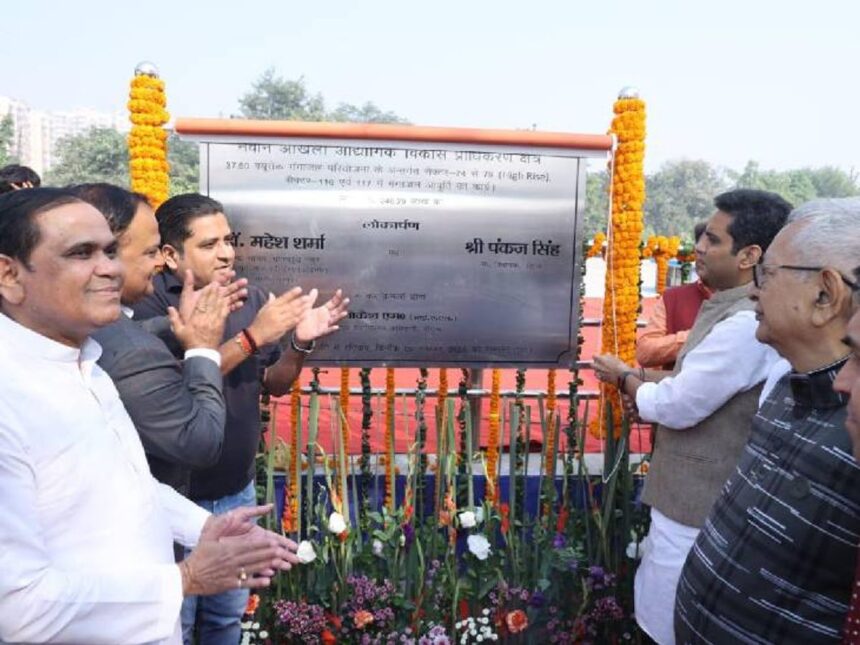
The city of Noida took a significant leap forward in its mission to provide clean and reliable drinking water to its residents as the long-awaited Ganga water supply project was inaugurated on Sunday. With an investment of ₹2.47 crore, this initiative will supply 40 million litres per day (MLD) of purified Ganga water to the densely populated SevenX region, covering sectors 74, 75, 76, 77, 78, 79, along with sectors 116 and 117. The project is expected to directly benefit more than 30,000 people, ensuring that households in these sectors receive safe, high-quality water for daily use.
The inauguration ceremony was conducted by local MLA Pankaj Singh, who emphasized that this initiative marks a major milestone in Noida’s urban infrastructure and environmental management. The project not only enhances the quality of water being supplied but also aligns with broader goals of sustainable resource management and improved civic amenities for residents. With the commencement of this project, several years of delay and anticipation among residents have finally come to an end.
Transforming Noida’s Water Infrastructure
For years, the residents of Noida’s rapidly developing sectors, especially in the SevenX belt, have faced challenges in accessing clean water. Many households depended on borewells and water tankers due to inconsistent municipal supply, which often contained high levels of impurities or hardness. The launch of the Ganga water project aims to permanently resolve this issue, providing treated water sourced directly from the Upper Ganga Canal.
Officials from the Noida Authority revealed that the newly constructed water pipeline network has been integrated with the existing water treatment system to ensure seamless distribution. The project was completed with an expenditure of ₹2.47 crore, which included the construction of new pumping stations, underground reservoirs, and a modernized filtration system designed to maintain the purity of the water at every stage.
The 40 MLD capacity has been designed to accommodate both current demand and future population growth. Each sector under the project’s coverage—ranging from the high-rise apartments of sector 74 to the upcoming residential complexes in sectors 116 and 117—will receive an uninterrupted supply of Ganga water. Authorities have assured that the water will meet all national safety and quality standards as prescribed by the Bureau of Indian Standards (BIS).
MLA Pankaj Singh, during the inauguration, highlighted that this project is a step toward realizing Noida’s goal of becoming a model city in urban living standards. He noted that access to clean drinking water is not just a civic facility but a fundamental right, and the government’s focus is to ensure that every household, regardless of its location or economic background, receives this essential service without disparity.
He also acknowledged the efforts of the Noida Authority engineers and field staff who worked tirelessly to complete the project within the stipulated timeframe, despite challenges such as delayed procurement, technical setbacks, and coordination with multiple departments. The MLA further assured that more such projects are in the pipeline to expand Ganga water coverage to other sectors in the coming months.
Clean Water for a Healthier City
The introduction of Ganga water in Noida is not merely an infrastructure upgrade; it represents a transformative change in the quality of life for thousands of families. For residents of sectors 74 to 79 and 116–117, this new supply system means freedom from the daily struggle of managing hard water, dependence on private tankers, and the associated health concerns arising from untreated water sources.
Experts note that the Ganga water, after undergoing rigorous treatment and chlorination, is among the safest forms of drinking water available in the region. The Noida Authority has also deployed a digital monitoring system that ensures real-time quality checks and prompt detection of impurities. Any deviation from quality standards will immediately trigger alerts to the control room, ensuring corrective measures are implemented without delay.
In the broader context, the Ganga water project supports the national agenda of integrating clean river water into urban pipelines to reduce groundwater depletion. Noida, which has witnessed unprecedented urbanization in the past decade, has seen a sharp fall in groundwater levels. Continuous extraction of underground water not only poses an environmental threat but also increases maintenance costs for residents who rely on borewells. The introduction of Ganga water helps reduce this dependency, contributing to long-term ecological balance.
Local residents have expressed relief and appreciation following the launch. Many apartment associations in sectors 74 and 78 stated that their long-pending demand for better-quality water has finally been fulfilled. They noted that earlier, hard water led to scaling in pipes, damage to appliances, and skin-related issues. With Ganga water now flowing through their taps, they expect significant improvement in household efficiency and health conditions.
The project also sets a benchmark for other developing regions in the National Capital Region (NCR). With its advanced infrastructure, it serves as a model for integrated water management that combines technological innovation, environmental sustainability, and citizen welfare. Officials further stated that the Noida Authority is committed to maintaining transparency and efficiency in monitoring water usage and billing systems to ensure public trust and participation.
Expanding Reach and Ensuring Sustainability
The success of this initiative is expected to pave the way for the next phase of Ganga water expansion in Noida. The Noida Authority has already outlined plans to extend similar pipelines to sectors 80–123 in the next stage of the project. Preliminary estimates suggest that an additional 60 MLD of capacity will be added to meet the city’s growing residential and industrial needs.
Authorities are also working closely with the Uttar Pradesh Jal Nigam to ensure that the water drawn from the Upper Ganga Canal remains sustainable and environmentally responsible. Regular maintenance of intake points, periodic cleaning of reservoirs, and water recycling mechanisms are part of the operational plan.
Another notable feature of the project is its energy-efficient pumping system, which reduces power consumption and operational costs. The system has been designed to operate on minimal energy while maintaining constant pressure throughout the distribution network. Officials also mentioned that solar-powered modules will be added to the system in the near future to make the project more eco-friendly and self-sustaining.
Citizen awareness is being treated as an equally important component of this initiative. The Noida Authority has launched a community outreach campaign to educate residents about the importance of conserving water, preventing leakage, and maintaining cleanliness around storage tanks and pipelines. Posters, local meetings, and digital awareness drives are being organized to promote responsible usage and community ownership of the system.
In the administrative setup, a dedicated control center has been established to monitor the flow, pressure, and quality of water supplied to each sector. This control center will operate 24×7, with engineers and technicians working in shifts to address complaints and ensure that the water supply remains uninterrupted even during maintenance or technical issues.
Officials are confident that such proactive measures will help prevent water shortages during summer months, a recurring problem in several parts of Noida. The combination of advanced infrastructure and community participation is expected to make the city’s water management system more resilient in the long term.
Beyond residential benefits, the improved water supply will also support local businesses, schools, and hospitals that rely heavily on clean water for their operations. The Noida Authority plans to connect several institutional and commercial areas to the Ganga pipeline soon, ensuring equitable distribution across all sectors.
The introduction of 40 MLD of Ganga water in Noida is more than a technical achievement—it symbolizes the city’s evolution toward a more sustainable, livable, and health-conscious future. The ₹2.47 crore investment is a step toward ensuring that every citizen enjoys access to clean, safe, and reliable water, marking a defining moment in Noida’s journey of urban transformation.