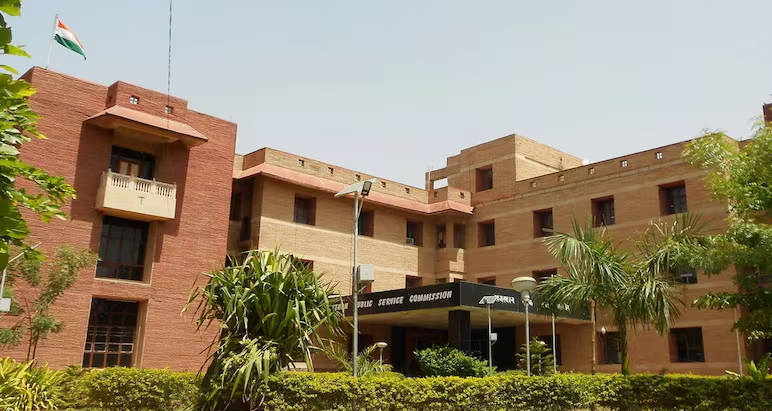
In a remarkable demonstration of dedication and perseverance, the Rajasthan Administrative Service (RAS) 2023 results have highlighted not only exceptional talent but also the inspiring journeys of candidates from diverse backgrounds. The final results, announced by the Rajasthan Public Service Commission (RPSC) on October 15, 2025, reflect a combination of hard work, determination, and the increasing participation of aspirants from smaller towns and rural areas, who have defied odds to achieve top positions in one of the state’s most competitive examinations. Among the high achievers, Kushal Chaudhary, a young man from Dungaria Kalan village in Ajmer, has emerged as the topper, while candidates from Ajmer and Nagaur districts have dominated the top 10, showcasing the rising talent from these regions. The examination, which assesses candidates on a wide range of subjects including administrative aptitude, general knowledge, and analytical skills, serves as a gateway to prestigious positions in the Rajasthan Administrative Service, offering an opportunity to contribute to governance and policy implementation across the state.
Ajmer’s Dominance and Rural Aspirants’ Triumph
The 2023 edition of RAS witnessed unprecedented representation from Ajmer and Nagaur districts, with aspirants from these areas occupying several top slots. Notably, three candidates from Ajmer secured places within the top three ranks, demonstrating the district’s growing prominence in civil service success. Kushal Chaudhary, the first-rank holder, hails from Dungaria Kalan village, a small rural settlement in Ajmer. His journey is emblematic of determination and self-study; despite humble beginnings, he overcame challenges to achieve the pinnacle of success in one of the state’s most competitive examinations. Currently employed as a laboratory assistant at a government school in Tabiji, Kushal resides in the police line quarters and has consistently balanced work commitments with preparation for the examination. He attributes his success to his relentless efforts and self-study strategies, emphasizing that the support and values imparted by his farming family played a crucial role in shaping his resolve.
Kushal’s story resonates with many aspirants from rural backgrounds who often face limited access to coaching resources and educational infrastructure. Yet, his achievement underscores the transformative power of determination, discipline, and effective time management. His success also highlights the changing landscape of competitive examinations in Rajasthan, where candidates from villages and smaller towns are increasingly making their presence felt alongside aspirants from urban centers. The RPSC’s meticulous examination and evaluation process ensures that merit remains the defining criterion, thereby offering a level playing field for aspirants irrespective of their socio-economic backgrounds.
Vikas Siyag’s Journey: Second Attempt Triumph and Dedication to Family
Another inspiring narrative from RAS-2023 comes from Vikas Siyag of Kolayat, Bikaner, who secured the 10th position in the examination. Vikas, who works as a junior assistant at the Government Senior Secondary School, Ranjitpura, under the Education Department, epitomizes the spirit of perseverance. His journey to success was not without challenges. Despite clearing the prelims in the RAS-2021 examination, he could not succeed in the mains. Instead of being disheartened, Vikas channeled his energies and focused entirely on preparation for the 2023 cycle. His disciplined approach, consistent study schedule, and unwavering confidence enabled him to achieve a top 10 position on his second attempt, demonstrating that resilience and determination can ultimately lead to success.
Vikas’s background is reflective of the hardworking ethos prevalent in rural Rajasthan. His father, Nathuram Siyag, is both a truck driver and a farmer, while his mother, Pappu Devi, is a homemaker. Vikas has consistently acknowledged the sacrifices and encouragement of his parents, dedicating his success to their unwavering support. His story highlights the crucial role of family encouragement in enabling aspirants to pursue rigorous preparation for competitive examinations, particularly in contexts where balancing employment and study becomes a significant challenge. Vikas’s achievement also reinforces the idea that persistence, coupled with focused preparation, can yield outstanding results even for candidates balancing professional responsibilities.
The RAS-2023 examination cycle saw interviews for 2,188 candidates concluding on October 14, 2025, followed by the announcement of final results on October 15. The recruitment process, initially announced on June 28, 2023, aims to appoint 972 new officers across Rajasthan, reinforcing the state’s commitment to expanding its administrative capacity. Candidates who cleared the examination will play pivotal roles in governance, policy implementation, and developmental initiatives across various districts. These appointments are crucial not only for efficient administration but also for ensuring that governance remains responsive, accountable, and inclusive, particularly in the context of rural and semi-urban regions where administrative interventions have the most tangible impact.
The success of candidates like Kushal Chaudhary and Vikas Siyag has drawn attention from political leaders and the public alike. Rajasthan Chief Minister Bhajan Lal Sharma extended his congratulations, emphasizing that the youth’s hard work and dedication have borne fruit. He noted that these newly recruited officers would significantly contribute to the state’s development and highlighted the government’s commitment to providing transparent and timely employment opportunities for youth, reflecting the broader agenda of promoting meritocracy and youth empowerment within governance frameworks.
These stories also underline the changing demographics of competitive examination success in Rajasthan. Increasingly, candidates from smaller towns and rural districts are achieving top positions, challenging conventional perceptions that urban centers dominate civil services. The RPSC’s role in providing a fair and rigorous evaluation process has enabled this democratization of opportunity, allowing talent from diverse backgrounds to shine and inspiring a new generation of aspirants to pursue their goals with confidence.
The prominence of Ajmer in RAS-2023 is notable, with multiple candidates from the district securing top positions, thereby illustrating the district’s evolving educational ecosystem and emphasis on civil service preparation. Local initiatives, community support networks, and aspirants’ self-driven learning strategies have collectively contributed to this outcome, highlighting the potential for rural regions to emerge as hubs of talent and public service leadership. The stories of Kushal and Vikas exemplify the synergy between personal determination, family support, and community encouragement, forming a comprehensive foundation for success in highly competitive arenas.
Moreover, these successes send a powerful message regarding social mobility through education and competitive examinations. Aspirants from modest socio-economic backgrounds, such as the sons of farmers or small business owners, have demonstrated that structured preparation, resilience, and strategic focus can overcome systemic challenges. These narratives serve to inspire thousands of students across Rajasthan and beyond, creating aspirational benchmarks and encouraging broader participation in civil services.
The meticulous process of the RPSC examination, including preliminary tests, mains, and interviews, ensures that candidates are evaluated holistically, encompassing knowledge, analytical abilities, and administrative aptitude. The final results reflect not just academic prowess but also qualities such as decision-making, leadership potential, and ethical judgment, which are essential for effective governance. By prioritizing merit and comprehensive assessment, the RPSC continues to nurture a cadre of officers capable of contributing meaningfully to Rajasthan’s administrative landscape.
The 2023 RAS cycle also emphasized inclusivity and representation. Candidates from multiple districts including Jaipur, Jhunjhunu, Hanumangarh, and Bikaner were among the top 10, reflecting a more geographically diverse cohort than previous years. Such diversity strengthens the administrative apparatus by ensuring a wider understanding of regional challenges, socio-economic dynamics, and local governance issues, which are critical for crafting policies that are equitable and contextually relevant.
The RAS-2023 results reflect a combination of hard work, resilience, and the democratization of opportunity across Rajasthan. The top-ranking achievements of Kushal Chaudhary and other candidates from Ajmer and surrounding districts showcase not only individual brilliance but also the broader potential of aspirants from rural backgrounds. As Rajasthan prepares to induct 972 new officers, these appointments are poised to influence governance positively, bringing fresh perspectives, energy, and commitment to public service. The success stories from this cycle will likely inspire a new wave of aspirants, reinforcing the importance of preparation, perseverance, and support systems in achieving excellence in civil services.