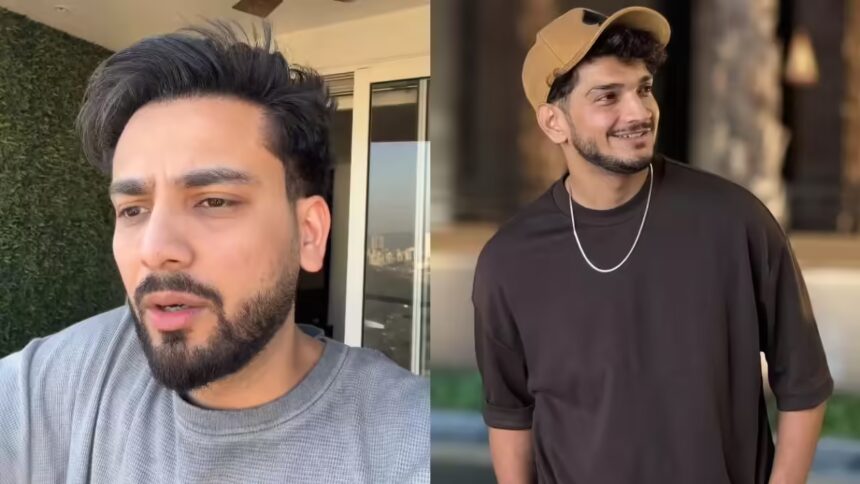
Social media influencer and reality show winner Elvish Yadav has publicly responded with strong words to comments made by comedian Munawar Faruqui, after the latter raised concerns about alleged fundraising scams run under the guise of non-governmental organisations, a remark widely interpreted as being aimed at Yadav’s recent appeal for a critically ill child.
The controversy erupted after Elvish Yadav shared a video appealing for financial help to save a child suffering from spinal muscular atrophy, a rare and life-threatening genetic disorder. The treatment requires a single injection imported from the United States, costing approximately ₹9 crore. While the appeal was intended to mobilise public support for an urgent medical cause, it soon became the centre of an online dispute after Munawar Faruqui posted a cryptic message suggesting that influencers were being paid to collect donations in the name of charity. Though no names were mentioned, the timing of the post led many social media users to link the comments directly to Yadav.
Elvish Yadav’s response and defence of the fundraising appeal
Reacting to the growing speculation, Elvish Yadav released a video statement on his official X account, expressing frustration over what he described as baseless accusations and misinformation circulating online. He said that he had consciously stayed away from controversies in recent times and had no intention of responding to personal attacks, but felt compelled to speak after seeing repeated claims suggesting that he had scammed people or taken money in the name of charity.
Yadav categorically denied any wrongdoing, stating that he does not charge money for helping anyone and does not believe in exploiting emotional causes for personal gain. He explained that the fundraising initiative was brought to him by close acquaintances whom he trusted, and that all relevant documents related to the child’s medical condition and treatment were verified before he shared the appeal publicly. According to Yadav, the paperwork included details of doctors and hospitals involved in the treatment, which gave him confidence that the appeal was genuine.
He further emphasised that the NGO associated with the fundraising had a transparent system in place, where details of incoming funds were publicly accessible. Yadav argued that transparency was central to the entire process and dismissed the allegations as an attempt to tarnish his image. He questioned why someone with a stable career and successful shows would risk credibility over what he described as “small things,” adding that he had no habit of engaging in scams.
Addressing online speculation that he might disappear with the collected funds, Yadav responded sarcastically, saying that people were already imagining scenarios where he fled the country in a private jet. He stated that once official hospital procedures, including payments at AIIMS, were completed, the truth would become evident. According to him, social media users often look for excuses to pull others down instead of supporting positive efforts.
In a pointed remark clearly directed at critics, Yadav urged people to focus on their own work. He added that if someone is not in a position to help others, that is acceptable, but spreading doubt and negativity about genuine efforts only discourages charitable action. He concluded by saying that he hoped everyone would someday be capable enough to help those in need, rather than questioning intentions without evidence.
How Munawar Faruqui’s remarks triggered the controversy
The controversy traces back to December 19, when Elvish Yadav uploaded a video introducing the family of a child diagnosed with spinal muscular atrophy. In the video, he explained the urgency of the situation, noting that the life-saving injection needed to be administered within a limited time frame and that failure to do so could prove fatal. He appealed to his followers to contribute whatever they could to help raise the substantial amount required.
Shortly after the video gained traction, Munawar Faruqui posted a story on Instagram stating that he had also received offers to promote similar fundraising videos. Without naming any individual, he questioned why influencers were being paid to promote donation drives if the money was genuinely meant for charity. He suggested that such practices could indicate a scam, framing his comments as a cautionary note to the public.
The timing of Faruqui’s post led many users to believe that it was directed at Elvish Yadav. As screenshots of the story circulated, social media platforms were flooded with debates, with some users accusing Yadav of wrongdoing and others defending his intentions. The situation escalated as hashtags and commentary began linking Yadav’s name with alleged fraud, prompting his strong rebuttal.
In response to the backlash, Munawar Faruqui later posted another video clarifying his position. He stated that his intention was not to target any specific individual but to raise awareness about the need for vigilance when donating money online. Faruqui said that people often misinterpret messages on social media and reiterated that he had not named Elvish Yadav or accused him directly. He even mentioned that he shared a cordial relationship with Yadav, adding that they had eaten together from the same plate, a remark intended to underscore the absence of personal animosity.
Despite this clarification, the episode highlighted how quickly indirect remarks can snowball into full-blown controversies in the age of social media. The exchange also reignited broader discussions about influencer-led fundraising, transparency in online charity campaigns, and the responsibility of public figures when commenting on sensitive issues. While Elvish Yadav stood firm in defending his actions and intentions, the incident served as a reminder of the intense scrutiny faced by high-profile personalities when engaging in public welfare initiatives.