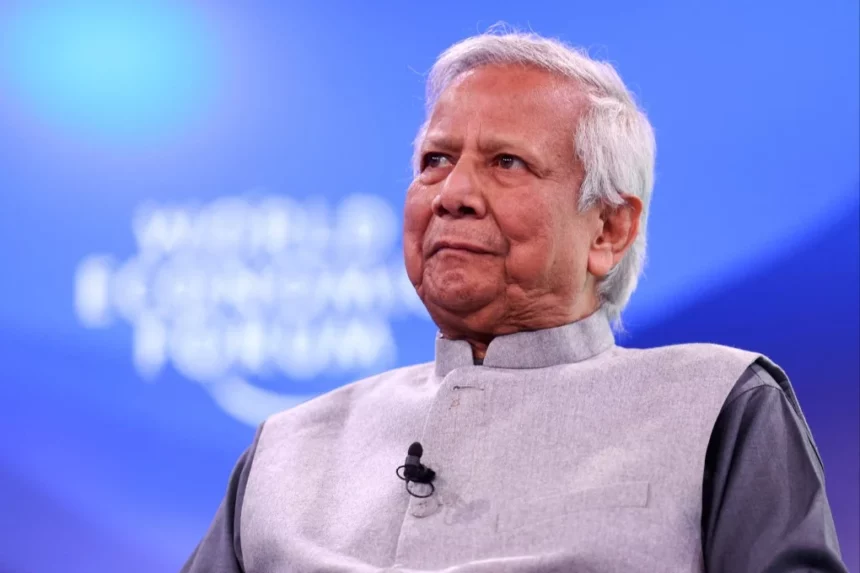
Bangladesh President Mohammed Shahabuddin has claimed that former interim government head Muhammad Yunus made repeated attempts to remove him from office during the 18-month interim administration, raising serious constitutional and political questions just days after the Bangladesh Nationalist Party formed a new government following the February 12 general election.
President alleges repeated attempts to unseat him during interim rule
In an interview published in a Bangla newspaper, President Mohammed Shahabuddin stated that during the 18 months of the interim government’s tenure, several efforts were made to remove him from his constitutional position. According to him, although he was not publicly at the center of political discussions, behind the scenes multiple “plots” were allegedly being hatched against him.
The President asserted that he was targeted in numerous ways but did not succumb to pressure. He indicated that attempts were made to create what he described as a “constitutional void” during the period when Muhammad Yunus was heading the interim administration. Such a void, according to constitutional experts, could have disrupted the command structure across key state institutions, including the armed forces, civil bureaucracy and the judiciary.
Shahabuddin emphasized that he received what he described as the “highest level of support” from the chiefs of the armed forces during that period. He recounted that military leaders approached him at different times and reassured him of their backing. According to the President, they reminded him that as the supreme commander of the armed forces, any attempt to undermine his position would symbolically amount to undermining the military establishment itself.
He quoted them as saying that his defeat would mean the defeat of the entire armed forces and that they would prevent such an outcome at any cost. Shahabuddin added that in the end, they stood by him and prevented any move that could have resulted in his removal. His remarks underscore the sensitive balance between constitutional authority and institutional stability in Bangladesh’s governance framework.
The President’s allegations come at a politically significant moment, shortly after the Bangladesh Nationalist Party assumed office following its victory in the February 12 general election. The transition from the interim administration to a newly elected government has reignited debates about the role and actions of the interim leadership.
Shahabuddin also stated that he could unequivocally affirm that the top leadership of the now ruling BNP stood beside him during the turbulent period. He specifically mentioned that the party, now headed by Prime Minister Tarique Rahman, demonstrated commitment to preserving constitutional continuity. This statement positions the BNP as supportive of institutional stability during what he described as a period of political strain.
Political transition and constitutional continuity under new parliament
The President’s remarks have added another dimension to Bangladesh’s ongoing political transition. After the February 12 general election, the Bangladesh Nationalist Party formed the government with a decisive mandate. The party secured a two-thirds majority in Parliament, placing it in a dominant legislative position.
In a related development, President Shahabuddin summoned the first session of the 13th Parliament for March 12, nearly a month after the BNP formed the government. The inaugural session is expected to formally consolidate the new political order, with the BNP holding a commanding majority and the far-right Jamaat-e-Islami emerging as the principal opposition force.
The summoning of Parliament marks a significant step toward restoring routine parliamentary functioning after a prolonged interim period. The President’s decision reflects constitutional procedure, as it is his responsibility to convene the legislature following general elections.
Observers note that the new parliamentary configuration, with the BNP enjoying a supermajority, could shape legislative priorities and influence institutional reforms. The presence of Jamaat-e-Islami as the main opposition introduces a different political dynamic compared to previous parliamentary terms.
Against this backdrop, Shahabuddin’s allegations about attempts to remove him from office highlight the fragility of constitutional balance during transitional phases. Constitutional experts have pointed out that removing a sitting President could have triggered far-reaching implications. The President occupies a pivotal ceremonial and constitutional role, and his removal without clear constitutional process might have affected the continuity of executive authority, military command hierarchy and judicial legitimacy.
The President’s assertion that he remained resilient despite pressure suggests that the period under the interim administration was marked by behind-the-scenes tension. However, no formal proceedings for his removal were publicly acknowledged during that time, and the claims are now emerging retrospectively.
Muhammad Yunus, who led the interim government, has not publicly responded to these allegations at this stage. The interim administration had been tasked with overseeing governance during a politically sensitive period, and its tenure remains subject to differing interpretations within Bangladesh’s polarized political landscape.
As Bangladesh moves forward under the newly elected government, the interplay between constitutional authority, executive leadership and institutional stability remains central to its democratic framework. The convening of Parliament on March 12 will mark the formal beginning of legislative activity under the BNP administration, setting the tone for the country’s next political chapter.