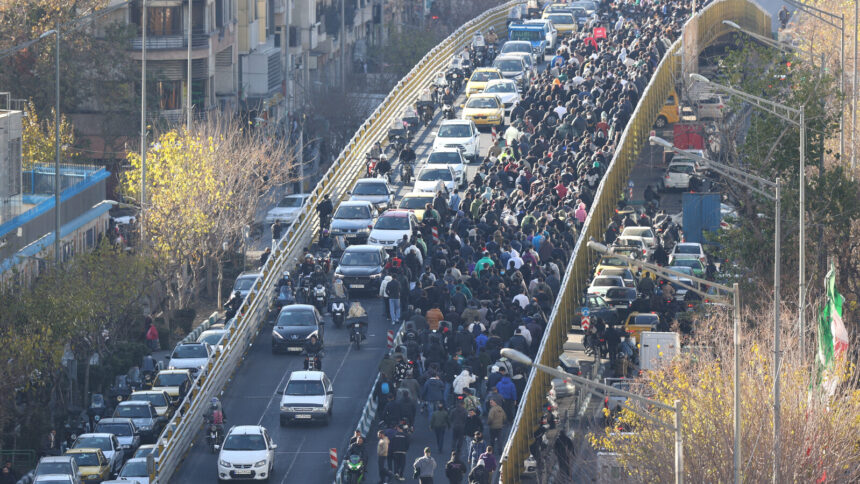
Iran is witnessing its largest wave of protests in years as a deepening economic crisis, driven by surging prices and a collapsing national currency, pushes thousands of citizens onto the streets of Tehran and other major cities, forcing the leadership to publicly acknowledge mounting public anger and hardship.
economic collapse and street protests shake iranian cities
Protests erupted over the weekend and intensified on Monday after the Iranian rial fell to a record low against the us dollar, underscoring the severity of the country’s economic troubles. The rapid depreciation of the currency has dramatically eroded household savings and purchasing power, leaving many families struggling to afford basic necessities. In the capital, Tehran, shopkeepers and traders gathered near the historic grand bazaar, closing stores and marching in scenes that evoked memories of the 1979 revolution, when merchants played a decisive role in mobilising public resistance.
The demonstrations, initially driven by economic grievances, quickly took on a political tone. Videos circulating online showed crowds chanting slogans against Iran’s ruling clerics, reflecting anger that extends beyond prices and wages to broader frustrations with governance and accountability. Although the exact timing of some footage could not be independently verified, the scale and intensity of the protests were unmistakable. Images released by state-run media showed security forces deploying tear gas in certain areas, highlighting the tension between demonstrators and authorities.
At the heart of the unrest is the dramatic fall of the rial, which plunged to around 1.42 million to the dollar before recovering slightly. Analysts say the volatility has hit traders particularly hard, especially those dealing in imported goods whose prices fluctuate daily with exchange rates. According to official data, inflation has reached more than 42 percent year on year, with food prices surging by over 70 percent and health-related costs rising by about 50 percent. Many economists and critics warn that these figures point toward the risk of hyperinflation if corrective measures are not taken.
The economic pressure has already produced tangible consequences within the government. Mohammad Reza Farzin, the embattled head of Iran’s central bank, resigned amid growing criticism of monetary management and the failure to stabilise the currency. His departure was widely seen as an attempt by authorities to signal responsiveness, though protesters and analysts alike questioned whether personnel changes alone could address systemic problems rooted in years of sanctions, mismanagement, and isolation.
leadership response, political tensions, and echoes of past unrest
Iran’s leadership has responded cautiously, balancing calls for restraint with efforts to deflect blame. President Masoud Pezeshkian acknowledged the severity of the situation in public statements, urging authorities to listen to what he described as the legitimate demands of protesters. He said he had instructed the interior minister to engage directly with representatives of demonstrators in an effort to hear their concerns and seek solutions to livelihood problems.
Parliament speaker Mohammad Bagher Qalibaf also addressed the unrest, calling for immediate decisions to protect people’s purchasing power and reassure citizens that harmful economic practices would be corrected. At the same time, he accused Iran’s enemies of attempting to exploit public anger, a familiar refrain in official responses to domestic dissent. Authorities announced temporary shutdowns in Tehran and several provinces, officially citing cold weather and energy constraints, though critics viewed the move as a means to limit gatherings.
Despite these statements, analysts say public trust remains low. Many Iranians believe that economic hardship is inseparable from political choices, including confrontational foreign policies and internal repression. Years of international sanctions have strained the economy, while a recent conflict with Israel and attacks on nuclear facilities further damaged prospects for recovery. Hopes that post-war conditions might bring diplomatic openings and economic relief have faded, replaced by perceptions of an increasingly hardline leadership and diminishing avenues for reform.
Observers note that while the immediate trigger for the current protests is economic, the underlying grievances mirror those that fuelled the woman, life, freedom movement in 2022 and 2023. That uprising, sparked by the death of Mahsa Jina Amini, challenged the foundations of the Islamic Republic and only subsided after a harsh security crackdown that resulted in hundreds of deaths and thousands of arrests. Although the present demonstrations have a different catalyst, many of the same frustrations persist, including anger over corruption, lack of accountability, and restrictions on personal freedoms.
The scale of the current unrest suggests a society under immense strain. Traders, workers, and middle-class families alike are feeling the impact of inflation and currency collapse, creating a rare convergence of interests among groups that do not always protest together. Analysts warn that without meaningful economic and political change, cycles of unrest are likely to continue, as each new shock compounds unresolved structural problems.
For now, Iran stands at a tense crossroads. The leadership’s willingness to engage with protesters rhetorically contrasts with its long history of suppressing dissent when challenges grow too large. As prices continue to rise and confidence in the currency erodes, the demonstrations represent not only an outcry over economic survival but also a broader test of the state’s ability to respond to deepening public discontent.