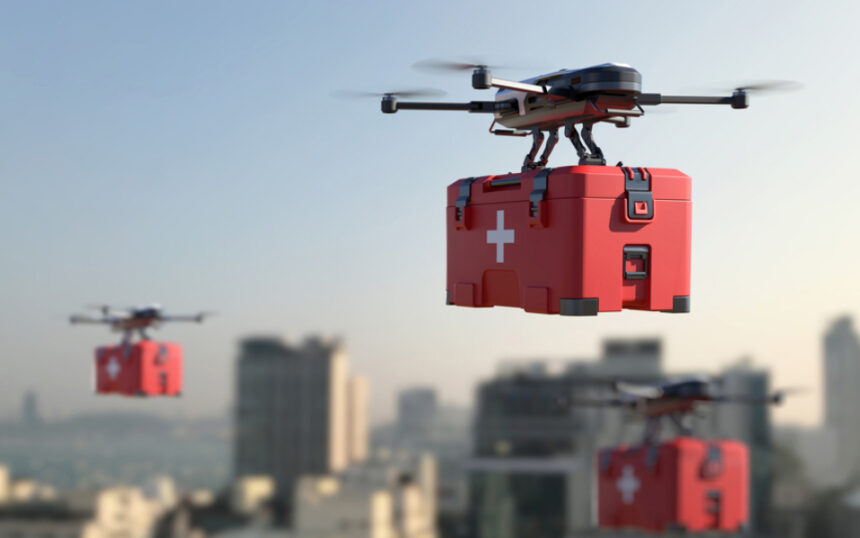
In a striking demonstration of technology outpacing traditional systems, drones have managed to deliver blood across Delhi in just 15 minutes, a journey that typically takes over an hour by ambulance. The Indian Council of Medical Research (ICMR) recently published a report based on these trials, showing that drones could revolutionise emergency medical delivery in India, but significant regulatory, operational and infrastructural challenges remain before this vision can be realised across the country.
Faster Deliveries in Critical Moments
In 2023, a drone transported blood bags from GIMS Hospital in Greater Noida to Lady Hardinge Medical College in Delhi’s Connaught Place, covering 35 kilometres in 15 minutes and bypassing Delhi’s chaotic traffic. This operation, monitored by ICMR scientists, was significantly faster than the over one-hour duration an ambulance would take on the same route. The detailed findings were published by ICMR in June 2025, emphasising that drones could serve as first-response vehicles in critical emergencies where every minute can mean the difference between life and death.
A similar success was recorded when drones reduced the time taken to deliver eye tissue between Sonipat and Jhajjar by 70%, completing the 38 km journey in 40 minutes instead of the usual two hours by road. These examples highlight the potential of drones to transform healthcare logistics, especially in time-sensitive situations, while aligning with India’s push towards a tech-enabled healthcare system under the i-Drone initiative.
Technical and Regulatory Challenges to Address
Despite the encouraging results, the ICMR study highlighted the complex challenges in using drones for blood delivery. Transporting blood is significantly more complicated than transporting organs due to strict temperature controls and careful handling needed to preserve quality and safety. During the trials, blood components like whole blood, plasma, and platelets were transported in special temperature-controlled boxes, maintaining safe temperature ranges and showing no damage such as hemolysis during the flight.
The report emphasised that while minor changes in blood components were observed, these were consistent with those found in van transport, indicating that the quality of blood remained safe. However, to expand drone-based blood delivery, rigorous validation of drone vibrations to avoid damage to blood components, use of advanced cooling systems, and real-time monitoring are essential.
ICMR also flagged the importance of strict compliance with aviation regulations and the need for coordination with air traffic control, especially for beyond visual line of sight (BVLOS) operations that are necessary for longer distances in rural and urban settings. India’s diverse topography, from humid plains to high-altitude regions, presents additional challenges to drone performance, along with concerns over battery life, weather conditions, and high operational costs that currently hinder scalability.
While the technology promises significant advantages, including reducing costs and increasing accessibility of medical supplies to remote and underserved areas, creating a pan-India robust regulatory framework remains a priority for real-world deployment. The high costs of technology, limited infrastructure in rural blood banks, and challenges in integrating drones with the existing healthcare system require strategic interventions to ensure the scalability of drone-based healthcare delivery.
Drones are emerging as critical allies in healthcare, not just as tools of surveillance or photography, but as potential lifesavers in emergencies where conventional transportation fails to match the urgency required. While they may not replace ambulances entirely, drones can outrun them when it matters most, making them a promising, game-changing addition to India’s healthcare infrastructure if the regulatory and operational hurdles can be addressed effectively.