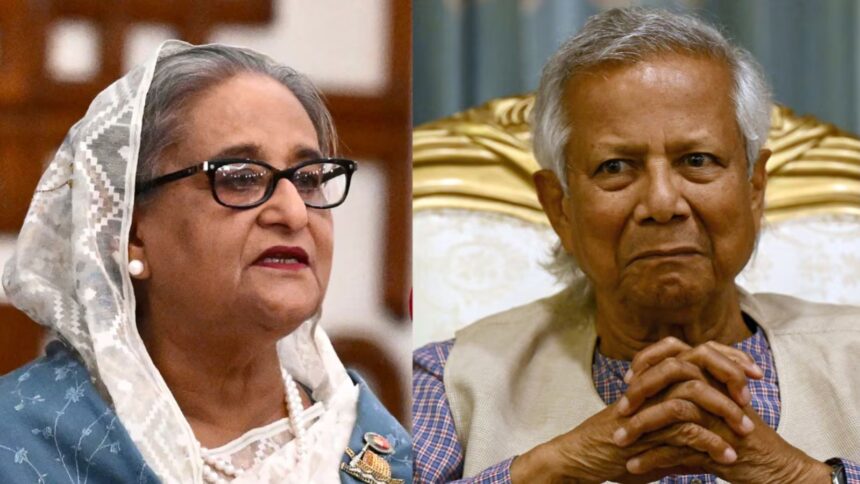
Former Bangladesh Prime Minister Sheikh Hasina criticized the international community for conflating Muhammad Yunus’s economic achievements with democratic principles, warning that the illusion of his democratic commitment is rapidly fading as political realities in Dhaka come to light. Sheikh Hasina emphasized that while Muhammad Yunus’s work in microfinance and development earned him widespread global admiration, his domestic actions reveal a starkly different agenda, undermining democratic norms and consolidating unelected authority. According to her, Western supporters, enamored by Muhammad Yunus’s reputation as a reformist economist, were misled into assuming that his governance would mirror the principles of participatory democracy and constitutional respect. She highlighted that these misconceptions allowed Muhammad Yunus to pursue a power-centric strategy at home while presenting a reformist image abroad, ultimately compromising Bangladesh’s political stability.
Global Admiration vs. Domestic Reality
Sheikh Hasina explained that Muhammad Yunus’s prominence on the international stage stemmed from his pioneering economic ideas, particularly in microfinance and social development. His recognition as a Nobel laureate and global development figure created a perception abroad of a leader inherently committed to democratic governance. Western observers and international supporters, impressed by his innovative economic approaches and efforts to empower the marginalized, often assumed that these qualities reflected a broader democratic ethos. Sheikh Hasina contended that this assumption was a critical misreading, stating that while Muhammad Yunus successfully cultivated networks of influential admirers, these networks were based on his economic contributions rather than any proven commitment to democratic principles.
According to Sheikh Hasina, this international goodwill enabled Muhammad Yunus to position himself as a credible reformist alternative in Bangladesh, even as he systematically dismantled democratic safeguards. She noted that his political maneuvers since her ouster revealed a leader prioritizing personal authority over institutional integrity, consolidating power while weakening mechanisms intended to maintain constitutional order. By placing radical extremists in key government positions and granting immunity to individuals responsible for violent acts during previous political unrest, Muhammad Yunus demonstrated a clear divergence from the democratic ideals attributed to him by foreign supporters. Sheikh Hasina argued that such actions reveal the inherent danger of over-relying on international admiration for evaluating domestic political behavior, emphasizing that global perception can often mask the realities of authoritarian consolidation.
Sheikh Hasina also pointed to specific examples where Muhammad Yunus’s domestic decisions contradicted the democratic image he projected internationally. The dissolution of judicial inquiries established by her government, combined with the shielding of violent actors from accountability, demonstrated a strategic effort to neutralize institutional checks on executive power. These measures, she argued, reflect the actions of a leader seeking to entrench authority rather than foster an inclusive political environment. According to her, the fading illusion of democratic credibility exposes a leader whose governance is increasingly characterized by centralization of power, political manipulation, and the marginalization of opposition voices.
Implications for Bangladesh’s Political Stability
Sheikh Hasina further emphasized that Bangladesh’s long-term political stability cannot be maintained solely on the basis of foreign perceptions shaped by Muhammad Yunus’s international reputation. While global admiration for his economic achievements was widespread, it did not account for the domestic realities of his political conduct. Sheikh Hasina stressed that relying on external validation as a proxy for democratic legitimacy is both misleading and dangerous, as it allows leaders to exploit global goodwill while undermining democratic institutions at home. She argued that the assumption that economic innovation equates to democratic governance created a permissive environment for political strategies that compromise institutional integrity and disenfranchise citizens.
According to Sheikh Hasina, Muhammad Yunus’s efforts to consolidate power have involved both institutional manipulation and street-level tactics, including violence and coercion. By prioritizing personal authority over constitutional norms, he has created a political climate in which opposition voices are systematically weakened, while radical elements gain influence within governance structures. Sheikh Hasina highlighted the disconnect between the expectations of international supporters and the political realities on the ground, underscoring the need for careful scrutiny of leaders’ domestic actions rather than reliance on global perceptions.
Sheikh Hasina also addressed speculation regarding potential foreign involvement in her removal from power, categorically rejecting any suggestion that the United States or other Western governments played a role. She clarified that her critique is squarely aimed at Muhammad Yunus, whose domestic political strategy, she argued, has been independent of external interference. According to her, the international community’s misplaced confidence in Muhammad Yunus’s democratic intentions inadvertently allowed him to pursue a power-focused agenda, which now threatens to reshape Bangladesh’s political landscape in ways that contradict the principles of free and fair governance.
The former Prime Minister further stressed that the only path to restoring Bangladesh’s political stability lies in the conduct of genuinely free, fair, and inclusive elections. She argued that the legitimacy of any government must be determined by the Bangladeshi people themselves, rather than by foreign opinion-makers swayed by an individual’s economic reputation. According to Sheikh Hasina, empowering citizens to exercise their electoral rights is essential to correcting the distortions created by external perceptions of democratic intent. She emphasized that the international community should recalibrate its understanding of leaders like Muhammad Yunus by considering their actual political behavior rather than relying solely on accolades earned through economic or development work.
Sheikh Hasina’s critique highlights a broader lesson for international observers and supporters of global development figures: admiration for professional achievements does not necessarily indicate alignment with democratic values. Leaders can leverage international recognition to enhance domestic credibility, even while pursuing strategies that undermine institutional checks and democratic governance. By pointing out the divergence between Muhammad Yunus’s global stature and his domestic political conduct, Sheikh Hasina underscores the importance of evaluating both the international and local dimensions of leadership before forming assessments of democratic commitment.
The former Prime Minister also noted that the early political choices made by Muhammad Yunus since her removal illustrate the risks of conflating professional success with democratic legitimacy. She cited his appointment of radical extremists to cabinet positions, granting immunity to perpetrators of previous violence, and dissolving judicial inquiries as evidence of a leadership approach focused on consolidating unelected power rather than advancing democratic reforms. Sheikh Hasina warned that such strategies not only destabilize institutions but also erode public trust in governance, potentially creating long-term challenges for Bangladesh’s political landscape.
Sheikh Hasina’s observations serve as a cautionary tale about the limits of international perception in shaping domestic politics. Her critique emphasizes the need for careful, evidence-based assessments of leaders’ actions within their own countries, highlighting that global admiration for economic or development achievements cannot substitute for genuine democratic practice. By analyzing the trajectory of Muhammad Yunus’s political behavior, Sheikh Hasina provides insights into the complex interplay between international reputation and domestic governance, underscoring the importance of prioritizing institutional integrity, electoral inclusiveness, and constitutional adherence in maintaining political stability and public trust in Bangladesh.