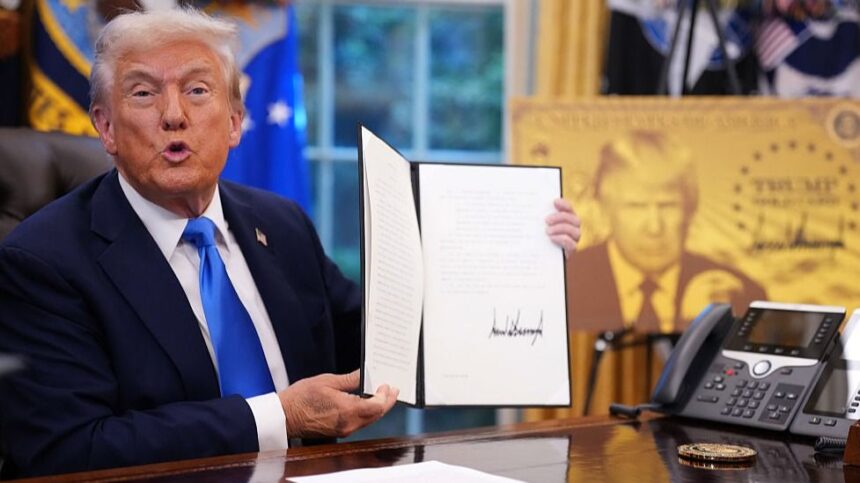
In a surprising shift from his earlier hardline immigration stance, U.S. President Donald Trump has publicly defended the role of skilled immigrants in strengthening the American workforce. While his administration has implemented several measures to restrict the H-1B visa programme — including a hefty $100,000 application fee — Donald Trump stated that the United States must continue to attract foreign talent to fill critical positions that domestic workers are currently unable to meet. His comments mark a nuanced turn in the administration’s immigration narrative, balancing protectionism with economic pragmatism.
During a televised interview on Tuesday, Donald Trump was asked whether the influx of foreign workers through H-1B visas reduces wages for American citizens. Responding candidly, Donald Trump acknowledged the importance of maintaining a strong domestic workforce but emphasised the need for importing specialised talent from abroad. “I agree, but you also do have to bring in talent,” he remarked. When pressed further on whether America already possesses sufficient skilled workers to meet its industrial and technological demands, Donald Trump replied, “No, you don’t, no you don’t. You don’t have certain talents and people have to learn. You can’t take people off an unemployment line and say, ‘I’m going to put you into a factory where we’re going to make missiles.’” His statement highlighted a practical understanding of labour market realities that go beyond political rhetoric.
Donald Trump’s Policy Actions and Contradictions
Donald Trump’s remarks come at a time when his administration continues to pursue measures aimed at tightening the H-1B visa programme. In September, the President announced a new $100,000 H-1B visa application fee. The move was presented as part of a broader effort to curb “systemic abuse” of the visa system, which the administration described as a “national security threat.” The steep fee increase was intended to discourage U.S. companies from hiring lower-wage foreign workers and to ensure that only the most highly compensated professionals are sponsored. However, the policy drew widespread criticism, particularly from the tech industry and Indian professionals, who form the majority of H-1B visa recipients.
Over 70 percent of approved H-1B petitions historically go to Indian nationals, many of whom use the programme as a stepping stone to permanent residency and eventual citizenship in the United States. The introduction of a $100,000 fee raised fears that smaller companies and startups would be unable to afford foreign talent, potentially stifling innovation. Critics argued that while the administration’s stated goal was to curb misuse, the new policy risked punishing legitimate applicants and employers who rely on global expertise.
Adding to the complexity, Donald Trump’s administration has also launched Operation Firewall, an initiative aimed at detecting and eliminating fraud within the H-1B programme. Under this effort, federal agencies have ramped up scrutiny of visa petitions, auditing employers and enforcing compliance. In parallel, the government has considered raising the wage eligibility threshold for H-1B holders, which would give preference to high-paying positions in the annual visa lottery. This would significantly limit access for entry-level workers and recent graduates, many of whom depend on H-1B sponsorship to begin their professional careers in the United States.
Despite these tightening measures, Donald Trump’s latest remarks appear to signal a softening of tone. He recognised that innovation-driven industries — from defense manufacturing to information technology — depend on a steady inflow of foreign expertise. His statement also suggests an awareness that overly restrictive immigration policies could harm America’s competitiveness, particularly as other countries, including Canada and Australia, actively attract skilled migrants.
Political Context and Reactions
The issue of H-1B visas has long been a flashpoint in U.S. political debate, balancing economic necessity with domestic job protection. Prominent American politicians across the spectrum have expressed divergent views. Florida Governor Ron DeSantis, who is expected to run for the presidency in 2028, has been among the most vocal critics of the visa system. He recently directed Florida’s state universities to cease using H-1B visas altogether, arguing that domestic talent should take precedence. Similarly, Vice President JD Vance has voiced concerns that the H-1B programme depresses wages and disincentivises American workers from entering technical fields.
Meanwhile, bipartisan legislation recently introduced in the U.S. Senate aims to further restrict access to the H-1B programme. The bill proposes higher wage floors, additional vetting procedures, and a prioritisation model favouring highly paid applicants. Supporters argue that these changes will protect American workers, while opponents warn they could lead to a talent drain and slow technological advancement.
Against this backdrop, Donald Trump’s recent statement defending skilled immigration marks a noticeable deviation from the administration’s earlier tone. During his 2016 presidential campaign and much of his first term, Donald Trump positioned himself as a staunch critic of the H-1B system, often portraying it as a vehicle for corporate exploitation and wage suppression. However, his more recent remarks indicate a willingness to reconcile the need for foreign expertise with national interests — a position that may appeal to business leaders and moderates concerned about economic growth.
The President also used the interview to distance himself from a recent immigration raid in Georgia, where hundreds of South Korean workers employed at a battery factory were detained. He described the incident as “unfortunate” and stated that such actions were not reflective of his administration’s broader policy goals. The comments were seen as an attempt to project balance and compassion while defending national security priorities.
Policy Adjustments and Economic Implications
The Donald Trump administration’s mixed approach toward the H-1B programme reflects an effort to balance political messaging with economic realities. The $100,000 visa application fee, initially announced to much controversy, has since been partially relaxed. Last month, officials clarified that the fee would not apply to foreign students transitioning from an F1 visa to an H-1B visa. The U.S. Citizenship and Immigration Services (USCIS) specified that the fee is only applicable to petitions involving individuals currently residing outside the United States. This amendment was welcomed by universities and employers who rely on international graduates to fill technical and research-oriented positions.
Economists argue that Donald Trump’s dual stance — tightening controls while acknowledging the need for skilled immigrants — reflects the broader tension between economic pragmatism and political populism. On one hand, restricting visa access aligns with the “America First” narrative that underpinned Donald Trump’s campaign promises. On the other, high-skilled immigration is essential to sustaining the U.S. economy’s innovation and technological edge. The American tech sector, in particular, depends heavily on H-1B professionals in fields like software engineering, artificial intelligence, and cybersecurity.
Industry leaders have voiced both concern and cautious optimism. Technology firms, including Google, Microsoft, and Amazon, have consistently lobbied for more open and predictable visa policies. Many executives warn that restrictive measures could drive talent to competing innovation hubs such as Canada, Singapore, and Europe. Meanwhile, smaller American businesses that depend on foreign expertise say they risk losing competitiveness under the new fee structure.
Nevertheless, Donald Trump’s latest comments suggest an emerging recognition that skilled immigration is not merely a labour issue but a strategic advantage. His acknowledgment that the U.S. “does not have certain talents” underscores the role of global talent in maintaining America’s leadership in science and industry. The contradiction between rhetoric and policy reflects the administration’s ongoing struggle to define a cohesive immigration framework that supports both national security and economic vitality.
While Donald Trump’s critics view his statements as politically convenient, supporters argue that his administration’s actions have been necessary to reform an outdated and often exploited system. The push for higher wages and stricter compliance, they contend, ensures that H-1B visas are reserved for the best and brightest rather than being used as a cost-cutting mechanism.
The H-1B debate, however, extends beyond economics — it embodies the question of what kind of nation America aspires to be in a globalised world. Donald Trump’s softened tone may indicate a recognition that isolationism cannot coexist with innovation. As global competition intensifies, the United States’ ability to attract and retain top talent will continue to shape its economic and geopolitical future.
President Donald Trump’s evolving stance on H-1B visas represents a moment of recalibration in U.S. immigration policy. His admission that America still needs foreign talent marks a subtle but significant acknowledgment that technological progress and national growth depend not just on domestic workers, but on a global pool of skill and innovation.