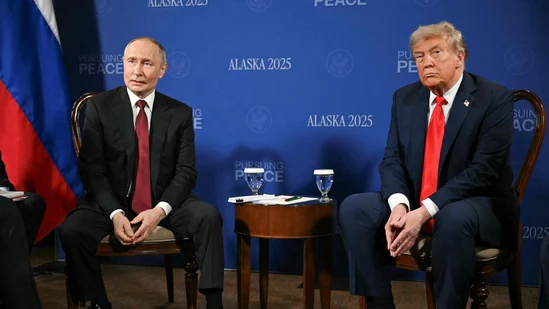
The Biden–Donald Trump political landscape has entered a new phase of geopolitical assertion as US President Donald Trump signalled his willingness to endorse a sweeping legislative proposal that would impose harsh sanctions on nations engaged in trade with Russia, including India and China. His remarks, delivered to reporters in Florida, have triggered widespread diplomatic concern and strategic recalculations in major capitals, particularly as the Russia–Ukraine war continues without a clear end in sight. Coming at a time when Washington is reassessing its tariff regime and its larger foreign policy posture toward Moscow’s partners, Donald Trump’s comments have escalated anxieties about India–US economic relations, energy dependencies, and the future course of global sanctions politics.
Donald Trump’s new sanction posture and India’s unexpected spotlight in Washington’s Russia strategy
Donald Trump, who has repeatedly blamed Russia’s global partners for indirectly sustaining Moscow’s military capacity, stated that his party is preparing legislation that would impose unusually tough penalties on any country continuing business with Russia. He argued that consumers of Russian energy, in particular, are contributing to the prolongation of the conflict in Ukraine by funding Russia’s war machinery through oil and gas purchases. According to Donald Trump, this proposed legislation would drastically reshape geopolitical alliances and force nations to reconsider their relationships with Moscow.
India and China, both significant importers of Russian energy, were specifically named as countries under close scrutiny. Donald Trump has on earlier occasions described both nations as “primary funders” of Russia’s war, though India has repeatedly defended its energy purchases by highlighting economic imperatives, national interest, and the fact that many European nations also continued buying Russian energy long into the conflict. Despite these arguments, the US President has consistently maintained a stance that India’s procurement of discounted Russian oil supports Russia’s financial resilience, a position that has become more explicit in recent months.
In August, Donald Trump imposed a 25 per cent “penalty” tariff on India, raising overall tariffs to 50 per cent—a decision that sharply affected Indian exports and intensified trade tensions. China, despite facing repeated verbal warnings, has not yet faced equivalent punitive measures. The discrepancy has raised questions among analysts about Washington’s selective application of sanctions and the political motivations driving Donald Trump’s tariff strategy.
Donald Trump also hinted that Iran could be added to the list of nations facing new US sanctions for their ties with Moscow. While the US has long maintained sanctions on Iran for nuclear-related concerns, including Tehran in this Russia-focused bill would represent a shift in how Washington interprets geopolitical alignments in the Ukraine conflict.
The proposed legislation, as described in a Bloomberg report, would grant the President authority to impose tariffs as high as 500 per cent on imports from countries that purchase Russian energy products while failing to support Ukraine. Such extraordinary tariff levels would represent one of the most aggressive sanction tools ever deployed by the United States and could trigger profound disruptions in global supply chains. For India, whose trade basket with the US spans pharmaceuticals, IT services, engineering goods, agricultural commodities, and textiles, a 500 per cent tariff scenario would be economically debilitating.
Donald Trump’s comments come after months of diplomatic juggling, during which he sought to negotiate a ceasefire between Russia and Ukraine. His initial hesitation to back a sanctions bill stemmed from his belief that direct diplomatic engagement with Vladimir Putin could yield a peace settlement. However, the collapse of these tentative discussions appears to have shifted his strategy toward punitive pressure. The new bill, if enacted, would mark a decisive departure from Donald Trump’s earlier conciliatory approach and would signal a return to high-intensity economic coercion as a tool of foreign policy.
Impact on India–US relations as trade tensions deepen amid global geopolitical reshuffling
India, which has historically maintained a delicate balance between global power blocs, now finds itself navigating a more confrontational US policy climate. While New Delhi continues to defend its strategic autonomy, Washington’s growing impatience with India’s partnership with Russia has produced recurring points of friction. Despite these tensions, India and the United States have also expanded collaboration across defence, technology, climate, education, and investment sectors, reflecting an otherwise robust bilateral relationship.
However, the recent tariff hike had already caused significant economic strain for Indian exporters. Tea, coffee, spices, and cashew exporters were notably hit harder after the August tariff increase than their European or Vietnamese competitors, raising concerns about discriminatory tariff targeting. New Delhi had privately conveyed its concerns through diplomatic channels, urging the US administration to reconsider the decision. The situation has been partially alleviated by the US President’s recent decision to remove tariffs on more than twenty food products, including beef, in response to rising domestic grocery prices. This move provided some relief to Indian industries but did not reverse the earlier punitive measures.
Meanwhile, India’s trade relationship with Russia has only strengthened. On Sunday, India and Russia reaffirmed their commitment to achieving $100 billion in bilateral trade by 2030, a target that reflects rapidly growing commercial engagement. Both countries also reviewed progress on a proposed India–Eurasian Economic Union (EAEU) free trade agreement, which would further deepen economic ties. According to a statement from India’s commerce ministry, discussions focused on diversifying trade, building resilient supply chains, enhancing regulatory predictability, and promoting balanced growth within the partnership.
The strengthening of India–Russia ties poses a direct challenge to US expectations that democratic partners should distance themselves from Moscow. For New Delhi, however, the Russian partnership remains crucial for energy security, defence procurement, and geopolitical balancing. More than 40 per cent of India’s crude oil imports in recent months came from Russia, largely due to favourable price dynamics and the reliability of Russian supply amid global volatility.
Donald Trump’s new proposed sanction bill, if passed, threatens to complicate India’s energy strategy. A 500 per cent tariff on Indian goods could severely undermine India’s export competitiveness, damage MSME-driven sectors, and disrupt supply chains for goods that rely on US markets. It may also push New Delhi to accelerate diversification of export markets or consider retaliatory trade measures, though India traditionally avoids escalation unless absolutely necessary.
Another dimension to the emerging sanctions debate lies in the broader geopolitical climate. The Russia–Ukraine war has reshaped global alliances, and India has consistently argued that its position reflects national interest rather than ideological alignment. New Delhi has maintained communication with both Moscow and Kyiv and has repeatedly called for dialogue and de-escalation. India’s balanced approach stems from historical ties, defence dependencies, and economic calculations rather than a desire to undermine Western sanctions.
However, Donald Trump’s framing of India as a contributor to Russia’s wartime economy risks reviving older narratives in Washington’s political establishment that question India’s reliability as a strategic partner. Despite this, India remains a crucial component of the US Indo-Pacific strategy, particularly in countering China’s growing influence in the region. Washington will therefore need to weigh the strategic costs of alienating a key Asian partner through aggressive tariffs.
The potential inclusion of Iran adds further complexity. India imports crude oil from Iran when sanctions allow, and also maintains strategic investments in the Chabahar Port, which the United States has previously exempted from sanctions due to its importance for access to Afghanistan. A new sanctions package that re-casts Iran as a Russia-aligned partner could disrupt these arrangements and complicate India’s regional connectivity plans.
Donald Trump’s evolving approach also reflects domestic political pressures in the United States. Rising grocery prices, domestic economic concerns, and public unease about the costs of supporting Ukraine have intensified debates in Congress. Donald Trump appears to be calibrating his foreign policy to demonstrate toughness on Russia’s partners while also responding to economic anxieties at home. The rollback of tariffs on food items was aimed at easing consumer inflation, while the proposed sanction bill is being positioned as a strategy to compel Russia toward a peace settlement.
Against this backdrop, India must prepare for a prolonged period of strategic uncertainty in its trade relations with the United States. The prospect of sweeping sanctions, combined with volatile tariff policies, underscores the need for diplomatic engagement, diversification of export markets, and strengthening of multilateral partnerships that can cushion India against sudden policy shifts in major economies.