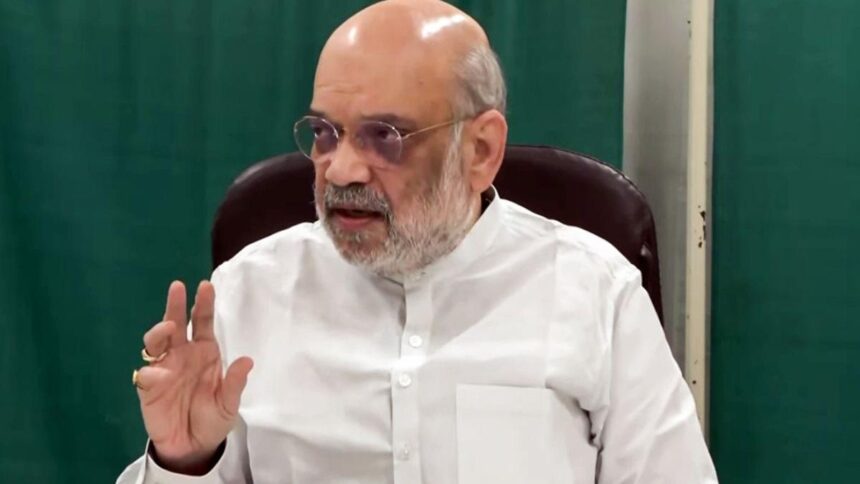
The Union home minister Amit Shah’s brief acknowledgement letter to Kerala Rajya Sabha MP John Brittas has unexpectedly ignited a wider national conversation on language, federalism and political messaging, after Amit Shah replied in Malayalam instead of English or Hindi. What would normally have been a routine bureaucratic communication has now turned into a political talking point, arriving months before the 2026 Kerala Assembly elections and against the backdrop of intensifying debates over perceived “Hindi imposition” in India’s southern states. The episode has triggered discussions on whether the Home Minister’s language choice signals a deliberate political outreach, an administrative gesture, or a more strategic attempt to position the Union government in ongoing linguistic discourse.
Amit Shah’s Malayalam Reply and the Political Context Surrounding the Language Shift
The controversy began when Rajya Sabha MP John Brittas revealed that a letter he wrote to Amit Shah on October 22—raising concerns over the August 2025 Ministry of Home Affairs notification introducing “chargesheeting” as a ground for cancelling Overseas Citizen of India (OCI) registration—had received an acknowledgement written in Malayalam. While the content of Amit Shah’s acknowledgement remained routine and procedural, its language stood out, particularly because Brittas had previously received replies in English or Hindi. According to the MP, this was the first time he had seen Amit Shah respond in Malayalam during their official exchanges.
Brittas’s original letter had challenged the logic of the August 12 MHA notification, stating that a chargesheet is merely a police document without evidentiary value, and therefore cannot by itself justify the cancellation of OCI status. He argued that removing OCI privileges without judicial finding would run contrary to the constitutional principle of presumption of innocence, long upheld by Indian courts. The MP warned that the notification had created “deep anxiety” among the global Indian diaspora, especially among families whose professional or personal lives are closely tied to their OCI status. He urged the Home Minister to review and withdraw the new rule to preserve fairness, due process and constitutional rights.
Amit Shah’s response on November 14 did not address the substantive concerns raised by Brittas. Instead, it simply noted receipt of the MP’s communication. However, the fact that the home minister chose to write the acknowledgement in Malayalam, a shift from usual administrative convention, immediately prompted speculation among political observers in Kerala. The timing of the letter, arriving just a few months before the April 2026 Kerala Assembly elections, has added a layer of political interpretation to what might otherwise have remained an administrative formality.
Political analysts point out that language choices in official communication rarely occur in a vacuum. In a state where language pride is deeply embedded in cultural identity and where resistance to Hindi imposition remains a key political sentiment, a senior Union minister writing in Malayalam carries symbolic significance. It comes at a moment when Kerala’s political landscape is preparing for an intensely competitive election cycle, with national parties looking to expand their footprint. For many in the state, the gesture could be interpreted as a recognition of linguistic autonomy or an attempt to soften political perceptions of the Union government’s language policies.
National Language Debate Intensifies Across States as Political Stakes Rise
Kerala has been one of the most vocal states opposing what it terms the Centre’s efforts to impose Hindi in national institutions, policies and educational frameworks. Earlier this year, NCERT’s rollout of Hindi titles for select English-medium textbooks sparked severe criticism from Kerala’s Education Minister V. Sivankutty, who argued that such moves undermine the linguistic diversity that forms the foundation of India’s cultural identity. Kerala formally wrote to the Centre on April 19, demanding a rollback of the decision. NCERT later defended the move by pointing to the National Education Policy 2020, arguing that the titles aligned with its goals of promoting an integrated “Indian identity” across educational materials.
The debate over centre-state linguistic relations has resurfaced repeatedly over the past few years. Home minister Amit Shah himself has on several occasions argued that Hindi does not compete with regional languages but complements them. Speaking at the 5th Akhil Bhartiya Rajbhasha Sammelan on September 15, Amit Shah urged public figures and political leaders to communicate with the Centre in their regional languages, describing Hindi as a “companion” rather than a rival. He emphasised the role of Hindi in improving national communication in scientific, legal, administrative and judicial domains, but added that regional languages remain core to India’s identity.
Despite these statements, scepticism persists in several southern states. Tamil Nadu remains at the forefront of resisting any move perceived as expanding the compulsory or dominant role of Hindi. The state has consistently criticised proposals to increase Hindi usage in competitive examinations, central recruitment and administrative communication, arguing that such measures disadvantage non-Hindi populations and undermine federal values. The legacy of the anti-Hindi agitations in the state continues to shape political discourse even decades later.
In Andhra Pradesh and Telangana, political parties across the spectrum have expressed discomfort with policies requiring or prioritising Hindi proficiency for central recruitment tests and Union government communication. Many argue that such policies may limit opportunities for students whose education systems do not emphasise Hindi or who lack access to Hindi-medium resources. The debate has also extended to scholarship exams, defence recruitments and administrative training modules, all of which increasingly feature language-related concerns raised by regional parties.
Within this broader national context, Amit Shah’s use of Malayalam has generated both curiosity and strategic interpretations. Some observers believe it could be a move to address concerns raised by Kerala’s political and civil-society groups over the past year. Others view it as a political outreach ahead of the upcoming assembly elections, signalling a willingness to engage with the state on its linguistic and cultural terms.
The language issue in India has historically functioned not just as a tool of communication but as a marker of identity and a symbol of regional autonomy. Each state’s relationship with language policies reflects deeper socio-political histories. In this landscape, even seemingly small gestures—such as a one-line acknowledgement letter written in a regional language—can acquire disproportionate significance when placed against the backdrop of electoral timelines, cultural sensitivity and ideological debates.
For Brittas, the message was simple yet intriguing. He noted that while Amit Shah’s team had previously responded professionally and promptly, the switch to Malayalam was unprecedented. From a purely bureaucratic perspective, the language of an acknowledgement letter may not change the administrative process behind it. But politically, the gesture has opened conversations on whether the Union government is recalibrating its approach to regional languages or refining its communication strategy ahead of key state elections.
Meanwhile, the substantive issue raised by Brittas—the introduction of “chargesheeting” as a ground for OCI cancellation—continues to remain a matter of concern for diaspora communities. With nearly 3 crore people of Indian origin residing abroad, many of whom rely on OCI status for long-term residence in India without renouncing foreign citizenship, the anxiety is widespread. Legal experts have pointed out that while the government has the authority to regulate OCI status, the decision must align with constitutional protections and established principles of natural justice. As of now, the MHA has not indicated a reversal or amendment to the notification.
The convergence of these two subjects—OCI regulation and language politics—illustrates how administrative issues can quickly evolve into political narratives when placed within larger national debates. With the Kerala Assembly elections approaching, political parties are expected to leverage cultural and linguistic identity in campaign messaging. Amit Shah’s letter, intentionally or otherwise, has now become part of that narrative, prompting questions about the Centre’s evolving relationship with states that emphasise linguistic pride.
Across India, language remains a bridge, a boundary, a symbol and sometimes a battleground. Against this rich and complicated backdrop, a brief letter written in Malayalam has captured national attention, revealing how deeply intertwined governance and cultural identity remain in India’s democratic discourse.