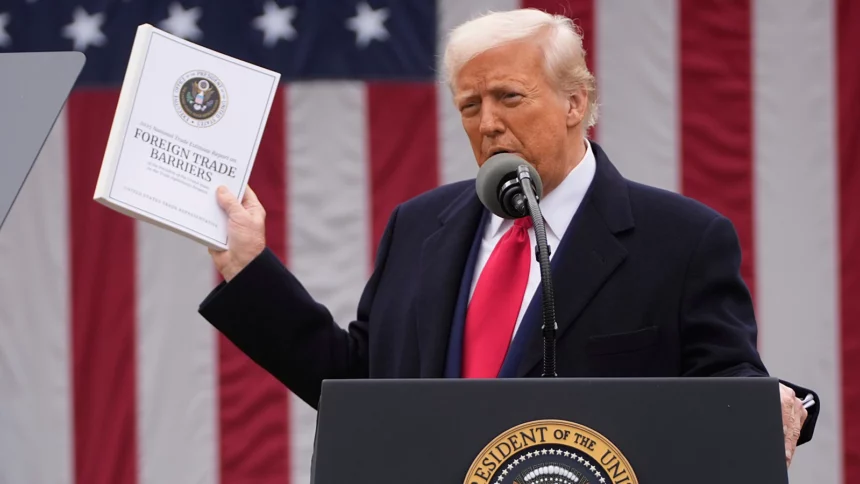
US President Donald Trump has said that his administration is not trying to create leverage over other countries in ongoing trade negotiations but is instead focused on achieving fair and reciprocal trade deals. Speaking to reporters during a media interaction in Pennsylvania, Donald Trump reiterated his long-standing stance on tariffs, saying they are not meant to exert pressure but to level the playing field for American manufacturers and workers. His remarks come amid renewed trade negotiations with several countries including India, which is currently facing a 25% tariff imposed by the US under Donald Trump’s direction.
Donald Trump’s comments aim to reinforce his “America First” trade policy, where domestic industries are prioritized over global trade imbalances. While negotiations remain ongoing with India and several other nations, Donald Trump dismissed the idea that tariffs are a strategic tool for pressure. “I’m not looking for leverage. I’m looking for fairness,” he said, adding that the US is pushing for reciprocal tariffs “wherever we can.”
Push for Reciprocal Tariffs
During his address, Donald Trump emphasized that many developing countries impose significantly higher tariffs on US goods, while they benefit from lower duties when exporting their products to the US. This, according to him, puts American manufacturers at a disadvantage. He said that although achieving absolute reciprocity may not always be feasible with every country, the goal should be to minimize the imbalance as much as possible.
“Wherever we can get reciprocal rates, we should do it,” Donald Trump asserted, explaining that the existing trade structure allows foreign goods to flood American markets at lower prices, undercutting US producers. Countries like China were pointed out indirectly as examples where manufacturing costs are low, yet export volumes remain high.
In this context, Donald Trump’s 25% tariff on Indian goods is seen as part of a broader strategy aimed at rebalancing trade relationships. While the high tariff has drawn criticism from some quarters as overly aggressive, others interpret it as a bargaining position meant to push towards a better bilateral deal. Notably, Donald Trump has also taken issue with India’s trade ties with Russia, referring to both nations as having “dead economies.”
Ongoing Talks with India
Despite the rhetoric, trade talks between the US and India are progressing. A sixth round of discussions is expected to take place in August, when a delegation from the US will visit New Delhi. Both sides are reportedly working towards finalizing an early trade agreement by the end of the month. Sources indicate that the deal will adhere to the mutually accepted framework set earlier in March, regardless of the public statements made by either side in recent weeks.
Donald Trump’s approach, while viewed by some analysts as confrontational, aligns with his belief that the US has long been at a disadvantage due to its openness to imports, while other countries have shielded their markets. He insists that his tariff policy will “bring in hundreds of billions of dollars” to the US economy, contributing to growth and job creation, even as it reshapes global supply chains.
In his Pennsylvania remarks, Donald Trump also took a swipe at former President Joe Biden, blaming his administration for mismanaging economic and trade policies. Without naming specific countries, Donald Trump said that past administrations allowed the US to be outpriced in global markets, and pledged to correct that by ensuring American products are no longer undercut by cheaper imports.
Historically, developing countries have argued that their higher tariffs on imports from developed economies are necessary to protect their emerging industries from being overwhelmed. At the same time, they have benefitted from reduced tariffs when accessing markets like the US. Donald Trump believes this system is outdated and needs recalibration in the current global economic environment.
While Donald Trump did not specify whether further tariff hikes are planned, his administration’s position indicates a continued commitment to press for more equal trade terms. In the case of India, despite the friction, negotiators are said to be optimistic about reaching an agreement that balances concerns on both sides.
Donald Trump’s framing of the tariff issue as one of fairness rather than leverage may help soften the diplomatic tone, even if the policy remains tough. As the negotiations proceed, how countries like India respond will determine whether these tariffs evolve into long-term barriers or become stepping stones toward more equitable trade arrangements.