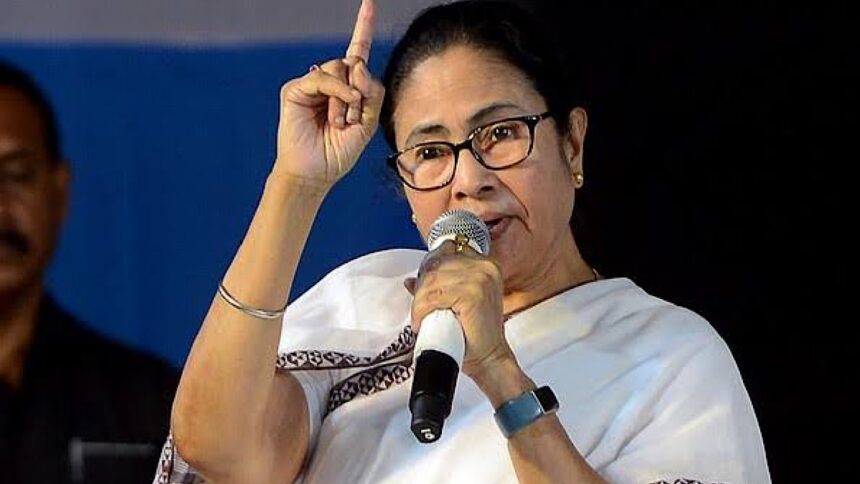
In a development that has triggered political outrage and cultural discontent across party lines, West Bengal Chief Minister Mamata Banerjee has strongly condemned the Delhi Police for describing Bengali, or Bangla, as a “Bangladeshi language” in an official communication. The incident has not only drawn sharp criticism from the Trinamool Congress (TMC) and cultural figures but has also united rival political camps like the Communist Party of India (Marxist) in defense of Bengali identity. The Bharatiya Janata Party (BJP), meanwhile, has dismissed the criticism, accusing Mamata Banerjee of politicizing the issue for electoral gains.
A Letter That Sparked a Storm
The controversy began after a letter dated August 3 from the Delhi Police to Banga Bhawan—the official guest house of the West Bengal government in Delhi—referred to documents in a “Bangladeshi language” that needed translation. The documents were reportedly related to eight individuals suspected of being illegal immigrants from Bangladesh. The terminology used in the letter sparked widespread backlash, as it implied that Bengali, one of India’s 22 constitutionally recognized official languages, was being categorized as foreign.
Chief Minister Mamata Banerjee, visibly agitated by the incident, took to social media to express her anger, calling the language used in the letter “scandalous, insulting, anti-national, and unconstitutional.” She also shared an image of the letter, highlighting that Bengali is not only protected by the Indian Constitution but is also the mother tongue of literary icons like Rabindranath Tagore and Bankim Chandra Chattopadhyay. Her post struck a chord across Bengal, evoking a sense of collective insult among Bengali-speaking citizens.
TMC MP Mahua Moitra added to the criticism, stating that referring to Bengali as a “Bangladeshi language” in an official document was not a mistake but a deliberate move. She demanded an unconditional apology from the Delhi Police, arguing that such terminology undermines the legitimacy and pride of Indian Bengalis.
Political Backlash and Cross-Party Unity
What has made this controversy particularly significant is the rare convergence of political voices in its aftermath. The CPI(M), traditionally a fierce rival of Mamata Banerjee’s TMC, also issued a statement condemning the language used in the letter. The party emphasized that millions of Indian citizens speak Bengali and that equating it with Bangladeshi identity is a dangerous precedent. “We strongly condemn this criminalisation of language and identity,” said a CPI(M) spokesperson.
TMC’s national general secretary and MP, Abhishek Banerjee, further escalated the matter by demanding an apology from Union Home Minister Amit Shah, under whose ministry the Delhi Police operates. He accused the BJP-led central government of perpetuating a narrative that targets Bengali-speaking citizens across BJP-ruled states. According to him, the letter is not an isolated incident but part of a broader agenda to equate Indian Bengalis with foreigners and undermine their cultural identity.
Bengali artists also reacted strongly. Film director Srijit Mukherji reminded everyone that India’s national anthem was originally composed in Bengali. “That’s not a Bangladeshi language… that’s Bangla or Bengali,” he wrote on X (formerly Twitter). Singer Surojit Chatterjee echoed similar sentiments, suggesting that the letter reflected deep-rooted ignorance about Indian linguistic diversity.
While the Delhi Police have yet to respond publicly or confirm the authenticity of the letter, the emotional and political fallout continues to intensify.
BJP Counters with Allegations of Vote-Bank Politics
In response, BJP IT cell chief Amit Malviya dismissed Mamata Banerjee’s outrage as an act of political theater aimed at consolidating her voter base. He accused her of spreading misinformation for the sake of “vote-bank politics” and described her social media post as a “badly scripted political stunt.”
Samik Bhattacharya, the president of the West Bengal BJP, went a step further, alleging that the TMC was trying to stir fear among Bengali-speaking citizens while shielding illegal immigrants from Bangladesh. According to him, the letter was related to a genuine investigation involving foreign nationals, and the TMC was exploiting the situation to distract from more pressing governance issues in Bengal.
This counter-narrative from the BJP has failed to douse the fire, however, as critics argue that even in matters concerning immigration, the state machinery must be careful not to delegitimize an entire language and, by extension, its native speakers.
A Cultural Flashpoint in a Politicized Nation
Beyond the realm of party politics, the controversy touches on deeper concerns about identity, inclusion, and cultural sensitivity in India. Language has long been a potent symbol of identity in the country, and any perceived slight can quickly become a flashpoint.
For many Bengalis, the episode is not just a bureaucratic error but a reminder of recurring attempts to marginalize linguistic minorities. The strong pushback from artists, opposition parties, and even neutral observers reflects the symbolic importance of the Bengali language in India’s cultural fabric.
This incident has also revived older debates around the centralization of language and the marginalization of regional identities. In a nation that prides itself on unity in diversity, such controversies raise troubling questions about whether the balance between national security and cultural sensitivity is being properly maintained.
While the Delhi Police may clarify or retract their communication in the days ahead, the deeper cultural wound left by this incident will likely continue to resonate. As tempers flare and political posturing intensifies, the episode serves as yet another reminder of the fragile intersection between governance, identity, and the politics of language in India.