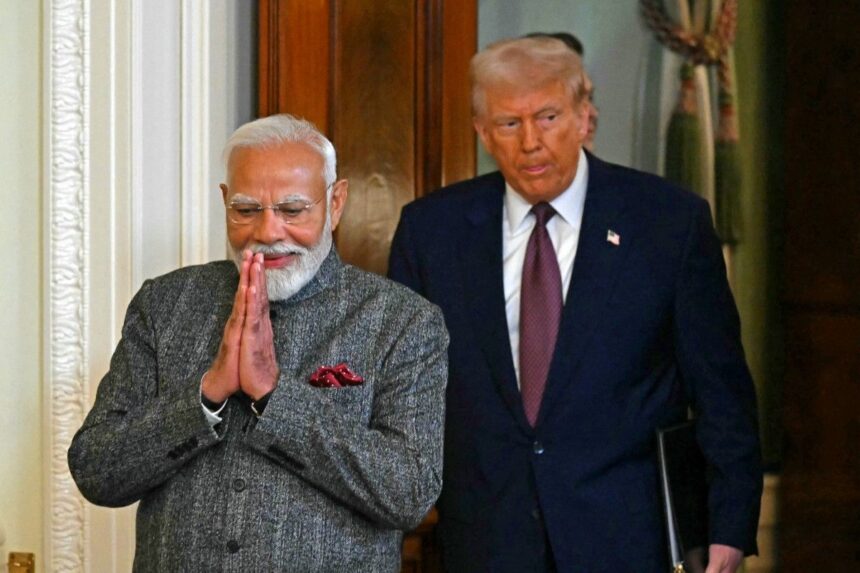
Prime Minister Narendra Modi has once again come under the global spotlight, this time through comments made by US President Donald Trump regarding the state of India-US relations. Speaking publicly in Washington, Donald Trump described PM Narendra Modi as a “great prime minister” and expressed personal admiration for his leadership, while simultaneously voicing strong concerns over India’s ongoing purchase of Russian oil. The remarks highlight the complex and sometimes contradictory nature of bilateral ties, where personal rapport between leaders coexists with serious economic disagreements. Donald Trump’s statements, made in the Oval Office and amplified on social media, come at a time when India-US trade relations are under strain due to punitive tariffs imposed by the United States, which reached a combined rate of 50 percent on certain Indian imports. The developments illustrate both the enduring strategic relationship between the two nations and the friction caused by conflicting economic interests.
Donald Trump’s Praise and Reservations on India’s Policy Decisions
During a press interaction in the Oval Office, Donald Trump provided a candid assessment of India-US relations, describing PM Narendra Modi as an exceptional leader while highlighting disagreements over current policy directions. He remarked, “I’ll always be friends with PM Narendra Modi… He’s a great prime minister. He’s great. But I just don’t like what he’s doing at this particular moment.” These comments underline the duality of the US approach, where appreciation for personal diplomacy and leadership qualities intersects with sharp critique of policy actions that Washington perceives as contrary to its interests. Donald Trump specifically referenced India’s ongoing purchases of Russian oil as a point of disappointment, noting that these purchases prompted the US to impose substantial tariffs, which he described as “very big” and amounting to 50 percent on specific imports. The timing of his remarks coincided with heightened concerns over the Ukraine-Russia war, and India’s role as a significant purchaser of Russian energy has become a flashpoint in bilateral economic negotiations.
Donald Trump also sought to reassure observers about the broader state of the relationship, emphasizing that despite disagreements, the India-US bond remains “special” and resilient. “There’s nothing to worry about. We just have moments on occasion,” he stated, framing the ongoing tariff disputes as temporary tensions within an otherwise robust strategic partnership. His comments suggested that while the punitive measures were intended to signal US displeasure with India’s economic choices, they were not meant to undermine the broader geopolitical and security cooperation that underpins the bilateral relationship. By distinguishing between personal rapport with PM Narendra Modi and policy disagreements, Donald Trump highlighted the nuanced nature of international diplomacy, where individual relationships often serve as a stabilizing factor amid structural economic tensions.
Social Media Posts and the Geopolitical Context
Beyond official remarks, Donald Trump also expressed his concerns through his social media platform, Truth Social, drawing attention to the broader strategic implications of India’s energy decisions. In one post, he remarked, “Looks like we’ve lost India and Russia to deepest, darkest, China. May they have a long and prosperous future together!” The post accompanied an image of PM Narendra Modi with Russian President Vladimir Putin and Chinese President Xi Jinping during a recent Shanghai Cooperation Organisation summit in Tianjin, China. This social media commentary served to frame India’s actions within a global geopolitical lens, suggesting that Washington viewed India’s energy and foreign policy decisions as potentially tilting toward China and Russia. Donald Trump’s observation, though provocative, reinforced the perception that the United States was closely monitoring India’s balancing act between multiple global powers, while simultaneously using tariffs as a policy lever to influence New Delhi’s strategic orientation.
The remarks come at a particularly sensitive time, as global energy markets remain volatile due to the ongoing conflict in Ukraine. India’s continued purchase of Russian oil, framed by Donald Trump and his advisors as indirectly funding the Russian war effort, has become a point of contention with the US. In addition to Donald Trump’s personal comments, his administration’s trade and economic advisers publicly criticized India’s energy imports. Peter Navarro, senior counselor for trade and manufacturing under Donald Trump, wrote on social media that India’s purchase of Russian oil “feeds Russia’s war machine” and noted that it imposes a financial burden on the United States and its taxpayers. Similarly, Kevin Hassett, former director of the National Economic Council, expressed disappointment that India was continuing to financially support Russia’s war in Ukraine but also suggested that a diplomatic resolution might be possible, reflecting a cautious optimism that bilateral engagement could resolve economic disputes.
These public statements highlight the intricate interplay between energy policy, trade regulations, and geopolitics. The US administration’s decision to impose tariffs on Indian imports was a direct response to India’s energy strategy, and the strong rhetoric from Donald Trump and his team underscores the strategic significance the US attaches to India’s compliance with Western sanctions on Russia. At the same time, Donald Trump’s acknowledgment of PM Narendra Modi as a “great prime minister” illustrates the persistent influence of personal diplomacy, where mutual respect between leaders continues to shape broader bilateral relations. This duality captures the essence of modern international relations, where economic disagreements, strategic imperatives, and personal rapport intersect to create both opportunities and challenges for sustained engagement.
The commentary also illustrates the challenges faced by India as it navigates its foreign policy objectives. New Delhi has maintained a careful balancing act, seeking to preserve strong economic and strategic ties with multiple global powers while pursuing its own national interests. India’s energy purchases from Russia have been motivated by market realities, cost considerations, and the need to secure energy supplies amid a turbulent global landscape. However, these decisions have inevitably attracted scrutiny from the United States, resulting in punitive tariffs that have further complicated trade negotiations. By publicly expressing both admiration and concern, Donald Trump has effectively highlighted the delicate equilibrium India must maintain in its foreign policy choices, underscoring the broader implications of bilateral economic disputes for geopolitical stability.
The situation also brings into focus the broader US strategy of leveraging economic tools, such as tariffs, to influence international behavior. By linking energy purchases to punitive measures, the US has signaled its expectation that allies and strategic partners align with its policy objectives regarding Russia. Donald Trump’s comments, both in the Oval Office and on Truth Social, reflect this approach and demonstrate how trade instruments are increasingly intertwined with national security and geopolitical considerations. For India, the challenge lies in managing domestic energy needs, international relations, and economic growth while responding to external pressures, highlighting the complexities inherent in global diplomacy today.
Donald Trump’s remarks about Prime Minister Narendra Modi and India’s trade actions offer a window into the multi-layered nature of India-US relations. On one hand, the personal respect Donald Trump expresses for PM Narendra Modi underscores the enduring strength of leader-to-leader diplomacy, which continues to anchor bilateral ties even during periods of disagreement. On the other hand, the strong disapproval of India’s Russian oil imports and the accompanying tariffs underscore the tangible tensions that economic policy can create in international relationships. By praising PM Narendra Modi while simultaneously criticizing specific policy choices, Donald Trump has framed a narrative in which personal rapport and economic disagreement coexist, reflecting the complex realities of contemporary diplomacy.
This episode emphasizes the importance of strategic navigation in bilateral relations, where leaders must balance domestic priorities, international pressures, and long-term geopolitical objectives. For India, maintaining constructive engagement with the United States while pursuing independent energy and economic policies remains a critical challenge. Donald Trump’s statements capture the nuances of this balancing act, highlighting both the opportunities and constraints inherent in managing a global strategic partnership amid ongoing trade disputes and shifting geopolitical alliances.
The remarks also serve as a reminder that personal diplomacy can temper tensions and preserve avenues for negotiation, even when policy disagreements appear stark. India’s engagement with the US under these circumstances demonstrates an effort to reconcile domestic economic imperatives with global diplomatic expectations. The dialogue around PM Narendra Modi’s leadership and India’s energy purchases from Russia underscores the interconnected nature of leadership, policy, and international perception in shaping the trajectory of bilateral relations.
By combining admiration for personal leadership with pointed critique of policy, Donald Trump’s remarks illustrate the dual pressures India faces on the global stage. The interplay of tariffs, energy policy, and personal diplomacy serves as a case study in the complex management of strategic partnerships, where mutual interests coexist with substantive disagreements. For observers and policymakers alike, the episode offers insights into how personal rapport can mitigate conflict while economic and geopolitical realities create friction, ultimately shaping the trajectory of one of the world’s most consequential bilateral relationships.