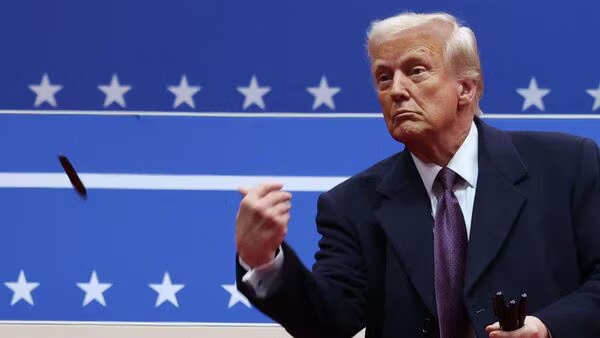
In a move that has drawn significant global attention, US President Donald Trump has signed an executive order initiating the withdrawal of the United States from the World Health Organization (WHO). This action, which marks the second time Donald Trump has ordered the US to exit the Geneva-based institution, was signed on his first day in office after his return to the White House. The decision to pull out of the WHO comes amid ongoing criticism of the organization’s handling of the COVID-19 pandemic and its perceived biases towards China.
The signing of the executive order was one of many that Donald Trump issued during his first day in office, as he wasted no time in enacting key policy changes. “Oooh, that’s a big one,” Donald Trump remarked while approving the document. His actions on this day suggest that the US is now closer than ever to formally leaving the global health body. While this marks the second time he has sought to withdraw the country from the WHO, Donald Trump’s stance on the organization has been long-standing. During the COVID-19 crisis, he criticized the WHO for its management of the pandemic, particularly its early handling of the situation in Wuhan, China. This criticism led Donald Trump to start the process of withdrawal in 2020, a decision that was later reversed by President Joe Biden after he took office.
The executive order issued on Donald Trump’s first day again stresses the reasons for the withdrawal, which include the WHO’s mishandling of the COVID-19 pandemic, its failure to enact necessary reforms, and its perceived political bias, particularly towards China. Donald Trump emphasized that the US had made “unfairly onerous payments” to the WHO and argued that the organization had failed to act independently from the influence of its member states, particularly China. The executive order also highlighted concerns about the WHO’s ability to effectively address other global health crises and its general inefficiency in responding to the urgent needs of the global community.
Throughout his presidency, Donald Trump expressed frustration with the WHO’s approach to COVID-19, accusing the organization of being too lenient towards China in its early responses. He repeatedly criticized the WHO for issuing guidance that he believed was influenced by China’s political interests. The decision to withdraw from the WHO was part of Trump’s broader “America First” foreign policy, which often involved pulling the US out of international agreements and organizations that he felt were not serving the nation’s best interests.
Despite Donald Trump’s efforts to withdraw from the WHO, the United States remained the largest financial contributor to the organization during the Biden administration. In 2023, the US contributed nearly one-fifth of the WHO’s $6.8 billion annual budget. Under Biden, the US reaffirmed its commitment to global health initiatives and continued to support the WHO’s work in combating pandemics and improving public health worldwide. The Biden administration also focused on restoring US leadership in global health, a sharp contrast to Donald Trump’s “America First” approach.
Donald Trump’s decision to withdraw the US from the WHO has drawn sharp criticism from public health experts, who warn that it could have serious repercussions for global health, as well as for the health of Americans. Critics argue that the move could undermine efforts to combat infectious diseases such as malaria, tuberculosis, and HIV/AIDS, which require coordinated international efforts. Ashish Jha, who previously served as the COVID-19 response coordinator under President Biden, has warned that a US withdrawal from the WHO would harm not only global health efforts but also the United States’ leadership role in science and public health.
Lawrence Gostin, a global public health expert and professor at Georgetown University, described the decision as “cataclysmic,” adding that it would be a “grievous wound to world health” and an even deeper blow to the United States’ standing on the global stage. Experts argue that in a world increasingly interconnected by global health challenges, it is essential for the US to remain an active participant in international health organizations, and withdrawal from the WHO could set back progress in addressing global health crises.
As the debate over the US’s relationship with the WHO continues, Donald Trump’s latest executive order has raised serious questions about the future of global health cooperation and the role of the United States in shaping international health policies. With the US being a key player in global health initiatives, the decision to withdraw from the WHO will undoubtedly have far-reaching implications for both global health governance and the country’s position in the international community. While Donald Trump has suggested that the US may return to the WHO in the future, it remains to be seen whether this decision will be revisited by future administrations or whether the withdrawal will mark a permanent shift in the country’s approach to global health cooperation.