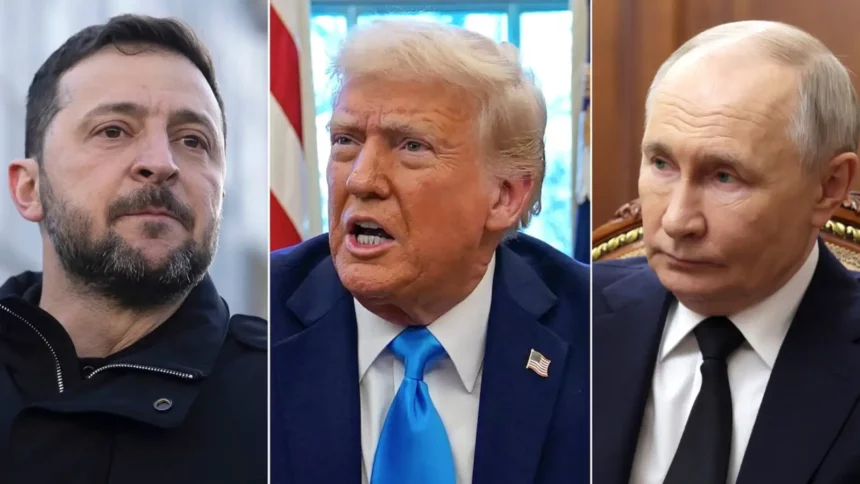
The possibility of a breakthrough in the nearly four-year-old Russia-Ukraine war emerged on Monday after US President Donald Trump revealed that preparations were underway to bring Ukrainian President Volodymyr Zelenskyy and Russian President Vladimir Putin to the negotiating table. Donald Trump described the initiative as a “very good, early step” toward peace after hosting high-level talks at the White House with European leaders, NATO officials, and Volodymyr Zelenskyy. His announcement signals one of the most significant attempts yet by Washington under his administration to directly mediate the conflict that has defined global security discussions since Russia’s full-scale invasion of Ukraine.
High-Level White House Talks Signal Turning Point
President Donald Trump’s declaration followed a series of intensive consultations with key European leaders and representatives of NATO, highlighting how Washington and its allies are attempting to align strategies for peace in Ukraine. The White House hosted a gathering that included French President Emmanuel Macron, Italian Prime Minister Giorgia Meloni, British Prime Minister Keir Starmer, Finnish President Alexander Stubb, German Chancellor Friedrich Merz, European Commission President Ursula von der Leyen, and NATO Secretary General Mark Rutte. The presence of such a wide-ranging coalition underscored the seriousness with which the international community views the moment and the possibility of progress.
Speaking on Truth Social, Donald Trump said, “I had a very good meeting with distinguished guests which ended in a further meeting in the Oval Office.” He framed the discussion as focused not only on Ukraine’s immediate needs but also on long-term guarantees for its sovereignty and stability. According to Donald Trump, security guarantees for Ukraine were discussed in detail, with European nations expected to play a central role in coordination with Washington. He emphasized that “everyone is very happy about the possibility of PEACE for Russia/Ukraine,” marking a rare moment of optimism in a war that has seen little progress toward negotiation.
The fact that the talks moved beyond generalities to discussions about practical guarantees for Ukraine is a notable development. European leaders have been divided on how far they should go in committing long-term security assurances to Kyiv, but Donald Trump’s attempt to consolidate positions may open the way to a more unified stance. Analysts have pointed out that European capitals such as Paris and Berlin have in the past leaned toward encouraging negotiations, while Warsaw and Baltic states have remained firmly hawkish. The new momentum at the White House meeting suggests that divisions might be softening under Washington’s coordination.
At the conclusion of the talks, Donald Trump made a dramatic move: he phoned President Vladimir Putin directly. According to his own account, he began the process of arranging a face-to-face meeting between Vladimir Putin and Volodymyr Zelenskyy. “I called President Vladimir Putin, and began the arrangements for a meeting, at a location to be determined, between President Vladimir Putin and President Volodymyr Zelenskyy,” Donald Trump said. His direct engagement with Vladimir Putin is being read as an acknowledgment that Moscow must be at the center of any eventual peace arrangement, however uncomfortable that may be for Kyiv and its allies.
Donald Trump further revealed his plan to expand the discussions into a trilateral format involving himself alongside Vladimir Putin and Volodymyr Zelenskyy. “After that meeting takes place, we will have a Trilat, which would be the two Presidents, plus myself,” he said, outlining an ambitious role for Washington as not merely a facilitator but as an active participant in shaping the framework of a potential settlement. This suggestion has already sparked debate among international observers, with some viewing it as an overdue step and others warning it could tilt negotiations toward Moscow’s advantage if not carefully managed.
Vice President JD Vance, Secretary of State Marco Rubio, and Special Envoy Steve Witkoff have reportedly been tasked with managing the delicate logistics of arranging such unprecedented meetings. Coordinating with both Kyiv and Moscow on venue, agenda, and security will be a formidable task. Still, Donald Trump framed the initiative as a necessary step toward resolving “a war that has been going on for almost four years.”
Kremlin Confirms Direct Contact as Optimism Surfaces
On the Russian side, the Kremlin was quick to confirm Donald Trump’s outreach. Russian state media reported that Vladimir Putin warmly thanked Donald Trump for his hospitality and for the progress made during their previous Alaska summit. While details remain sparse, it was disclosed that the two leaders spoke for approximately 40 minutes by phone following the White House discussions.
According to a Kremlin aide, both Donald Trump and Vladimir Putin agreed on the importance of continued direct talks between Russian and Ukrainian delegations. The aide further suggested that Moscow was prepared to keep communication channels open with Washington on Ukraine as well as on broader global issues, signaling a potential thaw in a relationship that has otherwise been marked by distrust and hostility over the past several years.
For Moscow, agreeing to Donald Trump’s mediation serves several purposes. Firstly, it underscores Vladimir Putin’s interest in being seen as a central actor in international diplomacy, countering the narrative that Russia has become isolated due to the war. Secondly, it allows Russia to test Washington’s willingness to engage directly outside of the framework established by European diplomacy, where Moscow has often felt cornered. Finally, it provides Vladimir Putin with an opportunity to project an image of openness to peace, even if substantive concessions remain unlikely at this early stage.
For Kyiv, however, the stakes are far higher. Volodymyr Zelenskyy has repeatedly said that peace cannot come at the expense of Ukraine’s sovereignty or territorial integrity. The Ukrainian leader has maintained that Russia must withdraw its troops and respect internationally recognized borders before negotiations can move forward meaningfully. Yet, the reality of a protracted war, mounting casualties, and strained Western support means that Kyiv may have to consider at least exploring talks if its allies are united in pressing for them. Donald Trump’s insistence on bringing both leaders together in a single room suggests he is betting that the symbolism of dialogue could generate momentum that years of battlefield stalemate have not.
In Washington, reactions have been mixed. Supporters of Donald Trump’s initiative have praised it as a bold diplomatic gamble, one that could break the deadlock and save countless lives. Critics, however, have warned that engaging Vladimir Putin without strict conditions risks legitimizing Moscow’s aggression and undermining Ukraine’s negotiating position. Within NATO, too, there are quiet concerns that a premature meeting might fracture unity if different member states interpret the goals differently.
Nonetheless, the scale of Donald Trump’s announcement and the speed with which the Kremlin confirmed the outreach have created a moment of cautious optimism. For the first time in months, the possibility of high-level negotiations between Ukraine and Russia appears tangible. Whether that translates into real progress remains uncertain, but the very act of arranging such talks represents a shift in tone that could mark the beginning of a new phase in the conflict.
Observers note that any eventual peace process will likely be long, complex, and fraught with setbacks. Issues such as territorial control, reparations, security guarantees, and accountability for war crimes will inevitably surface. Yet, diplomats argue that no resolution can begin without dialogue. By moving to arrange a face-to-face meeting between Volodymyr Zelenskyy and Vladimir Putin, Donald Trump has effectively forced the question of negotiations back onto the global agenda at a moment when the war risks becoming normalized as an unresolved stalemate.