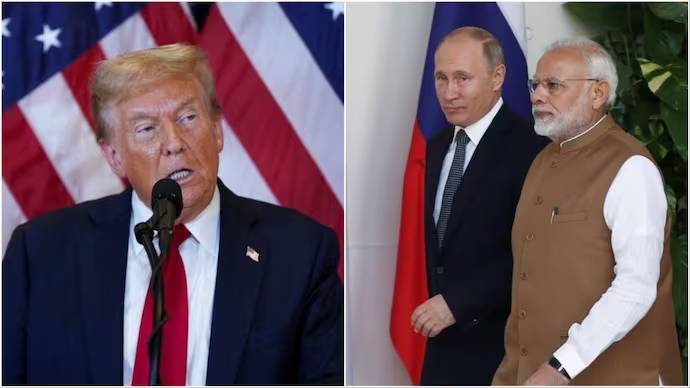
US President Donald Trump has claimed that his decision to impose steep tariffs on India over its continued purchase of Russian oil has delivered a serious setback to Moscow’s already struggling economy. Speaking at a White House press conference on Monday, Donald Trump referred to India as Russia’s “largest or second largest oil buyer” and said the move was a “big blow” to the Kremlin.
The remarks come less than a week after Donald Trump doubled the tariffs on Indian imports to 50 per cent, specifically citing India’s oil transactions with Russia as the reason. The hike was introduced in two phases: an initial 25 per cent duty announced on July 30, followed by an additional 25 per cent on August 7. The escalation was formalised through an executive order titled Addressing Threats to the US by the Government of the Russian Federation, which Donald Trump signed last Wednesday.
According to the President, these tariffs form part of a broader strategy to pressure Russia economically in response to its ongoing invasion of Ukraine, which has now entered its fourth year. The US has imposed a range of economic measures on Moscow and has been urging its allies and strategic partners to limit or halt purchases of Russian energy, arguing that oil and gas revenues are a critical lifeline for the Kremlin’s war machine.
‘Russia’s Economy Has Been Disturbed’
During Monday’s press conference, Donald Trump painted a bleak picture of Russia’s economic prospects. “I think Russia has to get back into building their country,” he said, stressing that while the country has “tremendous potential,” it is “not doing well” under current conditions.
“It’s a massive country… I think they have 11 time zones, can you believe it? From the standpoint of land, they are by far the largest. They have tremendous potential in Russia to do well. They’re not doing well. Their economy is not doing well right now because it’s been very well disturbed by this,” Donald Trump added, appearing to refer to the cumulative effect of sanctions and tariffs imposed by the United States and its partners.
Donald Trump explicitly linked the downturn in Russia’s economy to his recent action against India. “Doesn’t help when the President of the United States tells their largest or second-largest oil buyer that we’re putting a 50% tariff on you if you buy oil from Russia. That was a big blow,” he said.
India, for its part, has described the move as “unfair, unjustified and unreasonable,” arguing that it unfairly penalises its sovereign right to engage in energy trade based on national interests.
Upcoming Donald Trump–Putin Meeting in Alaska
Donald Trump’s comments come just days before a high-profile meeting with Russian President Vladimir Putin, scheduled to take place in Alaska on Friday, August 15. The summit is being billed as a potential step toward securing a ceasefire in Ukraine, more than three years after Russian forces launched a full-scale invasion.
Notably, this will be Putin’s first visit to the United States since 2015. Donald Trump emphasised that the decision for the meeting to take place on American soil was a sign of respect from the Russian leader. “I thought it was very respectful that the President of Russia is coming to our country, as opposed to us going to his country or even a third-party place. But I think we’ll have constructive conversations,” he said.
According to Donald Trump, the Alaska summit will focus on exploring avenues for ending hostilities and addressing the broader security challenges in Eastern Europe. He also revealed plans to coordinate closely with European allies after his meeting with Putin.
Path to a Potential Zelenskyy–Putin Dialogue
Donald Trump hinted at his intention to serve as a facilitator for direct talks between Putin and Ukrainian President Volodymyr Zelenskyy. “The next meeting will be with Zelenskyy and Putin, or Zelenskyy and Putin and me. I’ll be there if they need, but I want to have a meeting set up between the two leaders,” he said.
This proposed engagement could mark the most significant diplomatic overture since the early months of the war, though it remains unclear whether either Moscow or Kyiv is prepared to make concessions that could pave the way for a ceasefire.
India’s Strategic Position and Energy Ties with Russia
India has maintained a delicate balancing act in its foreign policy throughout the Ukraine conflict. While New Delhi has strengthened defence and strategic partnerships with the United States and other Western powers, it has also continued to purchase discounted Russian crude oil, citing its need to secure affordable energy supplies for its growing economy.
These purchases have increased significantly since 2022, making India one of the largest buyers of Russian oil alongside China. The arrangement has been criticised in Washington and European capitals, where policymakers argue that the flow of energy revenues to Russia undermines the effectiveness of sanctions designed to limit the Kremlin’s war financing.
However, Indian officials have repeatedly defended the country’s position, stressing that its energy security and developmental priorities cannot be compromised. The latest round of US tariffs, they argue, will harm both economies and could set back the trajectory of bilateral trade ties.
Impact of the 50% Tariff
The immediate economic consequences of the tariff hike are still being assessed, but trade analysts suggest that such a steep duty could discourage Indian imports of certain US goods while prompting New Delhi to consider retaliatory measures. Given that the tariff targets India’s purchasing behaviour from a third country — Russia — it has raised questions about the scope of US trade policy and its intersection with foreign policy objectives.
Critics of Donald Trump’s approach argue that penalising India risks alienating a key strategic partner at a time when Washington is seeking to strengthen its alliances in the Indo-Pacific to counterbalance China’s growing influence. Proponents, however, contend that such measures send a clear signal to both Moscow and its economic partners that continued support for Russia’s energy sector will carry a tangible cost.
Broader Geopolitical Implications
The tariff decision and Donald Trump’s strong public statements about its impact on Russia’s economy reflect the deepening intersection between trade policy and geopolitics in the current global order. By directly linking economic measures against India to the goal of weakening Russia, the US administration has underscored its willingness to use trade as a lever in pursuit of strategic objectives.
The upcoming Alaska summit between Donald Trump and Putin will be closely watched for signs of any breakthrough on the Ukraine conflict. While both leaders have expressed interest in dialogue, their countries remain at odds on fundamental issues, including territorial integrity, security guarantees, and the future political status of contested regions.
Any progress toward a ceasefire would likely require not only bilateral engagement between Washington and Moscow but also direct negotiations between Russia and Ukraine — a prospect Donald Trump appears eager to facilitate. Yet, the political and military realities on the ground remain complex, with neither side showing clear readiness for compromise
Donald Trump’s decision to impose a 50 per cent tariff on India over Russian oil imports marks a significant and controversial escalation in his administration’s efforts to apply economic pressure on Moscow. While he claims the move has already dealt a “big blow” to Russia’s economy, it has also triggered a diplomatic dispute with New Delhi. The coming days, leading up to the Alaska summit with Putin, may determine whether this hardline trade stance will yield diplomatic dividends or further strain key international relationships.