US President Donald Trump publicly criticized Chinese President Xi Jinping over hosting Russian President Vladimir Putin and North Korean leader Kim Jong Un at a grand military parade in Beijing, marking the 80th anniversary of the end of World War II. In his statement, Donald Trump accused Xi of conspiring against the United States while simultaneously asking him to convey his “warm regards” to both Putin and Kim. The military parade drew global attention not only for its scale and historic significance but also for the complex geopolitical implications of the high-profile leaders’ interactions. As Donald Trump’s remarks circulated widely on social media, the event underscored ongoing tensions between the United States and China, set against the backdrop of historical narratives, contemporary alliances, and strategic rivalries in the Indo-Pacific and Eurasian regions. This event, following closely after the Shanghai Cooperation Organisation (SCO) Summit in Tianjin, highlighted the intricate dance of diplomacy, symbolism, and power projection in global politics, particularly in relation to US-China-Russia-North Korea relations.
Donald Trump’s Remarks and Accusations Against Xi Jinping
During the parade, Donald Trump used social media to deliver a message mixing sarcasm, historical references, and sharp criticism of Xi Jinping. Donald Trump accused the Chinese leader of plotting against the United States, asserting that the historical sacrifices made by Americans during World War II should be remembered and honored. He wrote on Truth Social that many Americans died in China during its struggle against Japanese imperial forces in the 1930s and 1940s, framing this as a contribution to China’s victory and freedom. Donald Trump emphasized the bravery and sacrifice of American forces and implicitly criticized Xi for hosting leaders whom Donald Trump has often positioned as adversaries or strategic rivals of the US. By extending his “warm regards” to both Putin and Kim, Donald Trump juxtaposed diplomacy with pointed accusations, underscoring his perception of China’s alignment with powers that challenge American interests globally. The timing of these comments, amid the parade and in proximity to the SCO Summit, highlighted the interplay between ceremonial diplomacy and realpolitik, where public displays of unity among certain global powers could signal strategic challenges to the US.
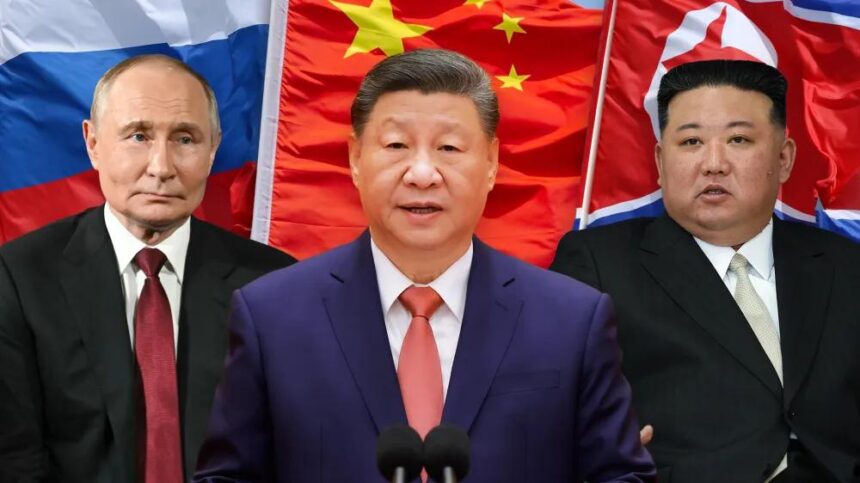
The parade itself was highly symbolic, showcasing military strength, historical memory, and national pride, with Xi Jinping and visiting leaders Vladimir Putin and Kim Jong Un walking together on the red carpet towards Tiananmen Square. The visual representation of the three leaders—Putin to Xi’s right, Kim to his left—reinforced narratives of international alliances that contrast with Western strategic interests. For North Korea, rare public appearances by Kim Jong Un on the international stage emphasize his regime’s diplomatic signaling, while Putin’s presence reinforces Russia’s ongoing role in global power dynamics. Donald Trump’s critique, therefore, was not just personal or rhetorical but directly engaged with the geopolitical symbolism of the parade and its implications for US influence in Asia and beyond.
Geopolitical Context: Historical Memory and Modern Diplomacy
The parade commemorated China’s victory over imperial Japan, a conflict that caused devastating losses for China and eventually drew the United States into direct military engagement after the attack on Pearl Harbor in 1941. Xi Jinping, in his address, emphasized China’s resilience, declaring the nation “unstoppable” and stressing that humanity faces choices between peace and war, dialogue or confrontation, and mutually beneficial outcomes or zero-sum games. Xi’s rhetoric reinforced China’s narrative of strength and strategic assertiveness while cautioning against what he perceives as external threats or “bullying.” By invoking history, Xi sought to connect past sacrifices with contemporary geopolitical positioning, framing China as a nation that has overcome adversity and will continue to assert its interests on the global stage.
The presence of multiple world leaders at the parade, including attendees from the SCO Summit such as Indian Prime Minister Narendra Modi and Pakistani Prime Minister Shehbaz Sharif, added layers of regional and international significance. The parade and summit together illustrated China’s role as a hub of diplomacy for Eurasian powers, creating opportunities for soft power projection, alliance signaling, and strategic communication. Donald Trump’s public critique of Xi during this period emphasized the persistent US perception of China as a rival, particularly when Beijing engages in high-profile interactions with countries such as Russia and North Korea.
Donald Trump’s commentary also referenced historical alliances and US contributions to global security, framing American involvement in China during World War II as foundational to the modern geopolitical order. He juxtaposed this history with contemporary strategic concerns, portraying Xi’s hosting of Putin and Kim as indicative of anti-US coordination. This blend of historical context, current events, and pointed rhetoric reinforced Donald Trump’s messaging to both domestic and international audiences, signaling vigilance over China’s strategic relationships while emphasizing American valor and sacrifice.
Xi Jinping’s speech, meanwhile, reaffirmed China’s emphasis on sovereignty, national pride, and resistance to intimidation, framing the country as a decisive actor in global politics that cannot be deterred by external powers. His reiteration of opposition to “bullying behavior, Cold War mentality, and camp confrontation,” echoes comments made at the SCO Summit, reflecting continuity in China’s diplomatic messaging. The parallel narratives of national history, military might, and global partnerships communicated during the parade illustrate the interconnectedness of symbolism, strategy, and international perception in China’s approach to foreign relations.
The interaction between Donald Trump’s accusations and Xi’s parade rhetoric highlights broader tensions in US-China relations, particularly concerning the Indo-Pacific region, Eurasian geopolitics, and the strategic positions of Russia and North Korea. As the parade showcased military and ceremonial power, it also served as a stage for diplomatic signaling, with the United States observing closely and reacting publicly to perceived challenges to its influence. Donald Trump’s statement underscores the intersection of domestic political positioning, historical memory, and international strategic calculations in shaping responses to such events.
The inclusion of Kim Jong Un, a leader whose international appearances are rare and tightly controlled, emphasized the significance of North Korea’s alignment with China and Russia in the context of the parade. This event allowed Beijing to visibly demonstrate alliances that contrast with US-led coalitions, while also reinforcing China’s image as a central mediator and power broker in East Asia and Eurasia. Donald Trump’s sharp critique thus functions on multiple levels: as a rhetorical defense of US interests, a historical reminder of American sacrifices, and a cautionary statement directed at the broader international audience regarding China’s perceived alignment with rival powers.
Overall, the parade and Donald Trump’s reaction illustrate the complex interplay of history, symbolism, and contemporary diplomacy. High-profile events such as the Beijing parade serve as critical venues for projecting national strength, signaling alliances, and shaping international perceptions, while also provoking reactions from other global actors, particularly the United States. Donald Trump’s approach, blending sarcasm, historical reflection, and strategic critique, exemplifies how US leaders communicate concerns about perceived adversarial coalitions and the broader implications for regional and global security dynamics.
Xi Jinping’s rhetoric and the presence of multiple SCO leaders underscore China’s commitment to cultivating partnerships, promoting national narratives, and asserting its role as a pivotal actor in global diplomacy. The parade, occurring shortly after the SCO Summit, further highlights the continuity of China’s strategic engagement with key Eurasian nations, while Donald Trump’s statements demonstrate the persistent contestation of influence and the complex, multi-layered nature of modern international relations.
This combination of ceremonial grandeur, historical reference, and geopolitical signaling illustrates the evolving dynamics of US-China-Russia-North Korea relations and the broader implications for regional security, alliance-building, and strategic competition in the contemporary world order.