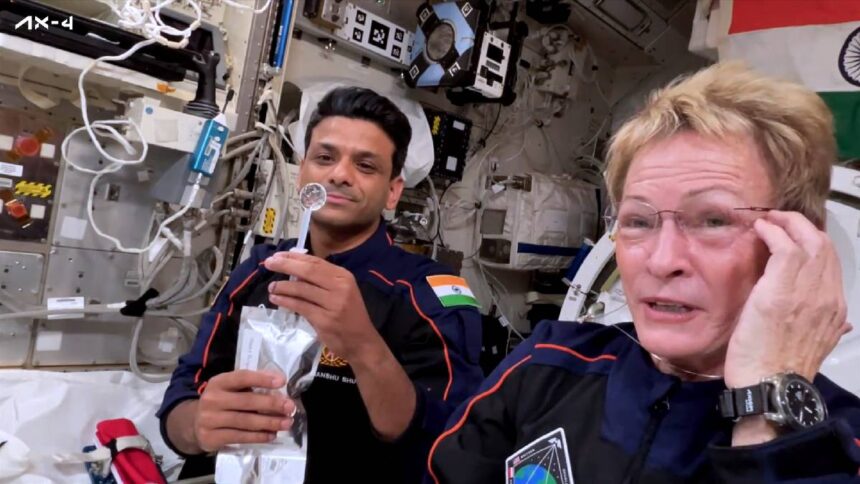
Meal times in space are a completely different experience than on Earth, as zero gravity fundamentally alters how food behaves and how astronauts interact with it. Shubhanshu Shukla, the first Indian to travel to the International Space Station (ISS), recently provided a detailed glimpse into the challenges of eating and drinking in orbit, sharing his firsthand experiences and insights into life aboard the ISS. Describing the experience as having to “learn to eat again,” Shukla highlighted how even simple actions such as handling a spoon, sipping coffee, or securing condiments require careful attention in a weightless environment. His revelations not only showcase the technical aspects of living in space but also provide a unique perspective on human adaptability in extreme conditions. From floating utensils to Velcro-covered tables, Shukla’s insights offer a window into the practical realities of astronaut life.
Challenges of Eating in Zero Gravity
Shubhanshu Shukla emphasized that zero gravity completely transforms basic daily activities, with eating being among the most intricate. In space, everything floats freely, meaning that food, utensils, and even liquids must be carefully secured to prevent them from drifting away. Shukla demonstrated the innovative use of Velcro and tape aboard the ISS, explaining that virtually every item is attached to a surface to keep it stable during meals. For instance, ketchup bottles and other condiments are fastened to the table, while spoons and forks are equipped with Velcro to prevent them from floating away when not in use. “Everything floats. So you will see Velcro and tape all around,” Shukla said, pointing to a small dining table that serves as the primary eating area for astronauts. The table is compact and designed to keep astronauts in place while they consume their meals, with seating arrangements that allow them to remain tethered during the activity.
The need for meticulous care while handling food extends to even the smallest items. Shukla explained that if any object is released carelessly, it immediately starts floating and could potentially create a mess in the cabin. He compared eating in space to performing a precise and deliberate task where mindfulness and attention to detail are paramount. “If you leave anything, it’s gone. So, you hold it, you put it with Velcro on something,” he explained, demonstrating with a spoon how even minor actions must be carefully executed to prevent items from drifting. The adaptation required for astronauts in this scenario is significant, as even ordinary utensils behave differently when not influenced by gravity. Eating and drinking, which humans take for granted on Earth, becomes a skill to master in space, requiring practice, patience, and constant awareness of the environment.
Handling Liquids and Maintaining Cleanliness in Orbit
Another major challenge in space dining, Shukla revealed, is consuming liquids in microgravity. Drinking fluids such as coffee, water, or juice requires specialized containers and careful handling to avoid floating droplets that could damage equipment or create hazards in the spacecraft. Shukla demonstrated this using a sippy pouch, pressing the opening with his fingers and observing how the coffee formed a cohesive bubble as it floated in front of him. He explained that astronauts then carefully bring the floating liquid bubble to their mouth to consume it, highlighting both the ingenuity and delicacy required for liquid management in space. This method not only ensures safe consumption but also minimizes the risk of spills and contamination within the confined cabin environment.
Shukla also shared a broader perspective on why eating slowly is essential in space. “Never thought I would have to learn to eat again,” he remarked, noting that even simple actions can lead to chaos if not performed deliberately. The mantra “Slow is Fast” becomes a guiding principle, emphasizing careful, measured movements that prevent accidents and ensure that all items remain secured. The astronaut’s explanation also addressed the human digestive system, clarifying that digestion does not depend on gravity. Food moves through the digestive tract via peristalsis, a process involving the rhythmic contraction and relaxation of muscles, which allows digestion to function normally regardless of orientation or gravitational forces. Shukla reassured viewers that whether one is head up, head down, or in zero gravity, the human body is capable of processing food effectively, providing both physiological insights and practical advice for life in orbit.
Throughout his demonstration, Shukla highlighted the ingenuity and adaptability required to live in space. From modified utensils to Velcro-covered tables and specially designed liquid containers, the systems in place allow astronauts to carry out essential daily activities safely and efficiently. His experiences not only underscore the challenges of zero gravity but also demonstrate how human innovation can overcome obstacles in extreme environments. Dining in space is not merely about sustenance; it is a carefully choreographed activity that reflects the broader demands of living in a microgravity environment, blending science, engineering, and human perseverance.
Shukla’s insights provide a rare glimpse into the everyday life of astronauts aboard the ISS. While space missions often focus on research, experiments, and exploration, basic routines such as eating, drinking, and maintaining hygiene represent critical aspects of life that ensure the wellbeing and functionality of crew members. The precautions, techniques, and tools developed for space dining also reflect broader principles of space engineering, where safety, efficiency, and practicality must coexist in a challenging, resource-constrained environment. Shukla’s demonstration, complete with examples of Velcro, floating utensils, and liquid bubbles, not only informs but also inspires, highlighting the resilience, creativity, and adaptability required for humans to thrive beyond Earth’s gravity.
By sharing his personal experiences and practical demonstrations, Shukla humanizes the challenges of life in orbit, moving beyond abstract descriptions to tangible, relatable examples. Viewers gain insight into how astronauts adjust to a radically different environment, where every action must be intentional, precise, and well-coordinated. The lessons from these adaptations extend beyond space travel, offering perspectives on problem-solving, patience, and mindfulness in unfamiliar or constrained conditions. Whether managing floating coffee or securing condiments, Shukla’s accounts illustrate that space living demands a unique blend of awareness, technical understanding, and adaptability, providing both educational and motivational insights for audiences on Earth.