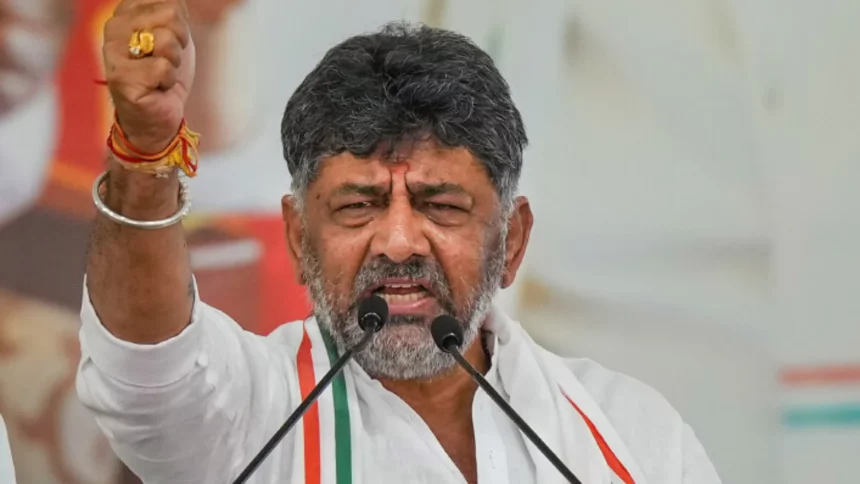
At a recent Congress event in Delhi, Karnataka Deputy Chief Minister DK Shivakumar made emotionally charged remarks that blended admiration for Sonia Gandhi with veiled criticism of those unwilling to share power. His comments have reignited speculation about his own political equation with Chief Minister Siddaramaiah, especially in the context of Karnataka’s leadership dynamics.
Speaking at the “Constitutional Challenges” event organised by the All India Congress Committee (AICC), Shivakumar drew on the legacy of the Gandhi family to emphasize the importance of political sacrifice and power-sharing. While his speech lauded Sonia Gandhi’s historic decision in 2004 to step aside from the prime ministerial role, it also subtly spotlighted internal tensions within the Karnataka Congress.
Sonia Gandhi’s Political Sacrifice as a Model of Leadership
During his address, DK Shivakumar revisited the moment in 2004 when Sonia Gandhi famously declined the Prime Minister’s position despite the Congress securing a clear mandate. “When the President asked her to take oath, she said, ‘For me, power is not important,'” he recalled. According to Shivakumar, Sonia Gandhi’s decision to support Manmohan Singh — a Sikh, a minority, and an economist — was a rare example of selfless political leadership.
“Has anyone in such a big democracy made such a sacrifice? Even at the panchayat level, many don’t sacrifice anything. Some MLAs and ministers do share power, but others are unwilling even to consider it,” he added. This statement, although general in tone, appeared to underline his frustrations about leadership arrangements in Karnataka.
Sonia Gandhi’s act, according to Shivakumar, was a symbol of visionary politics that prioritised national interest over personal ambition. His choice to raise this example at a high-profile event attended by party members and leaders came across as both praise and pointed messaging. He carefully avoided naming anyone, but his words carried weight in the current political climate.
Unspoken Rift Between Karnataka’s Top Leaders
Shivakumar’s remarks come against the backdrop of ongoing murmurs in Karnataka about a power-sharing arrangement between him and Chief Minister Siddaramaiah. Ever since the Congress formed the government in the state following a sweeping victory in the 2023 assembly elections, questions have lingered over how long Siddaramaiah would remain in office.
While DK Shivakumar was widely considered a strong contender for the Chief Minister’s post, the Congress high command eventually chose Siddaramaiah, offering Shivakumar the Deputy CM post. At the time, there was talk of a “rotational” model where Shivakumar might take over the top job midway through the term. However, Siddaramaiah has since publicly dismissed such speculations, asserting that he will serve the full five-year term.
Shivakumar’s recent speech, therefore, has been seen as a subtle reminder of that unfinished conversation. Without naming Siddaramaiah, he suggested that the principle of power-sharing is often not upheld, even among senior politicians.
Political observers view his comments as a strategic attempt to keep the conversation alive while maintaining a tone of respect and decorum. His emphasis on long-standing loyalty to the Congress and his contribution to the party’s resurgence in Karnataka were also not lost on the audience.
In the lead-up to the 2023 elections, Shivakumar played a pivotal role in mobilising the party machinery, rebuilding grassroots connections, and crafting an effective electoral strategy. His efforts were widely credited with bringing Congress back to power in the state after a gap.
However, his ambition for the Chief Minister’s post has remained an open secret. His speech in Delhi can be interpreted as an attempt to build a moral case for leadership change, based on the ethos of sacrifice and fair governance.
While speaking about power-sharing, he subtly brought the focus back to values over positions. His tone was carefully balanced—praising the Congress leadership, evoking historical examples of political generosity, and leaving his audience to draw their own conclusions about the present scenario.
Shivakumar’s use of Sonia Gandhi’s legacy was particularly significant given the context. In the Congress party, the Gandhi family’s role remains deeply respected and symbolic. By tying his argument to Sonia Gandhi’s decision in 2004, he ensured that his message resonated beyond regional politics.
Whether his remarks will prompt any realignment in Karnataka remains to be seen. But politically, the speech has given fresh momentum to discussions about succession and balance within the state’s Congress leadership.
Though the event focused on larger constitutional issues, Shivakumar skilfully used the platform to highlight a core theme of intra-party democracy. His reflections spoke to a broader concern within political circles: that the willingness to share power is often the exception, not the norm.
As Karnataka continues to navigate governance challenges and coalition pressures, the underlying question of leadership and internal dynamics will remain central. Shivakumar’s remarks have added a new layer to that discourse, forcing party members and observers alike to reconsider the unwritten rules of political compromise and ambition.