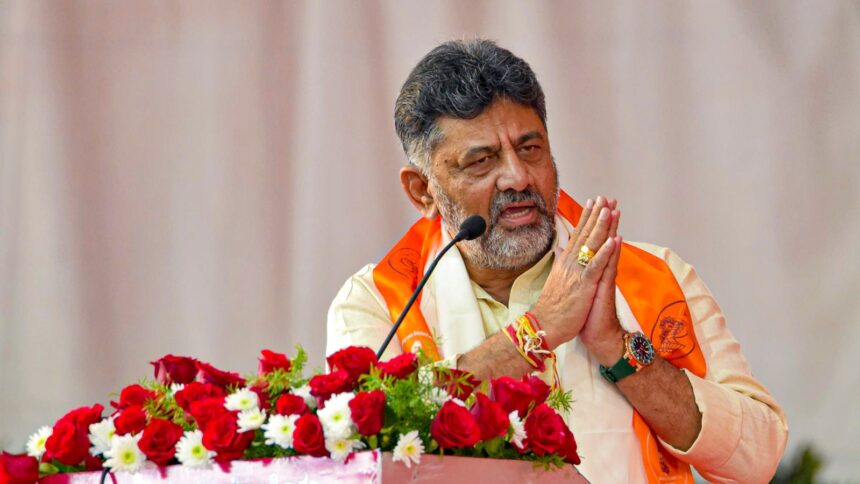
Amid rising speculation and internal tension over a possible leadership transition in Karnataka, Deputy Chief Minister DK Shivakumar on Thursday denied any ongoing negotiations to replace Siddaramaiah as Chief Minister. His latest remarks sought to cool mounting political conjecture about a 2023 power-sharing arrangement within the ruling Indian National Congress.
Speaking to reporters, Shivakumar reiterated that he is “not in a hurry for anything” and made it clear that no discussions regarding a chief ministerial change had taken place so far. He also denied meeting any senior Congress leaders during his recent visit to Mumbai, contrary to political buzz suggesting high-level talks on a possible transition.
“If leadership discussions ever happen, it will be in Bengaluru or Delhi — not Mumbai,” Shivakumar said, drawing a firm boundary around the narrative that his Mumbai trip was politically significant. He added that his visit was personal, not political, and had no connection to any potential shift at the top of the state government.
The tussle comes at a sensitive time for the Congress as the party is determined to prevent factional narratives from undermining its administrative credibility ahead of upcoming electoral cycles. Karnataka has been witnessing renewed commentary on leadership ambition and insider deals, adding pressure on the party’s central leadership to step in and forge consensus.
The speculation originated from repeated references in party and media circles to a “secret power-sharing agreement” allegedly struck in 2023 between Siddaramaiah and Shivakumar before the Congress formed the government in the state. While Shivakumar has previously hinted at the existence of such a pact, he has consistently avoided public disclosure, citing party interest.
According to insiders, Shivakumar recently described the alleged understanding as limited to “five–six Congress insiders” and refused to elaborate, saying that an open conversation would only weaken the party and strengthen the opposition. His attempts to maintain political discipline, however, have not fully neutralised competing claims or messaging at the senior level.
The friction intensified further this week when Shivakumar posted an indirect yet symbolic social media message, stating that “keeping one’s word is the greatest strength” and “word power is world power.” The phrasing was interpreted by many as a quiet push toward the party high command, urging it to maintain political commitments.
Chief Minister Siddaramaiah, meanwhile, responded with his own carefully framed statement, implicitly asserting his claim to hold office for “a full five-year term.” While his remarks contained no hostility on the surface, political observers saw it as a counter-signal to Shivakumar’s cryptic messaging, emphasising that no leadership transition was imminent and that only the high command would take a call.
Tension at the top — but no decision yet
The running verbal exchange, without direct accusations, has highlighted the leadership tension in Karnataka, where political messaging has now subtly replaced open confrontation. Party sources acknowledge that while the rivalry is not new, its public visibility has increased, pushing Congress leadership to take internal control over the narrative.
Karnataka Home Minister G Parameshwara further complicated the scenario by suggesting he too remains in the running for the Chief Minister’s position, amid rising demand from Dalit organisations for a Dalit CM. His comments added another layer to an already complex succession conversation in the state, broadening the contest beyond the Shivakumar-Siddaramaiah axis.
The Congress central leadership — including Mallikarjun Kharge and Rahul Gandhi — is now reportedly preparing to hold decisive talks with the state leaders to put the matter to rest and determine a roadmap that restores internal stability. Dalit groups, meanwhile, have intensified their push, saying their demand is rooted in social representation, not factional politics.
Although the party has not officially acknowledged any replacement plan, it has signalled readiness to negotiate political expectations to ensure unity and administrative continuity.
Congress high command prepares intervention amid claims of ‘word politics’, caste pressure, and alliance strain
New political signals emerging within Congress indicate that the party central leadership may not delay internal dialogue any longer, as power equations, social representation demands, and personal ambitions increasingly collide in public discourse.
The Congress high command has been planning an internal roadmap to resolve three key pillars of the conflict:
- Speculation over power-sharing agreement (2023)
- Leadership friction between Siddaramaiah and Shivakumar
- Demand for a Dalit CM led by social groups and supported indirectly by Parameshwara
Congress insiders say Shivakumar’s statement that “talks won’t happen in Mumbai” was strategic — designed to block misinformation and speculation that his private meetings or personal travel were connected to leadership decisions.
Meanwhile, Siddaramaiah’s assertion for five full years has underscored that he does not expect any leadership realignment before a formal party directive, a formulation that seeks to protect political hierarchy and stability.
The contrast in tone between the two senior leaders is notable:
- Shivakumar’s approach: Patient, calibrated, aspirational, wrapped in “word politics” symbolism
- Siddaramaiah’s approach: Confident, tenure-focused, and institutionally correct
Congress strategist circles say this divergence signals what could be defined as a “politics of intent vs politics of continuity,” both waiting for a top-down Congress decision, not a local power grab.
Balancing social representation and political continuity
The internal challenge for the Congress is no longer only about leader vs leader, but also about how the party balances:
- Caste representation
- Electoral optics
- Welfare credibility
- Faction management
- Administrative delivery
While the BJP has repeatedly accused the Congress of unstable alliances and internal succession drama, Shivakumar’s latest statements indicate that the Congress wants to appear calm, patient, and internally unified, at least publicly, even if internal negotiation intensifies.
Dalit organisations in Karnataka have sharpened their pitch, saying that the next chief minister should come from the Dalit community to reflect social balance. Karnataka Home Minister G Parameshwara, while not directly leading this demand, has acknowledged he is still in the CM race, a statement that gives the narrative further momentum.
Observers say the Congress central leadership now faces a delicate task of:
- Resolving leadership expectations without public breakdown
- Ensuring a formula that satisfies both political and social stakeholders
- Delivering a final decision that does not look reactive or forced
What happens next?
- Congress high command is expected to hold talks in Bengaluru or Delhi
- Both Siddaramaiah and Shivakumar may be called for one-on-one consultations
- A broader leadership formula including social representation demands is likely to be reviewed
- No timeline or immediate CM change is official yet
- Internal consensus is being prioritised to avoid party image erosion and opposition ammunition
At present, Siddaramaiah continues as CM, Shivakumar says he is patient, and Parameshwara remains in contention, making the leadership contest unresolved, but heating up, as everyone waits for a decisive Congress high command intervention.
The Congress, keen to avoid further public commentary, appears set to treat this phase as an internal organisational matter rather than a political negotiation conducted via media soundbites.