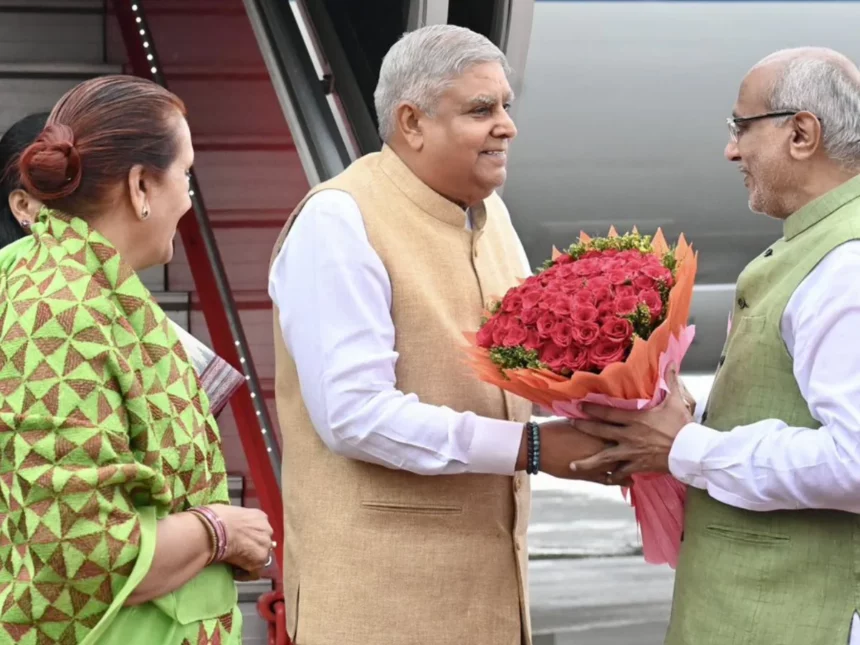
Former Vice President Jagdeep Dhankhar, who stepped down from his constitutional post in July citing health concerns, issued his first public statement since his departure, extending heartfelt congratulations to his successor, CP Radhakrishnan. Radhakrishnan, the National Democratic Alliance’s nominee, secured a decisive victory in the Vice Presidential elections held on Tuesday, obtaining 452 votes compared to the Opposition candidate B Sudershan Reddy’s 300 votes. Jagdeep Dhankhar’s acknowledgment emphasizes not only the smooth and honorable transition of power but also underscores the continuity and integrity of India’s democratic institutions. Through his letter and public remarks, Jagdeep Dhankhar lauded Radhakrishnan’s vast experience in public service, expressing confidence that under his stewardship, the office of the Vice President would attain greater prestige, authority, and functional significance in India’s constitutional framework. This milestone represents both a personal and institutional affirmation, signaling unity, respect, and the commitment to maintain the dignity and responsibilities of one of the highest offices in the country.
Acknowledging Experience and Institutional Continuity
In his letter, Jagdeep Dhankhar highlighted the trust and confidence placed in CP Radhakrishnan by the representatives of the nation. Jagdeep Dhankhar emphasized that the elevation of Radhakrishnan to the Vice President’s office reflects not only personal merit but also the faith that the parliamentary representatives have in his judgment, experience, and ability to manage legislative processes effectively. He praised Radhakrishnan’s deep familiarity with constitutional procedures, parliamentary conventions, and public administration, asserting that these qualities would ensure that the Vice President’s office continues to function with dignity, impartiality, and efficiency. Jagdeep Dhankhar’s remarks also conveyed mentorship and encouragement, framing his message as both a personal endorsement and a professional recognition of Radhakrishnan’s ability to lead. By emphasizing the importance of experience, Jagdeep Dhankhar reinforced the notion that the office of the Vice President is more than a ceremonial post; it is a critical institution that facilitates the functioning of the Rajya Sabha and contributes to legislative deliberations at the national level.
Beyond the formal acknowledgment, Jagdeep Dhankhar’s message carried broader political and institutional significance. It reassured the public, lawmakers, and political observers that despite the unexpected resignation, the office of the Vice President remains in capable hands. Jagdeep Dhankhar highlighted Radhakrishnan’s capacity to navigate complex parliamentary procedures, manage debates constructively, and maintain impartiality in legislative oversight. He emphasized that with extensive administrative experience and a deep understanding of governance, Radhakrishnan is well-positioned to uphold the office’s prestige while fostering a constructive environment for parliamentary engagement. The public communication also reflected a commitment to institutional integrity, demonstrating that India’s constitutional offices function above personal or political considerations and remain resilient even during sudden transitions.
Transition and Resignation: Reflections on Leadership and Legacy
Jagdeep Dhankhar’s resignation in July during the Monsoon session of Parliament came as a surprise to many, sparking discussions across political circles, media outlets, and civil society. Officially, health reasons were cited for his departure, but the abrupt nature of his exit prompted significant speculation and debate. This unexpected resignation necessitated fresh Vice Presidential elections, paving the way for CP Radhakrishnan’s candidacy and subsequent victory under the NDA’s banner. Jagdeep Dhankhar’s public congratulations to his successor serve as a demonstration of political maturity, collegiality, and respect for the democratic process. His message underscores the principle that constitutional office holders must prioritize the integrity of institutions and the smooth functioning of governance, even in the face of personal or political upheavals.
In his statement, Jagdeep Dhankhar also emphasized that Radhakrishnan’s elevation is a reflection of parliamentary trust in his abilities, integrity, and public service record. He framed the victory not merely as an individual achievement but as a testament to the collaborative spirit and functioning of India’s parliamentary democracy. By highlighting Radhakrishnan’s qualifications and capabilities, Jagdeep Dhankhar reinforced the importance of experience and competence in maintaining institutional effectiveness. His message also exemplifies the decorum and civility expected in political transitions, signaling that respect for constitutional roles and collaboration across party lines are essential to preserving the credibility and stability of governance.
The electoral outcome itself was notable, with Radhakrishnan securing a clear and decisive mandate. Jagdeep Dhankhar’s acknowledgment of this result positioned it as both an endorsement of Radhakrishnan and a validation of the democratic process. By recognizing the collective judgment of parliamentary representatives, Jagdeep Dhankhar emphasized the importance of respecting institutional outcomes and ensuring that constitutional offices continue to operate efficiently and impartially. His message highlighted the dual nature of the Vice President’s responsibilities as both the second-highest constitutional office and the ex-officio Chairperson of the Rajya Sabha. The office requires balancing legislative oversight, procedural impartiality, and active facilitation of parliamentary business, responsibilities for which Jagdeep Dhankhar expressed full confidence in Radhakrishnan’s ability to execute effectively.
Jagdeep Dhankhar’s reflections also underscored the importance of continuity in governance. Following his resignation, questions naturally arose regarding the stability and functioning of the Vice President’s office. By publicly affirming confidence in Radhakrishnan, Jagdeep Dhankhar addressed these concerns, reinforcing the perception that India’s democratic institutions remain robust and resilient even during unexpected leadership changes. His statement contributes to a broader understanding that constitutional offices in India function according to established norms and traditions, ensuring institutional integrity and public trust.
Moreover, Jagdeep Dhankhar’s communication highlighted the human and relational aspects of leadership transitions. Personal acknowledgment and public encouragement serve to foster a sense of mentorship, continuity, and institutional cohesion. By congratulating Radhakrishnan and emphasizing his capabilities, Jagdeep Dhankhar reinforced the value of experience, mutual respect, and collaboration in sustaining effective governance. This approach provides a template for future officeholders, demonstrating how transitions can be managed with dignity, foresight, and commitment to institutional responsibility.
The letter also emphasizes the symbolic and functional significance of leadership recognition. By praising Radhakrishnan, Jagdeep Dhankhar reinforces the understanding that the Vice President’s office is a vital component of India’s constitutional architecture, responsible for guiding legislative debate, ensuring procedural compliance, and maintaining the credibility of parliamentary processes. His message serves as a public endorsement of competence, signaling to lawmakers, political parties, and citizens that leadership roles should be acknowledged and respected based on merit and institutional capability.
Jagdeep Dhankhar’s first public statement post-resignation can also be seen as a demonstration of political discipline and institutional loyalty. It underscores the principle that personal decisions, even unexpected resignations, should not disrupt the functioning of constitutional offices. By publicly supporting his successor, Jagdeep Dhankhar exemplifies a commitment to continuity, the effective exercise of office, and the broader democratic ethos. This emphasis on institutional fidelity reinforces public confidence in governance and parliamentary procedures.
By highlighting Radhakrishnan’s extensive experience, Jagdeep Dhankhar conveyed that capable leadership is essential for sustaining the functionality and credibility of India’s legislative framework. The Vice President’s role, encompassing oversight of parliamentary debates, procedural guidance, and legislative facilitation, demands a nuanced understanding of law, precedent, and governance. Jagdeep Dhankhar’s commendation signals that Radhakrishnan possesses these qualities and is prepared to undertake the responsibilities of the office with authority, impartiality, and diligence.
In essence, Jagdeep Dhankhar’s remarks serve multiple purposes: they celebrate the democratic process, reassure the public and political stakeholders about continuity, and affirm the institutional importance of the Vice President’s office. His acknowledgment of Radhakrishnan’s experience reinforces the principles of meritocracy, mentorship, and institutional respect that underpin India’s parliamentary system. The message is a model of dignified political communication, demonstrating how leadership transitions can maintain stability, promote respect for constitutional offices, and strengthen public trust in governance.
This statement has been widely interpreted as a benchmark for conduct during transitions of power, emphasizing collegiality, constructive engagement, and affirmation of institutional values. By prioritizing the continuity of governance over political differences, Jagdeep Dhankhar’s communication exemplifies the ideal balance between personal respect, procedural propriety, and public responsibility. His remarks underscore the interconnectedness of leadership, experience, and institutional continuity in sustaining India’s democratic framework.
Overall, Jagdeep Dhankhar’s first public message after resignation conveys a vision for the future of the Vice President’s office. By congratulating CP Radhakrishnan, acknowledging his capabilities, and expressing confidence in his ability to enhance the stature and effectiveness of the office, Jagdeep Dhankhar sets a tone of optimism, professionalism, and constructive engagement. The message reinforces the importance of respect, mentorship, and institutional competence, providing a roadmap for how leadership transitions should be managed in India’s constitutional framework.b