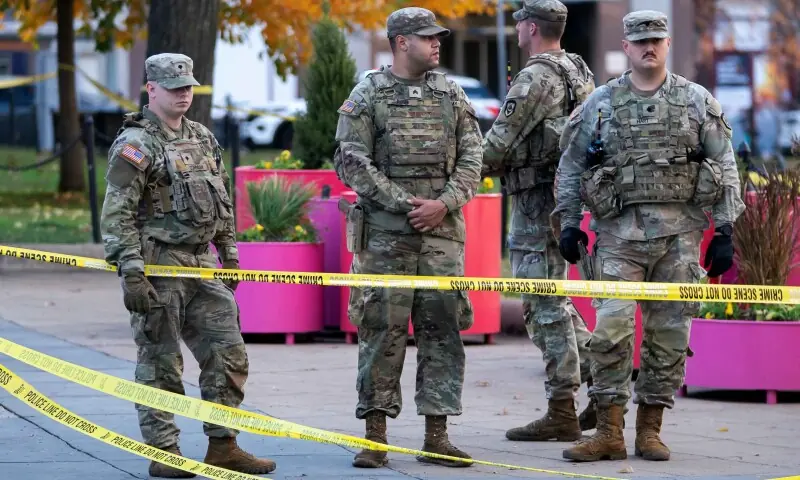
A deadly ambush near the White House on November 26 left one US National Guard soldier dead and another critically injured, as authorities confirmed the shooter was an Afghan national who had entered the United States in 2021. The incident has prompted intense scrutiny from law enforcement and renewed debates on immigration and national security.
US President Donald Trump confirmed that 20-year-old US Army Specialist Sarah Beckstrom, a National Guard member from West Virginia, died after being shot during a patrol just blocks from the White House. Her fellow guard, 24-year-old Andrew Wolfe, remains hospitalized and “fighting for his life,” officials said. Trump described the attack as a “terrorist act,” highlighting the serious security threat posed by the shooting.
The suspected gunman has been identified as 29-year-old Rahmanullah Lakanwal, an Afghan national who arrived in the United States under the Operation Allies Welcome program following the US withdrawal from Afghanistan in 2021. Authorities believe he acted alone.
Ambush-Style Attack and Arrest
According to Jeanine Pirro, US Attorney for the District of Columbia, Lakanwal drove across the country with the intention of staging an “ambush-style” attack on the National Guard members. Using a .357 Smith & Wesson revolver, he opened fire on Beckstrom and Wolfe while they were on routine patrol near central Washington, DC. Video evidence reviewed by investigators reportedly shows Lakanwal rounding a corner and immediately beginning to fire at the soldiers.
Law enforcement officials indicate that at least one Guard member returned fire during the attack. Troops quickly intervened, restraining Lakanwal until he could be taken into custody. The shooting occurred just a day before Thanksgiving, intensifying concerns about public safety and security protocols in the capital.
Authorities have not publicly released a motive for the attack. Early assessments suggest no known accomplices or terror network affiliations. Investigations are ongoing, with coordination among the US Secret Service, Homeland Security, and local DC police agencies to examine the suspect’s movements, background, and potential threats.
Background of Rahmanullah Lakanwal
Rahmanullah Lakanwal, originally from the eastern Afghan province of Khost, entered the United States through the Operation Allies Welcome initiative. This program, enacted under the Biden administration, facilitated the evacuation and resettlement of thousands of Afghans who had worked alongside US troops and diplomats as translators and interpreters during the US engagement in Afghanistan. The program reportedly resettled nearly 76,000 Afghan nationals.
Prior to arriving in the US, Lakanwal worked with the US government, including the CIA, as part of a partner force in Kandahar, according to CIA Director John Ratcliffe. While specific operational details were not disclosed, the statement confirmed his involvement in military and paramilitary activities in Afghanistan.
Lakanwal’s family, including his wife and five children, were residing with him in Washington state, according to his former landlord Kristina Widman. A cousin speaking to The Associated Press described him as a member of Afghanistan’s Zero Units—a special paramilitary unit operated locally but supported by the CIA.
Authorities confirm that Lakanwal applied for asylum during the Biden administration, and his application was approved after Trump assumed office. Officials continue to investigate whether his immigration and resettlement process played any role in facilitating the attack or raised prior warning signals.
The shooting has raised broader concerns regarding vetting protocols for refugees and asylum seekers, particularly those arriving from conflict zones where prior exposure to armed conflict may intersect with ideological or extremist risks. Legal experts caution, however, that country of origin alone does not automatically determine threat potential, and policy responses must balance national security with refugee and constitutional protections.
Security analysts note that the ambush occurred in a highly sensitive area, prompting immediate review of patrol routes, perimeter protocols, and emergency response coordination near the White House. The incident underscores vulnerabilities even in the nation’s most tightly secured areas and has spurred discussion among lawmakers and the administration on how to prevent similar attacks.
While authorities continue to gather evidence and interview witnesses, the focus remains on establishing motive, potential affiliations, and any preparatory actions leading up to the ambush. Early reports suggest that the attack was premeditated, and Lakanwal’s cross-country travel reflects deliberate planning rather than spontaneous action.
The incident has also drawn attention from immigration and national security experts, highlighting the intersection of refugee resettlement, background vetting, and public safety measures. Trump has used the event to emphasize his earlier proposals for stricter immigration controls and enhanced vetting for nationals from high-risk regions.
Meanwhile, public reaction in Washington and across the United States has been one of shock and mourning, particularly among military and National Guard communities. Memorial services for Specialist Beckstrom are being arranged, while Andrew Wolfe continues to receive critical medical care. The ongoing investigation seeks to ensure full accountability and assess any policy implications arising from the attack.
Authorities continue to review surveillance footage, digital communications, and other intelligence data to build a comprehensive timeline of the events. Federal and local agencies are coordinating with Afghan community representatives and social service organizations to address broader concerns stemming from this incident.
The White House has emphasized that the investigation is ongoing, and no definitive motive, terrorist affiliation, or ideological directive has been officially confirmed. Experts caution against drawing premature conclusions while law enforcement completes its work.
This ambush near the White House marks a rare and severe security breach, reaffirming the need for vigilance in protecting National Guard personnel and critical federal sites. The incident has also intensified political debates over immigration policies, refugee vetting, and national security preparedness, potentially influencing legislative discussions and executive decisions in the months ahead.