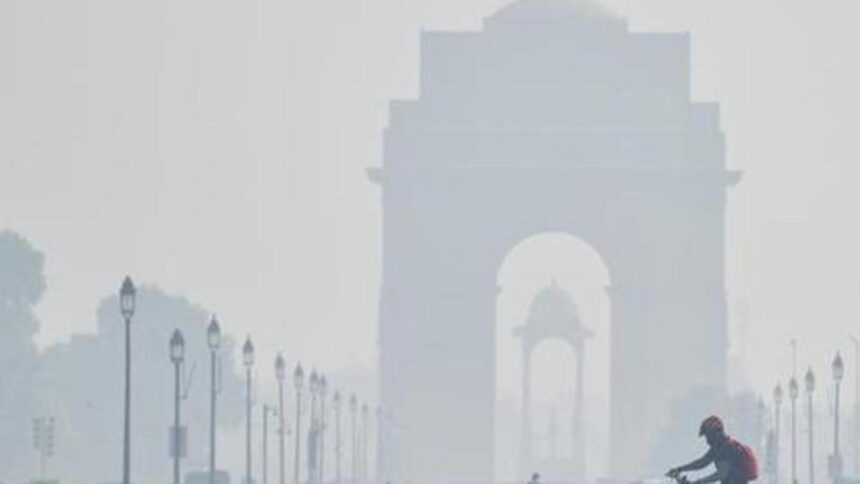
Delhi recorded its lowest monthly average air quality index (AQI) for February at 214, marking an improvement in air quality, according to data from the Central Pollution Control Board (CPCB). However, pollution levels still exceed national and global safety standards, and experts have raised concerns over the rising ozone concentrations.
While the National Ambient Air Quality Standard (NAAQS) sets a safe limit of 100 µg/m³ for ozone over an 8-hour period, CPCB data shows that hourly levels have frequently approached 90 µg/m³. The number of hours exceeding 90 µg/m³ has increased significantly, with 37 such hours recorded this year compared to just six in 2023 and none in 2022.
Ozone, a secondary pollutant, poses serious health risks despite the overall improvement in air quality. Meanwhile, Delhi recorded its lowest AQI of 2025 on Saturday at 121, the best for the January-February period in three years. The average AQI until February 28 stands at 262, the second best after 2022, which recorded 253. The number of “Good to Moderate” air quality days (AQI below 200) reached 14 in 2025, equaling 2024 and improving significantly from previous years.
The India Meteorological Department (IMD) reported 0.8 mm of rainfall at Safdarjung on Friday and forecasted partly cloudy skies with mist conditions for the coming week. Temperatures are expected to be above normal, reaching up to 30°C during the day and 17°C at night.
Environmental experts stress that while PM2.5 and PM10 levels have dropped compared to last year, they still remain nearly double the safe daily limits. The rising ozone levels highlight the persistent challenge of air pollution, emphasizing the need for a comprehensive strategy focusing on emission reductions at the source and expanding monitoring efforts to address all pollutants.