New Delhi | February 10, 2026:
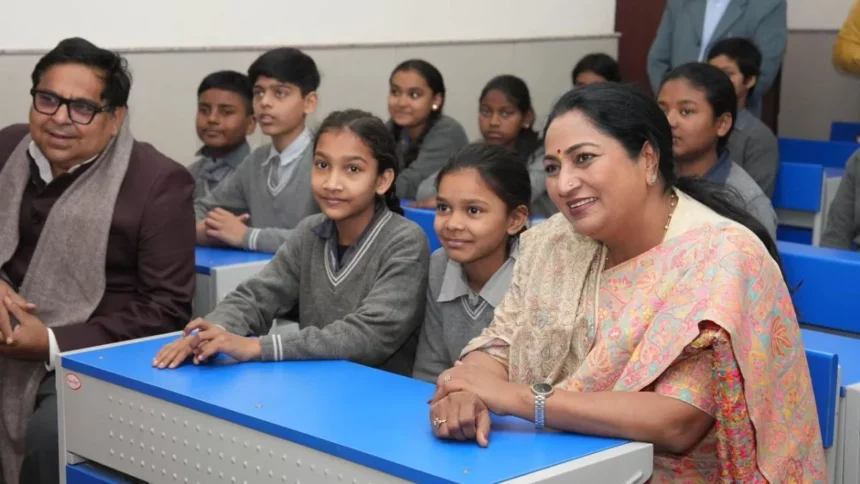
The Delhi Government has taken a significant step toward strengthening public education by upgrading both digital and physical infrastructure across government schools. New academic blocks were inaugurated at the District Institute of Education and Training, Dilshad Garden, and Sarvodaya Vidyalaya, Mansarovar Garden. In addition, 101 advanced ICT laboratories were launched across government schools in the capital.
The initiative reflects a broader vision to enhance learning outcomes by integrating modern technology with quality education. The focus is not limited to constructing buildings but extends to ensuring access to smart classrooms, digital laboratories, and contemporary teaching tools that support holistic student development.
According to the Education Department, substantial progress has been achieved within 355 days through the expansion of school infrastructure, establishment of computer laboratories, and development of modern academic facilities. These efforts aim to equip both teachers and students with digital competencies essential for today’s learning environment.
The government emphasized that sustainable improvements in education require collective participation. Partnerships with social and corporate organizations have therefore played an important role. With CSR support from the Ladli Foundation and the American India Foundation, 101 ICT laboratories have been established, providing a major boost to digital learning in government schools.
Each ICT laboratory has been equipped with 20 computers and an Interactive Flat Panel Display, enabling interactive and technology-driven classrooms. Alongside infrastructure, digital skills training programmes, workshops, and structured learning support are being provided for teachers and students to ensure effective use of technology.
At Sarvodaya Vidyalaya, Mansarovar Garden, a newly constructed ground-plus-three-storey academic building comprising 29 classrooms was inaugurated. The building has been developed in line with modern educational standards. Similarly, a new ground-plus-three-storey building with 19 classrooms was inaugurated at the DIET campus in Dilshad Garden, featuring advanced facilities for teacher training and academic innovation.
The Education Department stated that the government aims to position Delhi as a leading state in terms of smart classrooms, computer and language laboratories, modern sports facilities, and robust educational infrastructure. Equal emphasis is being placed on academics, sports, and student nutrition.
As part of its long-term strategy, 75 CM Schools are being developed as models of educational excellence within the public school system. These institutions are expected to set new benchmarks in quality education, infrastructure, and inclusive learning practices.
The ‘Neev’ curriculum is also being implemented to strengthen ethical values, civic responsibility, and social awareness among students. The curriculum seeks to balance academic learning with character building and responsible citizenship.
Through these initiatives, the Delhi Government has reaffirmed its commitment to building a modern, inclusive, and future-ready public education system. The integration of digital infrastructure with value-based education is transforming government schools into institutions equipped to meet evolving educational needs.