New Delhi, 21 December 2025:
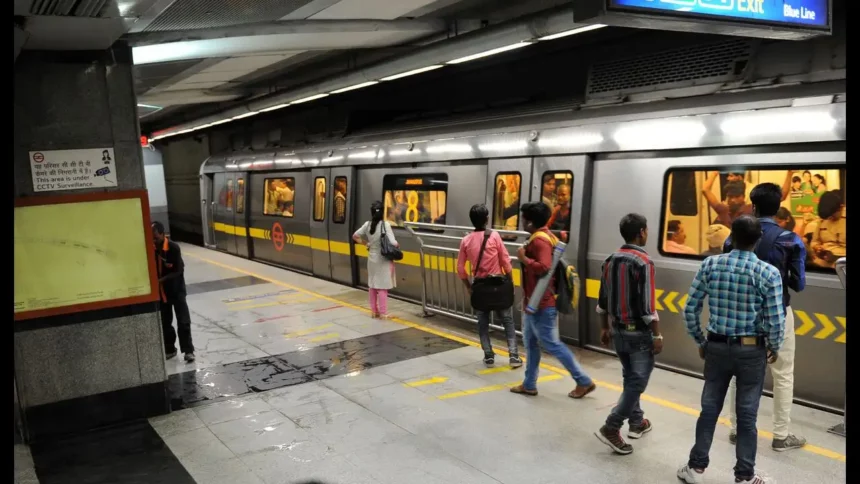
The Delhi Government, under Chief Minister Rekha Gupta, has emphasised the strengthening of public transport, particularly the Delhi Metro network, as a key strategy to curb pollution in the city and the NCR region. Highlighting the government’s commitment, CM Gupta stated that the transport department has been allocated a significantly higher budget, with 60 percent more funds provided in the current fiscal year to enhance public transport infrastructure and ensure uninterrupted progress on ongoing Metro projects.
CM Gupta noted that the government is also clearing the Delhi Metro’s outstanding liabilities left unpaid by previous administrations, ensuring that financial constraints do not hinder expansion work. She remarked that had earlier governments taken public transport development seriously, Delhi would not be facing such severe pollution challenges today.
Vehicle Emissions as a Major Pollution Source
The Chief Minister pointed out that studies from the Centre for Science and Environment (CSE) and other research institutions confirm that vehicular emissions are a major contributor to Delhi-NCR’s deteriorating air quality. To tackle this, she stressed the need to strengthen public transport systems, particularly the Delhi Metro, to reduce reliance on private vehicles. “Decisive steps are being taken to manage pollution levels and traffic pressure on city roads,” CM Gupta said, linking the government’s initiatives with Prime Minister Narendra Modi’s vision of ‘Net Zero Emission’ and modern transport systems.
Historic Budget Increase for Transport and Metro Expansion
CM Gupta highlighted that for the fiscal year 2025-26, the Delhi Government has allocated Rs 9,110 crore to the transport sector, a 60 percent increase from the Rs 5,702 crore allocated in 2024-25. She noted that this increase reflects the government’s serious focus on Delhi Metro, the lifeline of the city. While the previous administration allocated approximately Rs 500 crore for Metro projects, the current government has provided Rs 2,929 crore for ongoing and upcoming Metro projects in 2025-26.
The government has also approved three key corridors under the MRTS Phase-IV – Lajpat Nagar to Saket, Inderlok to Indraprastha, and Rithala to Kundli (Haryana) – for Metro expansion. These projects aim to enhance connectivity within Delhi and between Delhi and NCR, offering passengers a convenient public transport option. The Delhi Government is bearing a financial burden of Rs 3,386.18 crore for these projects, having already released Rs 940 crore in the current fiscal year, with Rs 336 crore in the next installment. Additionally, the government is settling past liabilities of around Rs 2,700 crore from Phase I, II, and III of the Metro.
Commitment to Sustainable, Last-Mile Connectivity
CM Gupta reiterated that sustainable reduction of pollution is only possible if citizens shift from private vehicles to public transport. The government aims to expand the Metro network to provide last-mile connectivity, eliminating the need for private vehicles for short trips. Active representation of the Delhi Government on the DMRC board ensures better coordination, timely funding, and on-schedule implementation of projects.
She stressed that the government is operationalising Prime Minister Modi’s vision of a ‘Net Zero Emission’ transport system, focusing not only on road infrastructure but also on creating an eco-friendly public transport network that ensures clean air for future generations. The government is utilising allocations received under the central ‘Special Assistance Scheme’ efficiently to complete Phase-IV Metro projects within the set timelines, reinforcing Delhi’s commitment to sustainable urban mobility and reduced environmental impact.