New Delhi, December 17, 2025:
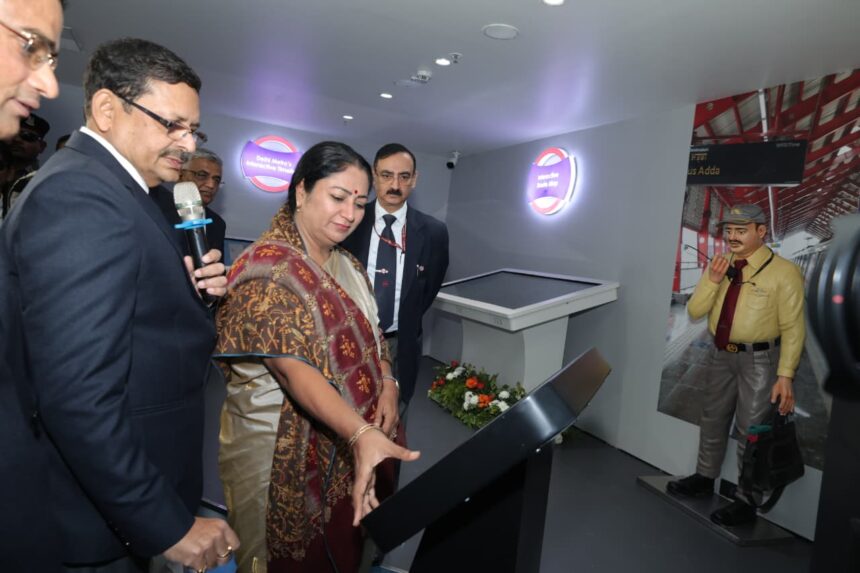
Delhi Chief Minister Rekha Gupta on Wednesday inaugurated the state-of-the-art Delhi Metro Museum at the Supreme Court Metro Station, emphasizing the Metro’s critical role in reducing pollution, easing traffic congestion, and transforming public transport in the national capital. She described the Metro as a backbone of Delhi’s urban life, noting that it has significantly reduced reliance on private vehicles and contributed to a cleaner, greener, and more sustainable city.
Addressing the gathering, Gupta praised the Delhi Metro Rail Corporation (DMRC) for building a modern, efficient, and environmentally friendly public transport system. She said the Metro has not only eased daily commuting for millions but also provided a long-term solution to Delhi’s traffic and pollution challenges. “The Metro has helped decongest roads by reducing dependence on private vehicles, thereby playing an important role in pollution control,” she said.
Recalling the vision behind the project, the Chief Minister highlighted that when former Prime Minister Atal Bihari Vajpayee approved the Delhi Metro plan, few believed that India could successfully implement and operate such a large-scale urban rail system. “Vajpayee’s Metro vision has transformed Delhi’s lifestyle. Today, the Metro stands as a symbol of foresight, planning, and determination,” she said.
Gupta noted that Delhi now has an approximately 400-kilometre Metro network with 289 stations, serving 3.5–3.7 million passengers daily. She said this extensive system has made travel faster, safer, and more reliable, while supporting economic growth and environmental sustainability. The Chief Minister congratulated the DMRC team for completing three decades of the Metro’s journey and showcasing it through the newly inaugurated museum.
The inauguration was attended by Cabinet Minister Pankaj Kumar Singh, DMRC Managing Director Vikas Kumar, and other senior government and Metro officials. Gupta said the museum is not only a celebration of past achievements but also a platform to inspire future generations to learn about urban transport, engineering, and innovation. She described the Metro as a cornerstone of a “clean, green and self-reliant Delhi” and urged citizens to use public transport more frequently to help the capital achieve sustainable development.
Transport Minister Pankaj Kumar Singh said the importance of the Delhi Metro is most evident when quick and reliable commuting is needed. “The Metro has made commuting in the capital remarkably convenient and dependable,” he said, adding that the Metro stands as a proud symbol of modern infrastructure in New India and is a milestone in realizing Prime Minister Narendra Modi’s vision of ‘Viksit Bharat.’ He emphasized that the museum will document the evolution of the Metro as the lifeline of Delhi’s urban ecosystem.
*Key Features of the Metro Museum*
Spread over nearly 12,000 square feet, the museum has been designed on the lines of the world’s leading metro museums and features modern exhibition platforms and interactive experiences. The first phase includes more than 50 panels, exhibits, kiosks, and models showcasing the Metro’s 30-year journey.
Visitors can experience operating a Metro train through a realistic simulator. Working models of Tunnel Boring Machines (TBMs) and launching girders are on display, along with interactive digital screens explaining Metro construction and operations. Major attractions include a dedicated panel on ‘Metro Man’ E. Sreedharan, a mock Metro tunnel, and a model of the Operations Control Centre (OCC). Quiz screens, selfie points, and souvenir shops offer an engaging, educational, and entertaining experience.
The Metro Museum will open to the public from 19 December 2025, from 10 a.m. to 4 p.m., Tuesday to Sunday, and will remain closed on Mondays and public holidays. The entry fee has been set at a nominal ₹10 per person.