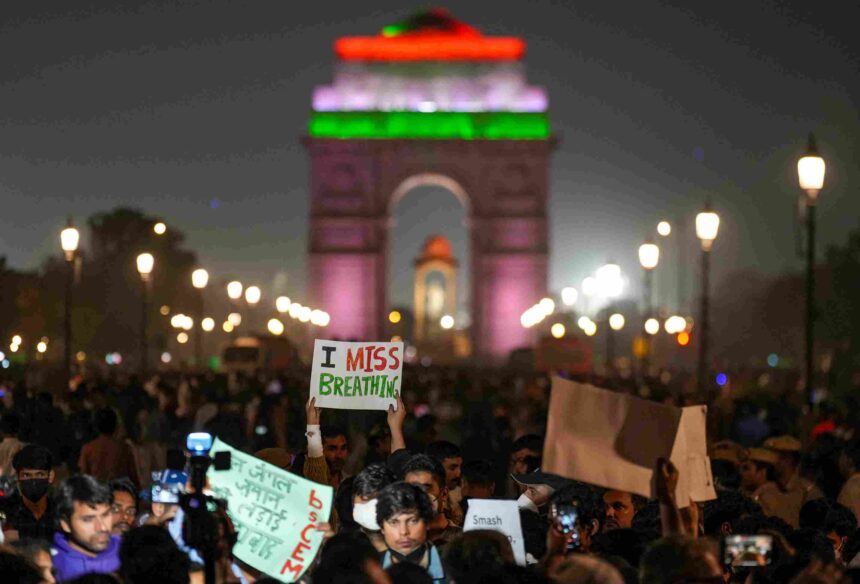
As Delhi continues to grapple with some of the worst air pollution levels in recent memory, citizens took to the streets and iconic public spaces to demand immediate government action and sustainable solutions. On a Sunday evening, scores of people gathered at India Gate, one of the capital’s most prominent landmarks, to protest against the deteriorating air quality. The demonstration highlighted widespread concern about public health, particularly for children, the elderly, and people with respiratory conditions, while simultaneously sparking debate over government responsibility and policy measures. Heavy police presence accompanied the protest, reflecting the authorities’ unease with mass public gatherings.
Citizens’ Protest at India Gate and Rising Public Awareness
The protest at India Gate unfolded against a backdrop of alarming air quality data, which had already prompted several health advisories for residents. Delhiites expressed frustration with the persistent smog and toxic air that has enveloped the city for weeks, noting the cumulative health impacts, particularly for vulnerable populations. Protesters claimed that the government had failed to implement long-term measures to curb pollution, and many highlighted the need for stricter regulations on vehicular emissions, industrial smoke, and the seasonal burning of crop residues in neighboring states.
Participants, including students, parents, and local residents, gathered peacefully, holding placards and banners urging authorities to prioritize public health over political agendas. Several attendees emphasized that children were among the most affected, with rising cases of asthma, allergies, and other respiratory illnesses documented in recent months. The protesters underscored the urgency of protecting future generations from prolonged exposure to hazardous air.
Despite the peaceful nature of the demonstration, police intervened, citing the lack of prior permission for the gathering. Multiple people were detained and taken into custody, with video footage circulating on social media showing law enforcement escorting citizens into police vehicles. Some protesters reported threats of FIRs, while police maintained that they were enforcing standard procedures to manage public order.
The protest sparked discussions online and in mainstream media about the right to civic participation and the responsibility of authorities to balance public safety with citizens’ demands for environmental accountability. Many citizens highlighted that their gathering was not politically motivated, but rather a collective call for urgent action to ensure breathable air in the capital.
Government Response and Policy Debate
Delhi’s Environment Minister, responding to the protests, asserted that the city’s air had been deteriorating continuously over the past decade, blaming previous administrations for neglect and ineffective policies. He stressed that the current government aimed to implement stronger measures to address pollution, safeguard public health, and establish long-term monitoring and control systems.
Experts have noted that Delhi’s pollution arises from multiple sources, including vehicular emissions, industrial activity, construction dust, and seasonal stubble burning in surrounding regions. The combination of these factors, coupled with climatic conditions in winter, leads to persistent smog and hazardous air quality levels. The recent protests emphasized the citizens’ call for immediate interventions, such as stricter vehicular regulations, enforcement of industrial emission standards, and collaboration with neighboring states to prevent crop residue burning.
The demonstrations also highlighted growing public engagement and environmental consciousness. Citizens increasingly monitor air quality using digital tools, advocate for policy changes, and participate in awareness campaigns. The India Gate protest symbolized a larger movement in which residents refuse to passively endure the consequences of pollution, demanding tangible action from policymakers.
Health concerns formed the core of the protest narrative, with participants emphasizing the severe impacts on children and the elderly. Rising respiratory illnesses, decreased lung capacity, and other long-term health effects were cited as urgent reasons for immediate intervention. Protesters demanded that the government enforce stricter environmental standards, invest in clean energy, and implement traffic management measures to reduce vehicular emissions.
At the same time, the protest revealed broader societal debates about accountability and governance. Citizens questioned the efficacy of existing pollution control boards and air quality monitoring mechanisms. They highlighted the need for a holistic approach that integrates urban planning, transportation policy, and industrial regulation. Environmental groups participating in the protest stressed the importance of sustained public pressure to ensure that air quality remains a priority for successive administrations.
The events at India Gate also served as a reminder of the intersection between civic rights and public health. While authorities enforced regulations regarding public gatherings, protesters argued that their right to assemble peacefully and demand a safe environment is fundamental. The standoff illustrated the delicate balance governments must strike between law enforcement and facilitating civic activism, particularly when urgent health concerns are at stake.
The protest at India Gate has already triggered discussions among policymakers, environmentalists, and the public. Advocates argue that short-term measures, such as restrictions on construction and the use of certain fuels, should be complemented by long-term strategies that reduce dependency on polluting energy sources. Citizens also called for educational campaigns to raise awareness about individual actions that can mitigate air pollution, such as adopting public transportation, reducing vehicle use, and supporting renewable energy initiatives.
In addition to governmental responsibility, the protests highlighted the role of media in shaping public perception. Videos and reports from India Gate circulated widely on social media, drawing attention to both the severity of pollution and the response of law enforcement. Citizens leveraged these platforms to amplify their message, mobilizing wider participation and fostering debate on environmental justice.
The India Gate demonstration underscored the urgent need for systemic changes in urban environmental policy. Protesters stressed that without comprehensive reforms, Delhi’s residents would continue to face severe health risks and declining quality of life. The movement also reflected growing civic awareness, illustrating that communities are increasingly unwilling to tolerate environmental degradation and are prepared to hold governments accountable.