Publication chronicles a century of legislative evolution; Delhi Assembly sets benchmark in digital governance and sustainability
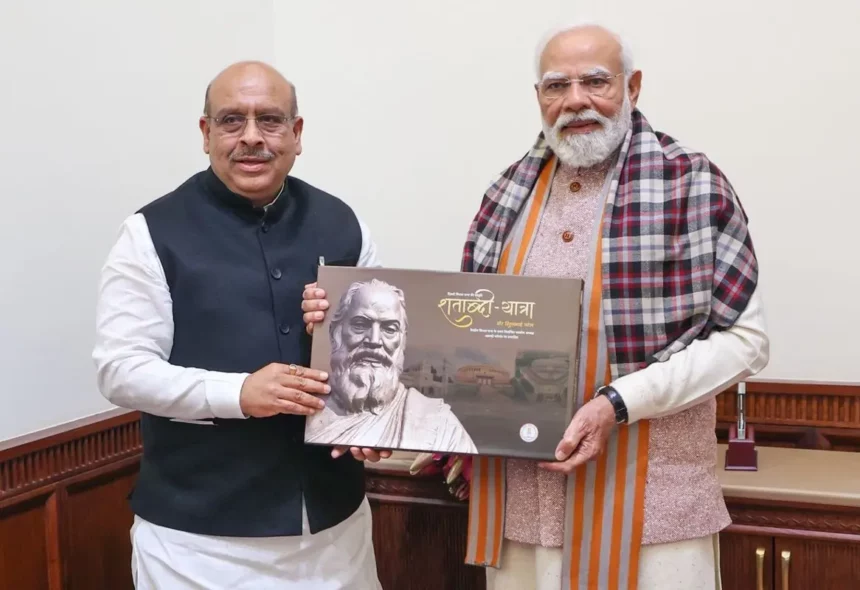
New Delhi, 12 December 2025: The Speaker of the Delhi Legislative Assembly, Vijender Gupta, called on Prime Minister Narendra Modi at the Prime Minister’s Office in Parliament House on Friday, presenting a specially curated Coffee Table Book titled “Delhi Legislative Assembly presents Shatabdi-Yatra, Veer Vithalbhai Patel.” The publication is dedicated to Veer Vithalbhai Patel, the first Indian elected Speaker of the Central Legislative Assembly, and traces India’s parliamentary journey from 1925 to 2025.
The Coffee Table Book serves as a historical record, compiling rare archival photographs, official documents, and defining moments that have shaped Indian democracy over a century. A notable section highlights the 2025 All India Speakers’ Conference, held to commemorate 100 years since Veer Vithalbhai Patel became the first Indian Speaker of the Central Legislative Assembly, a milestone that laid the foundation for India’s modern parliamentary traditions.
During the interaction, Gupta briefed the Prime Minister on the operational status of the Audit Para Monitoring System (APMS) within the Government of the National Capital Territory of Delhi. This system makes Delhi arguably the first State Assembly in India to implement a comprehensive real-time audit monitoring portal, enhancing transparency and accountability.
Gupta also discussed transformative initiatives undertaken by the Delhi Assembly, including the National e-Vidhan Application (NeVA), which has enabled the legislature to function as a fully digital and paperless House. He highlighted the Assembly’s successful conversion into a fully solar-powered, green legislature, reflecting the government’s commitment to sustainable governance.
Speaking on heritage preservation, Gupta shared that the Delhi Legislative Assembly is set to be developed as a distinguished Heritage Site, aimed at conserving its rich democratic legacy for future generations. The initiative will allow the general public to access and experience the institution’s historical journey and its enduring role in strengthening India’s democratic framework.
Emphasising India’s progress under Prime Minister Modi’s leadership, Gupta stated that the country is setting new benchmarks in democratic values, good governance, technological adoption, and global cooperation. He noted that these initiatives demonstrate the government’s commitment to a prosperous, self-reliant, and developed India.
Officials noted that the Coffee Table Book not only commemorates a century of parliamentary history but also reflects India’s evolving democratic ethos, blending tradition with innovation. The publication is expected to serve as both a scholarly resource and a symbol of the Delhi Assembly’s dedication to transparency, sustainability, and public engagement.
The meeting underscored Delhi Assembly’s continuous efforts to integrate technology, heritage preservation, and citizen engagement into legislative processes, positioning the institution as a model for state legislatures across the country.
Gupta concluded by highlighting that the Assembly’s initiatives are aligned with the vision of a modern, inclusive, and accountable democracy, and reaffirmed the commitment to maintaining India’s parliamentary legacy for generations to come.