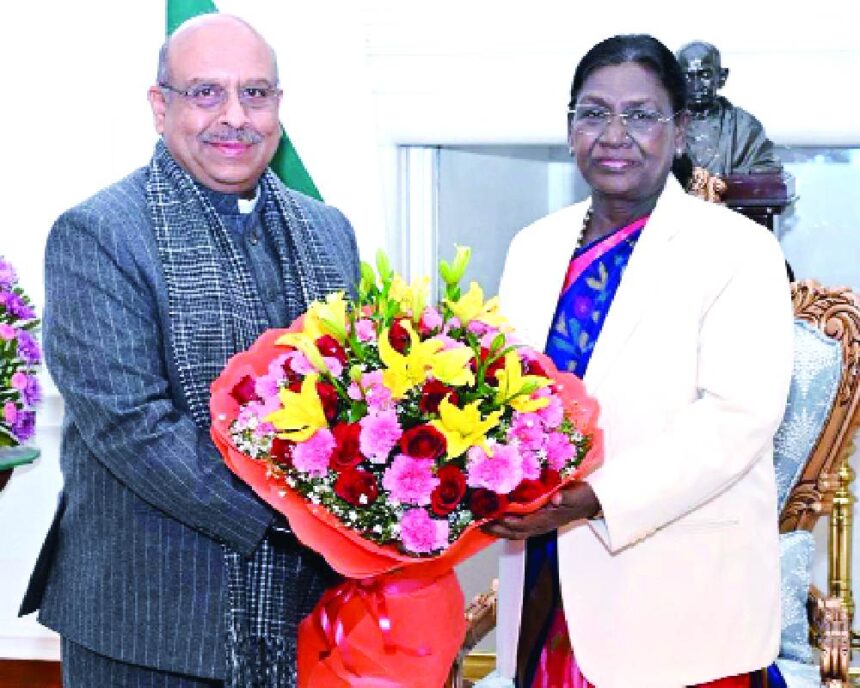
New Delhi, December 24, 2025:
Delhi Legislative Assembly Speaker Vijender Gupta, accompanied by eminent Jain spiritual leader Aryika Purnamati Mataji, paid a courtesy visit to President of India Droupadi Murmu at Rashtrapati Bhavan on Tuesday. The meeting provided an opportunity to reflect on the ethical foundations of public life as well as the ongoing institutional reforms being undertaken by the Delhi Legislative Assembly to strengthen transparency, efficiency, and accountability in governance.
During the interaction, Aryika Purnamati Mataji, a respected Jain spiritual leader who took spiritual initiation from Acharya Vidyasagar Ji Maharaj, shared her reflections on the moral and ethical dimensions of public service. She emphasised that values such as self-discipline, compassion, restraint, and moral clarity are essential for those entrusted with public responsibility. Mataji underlined that ethical conduct and inner discipline form the backbone of credible and people-oriented governance, and conveyed her blessings to President Droupadi Murmu for her service to the nation.
The President listened attentively to the spiritual leader’s reflections, which highlighted the relevance of ancient ethical principles in contemporary public administration and leadership. The exchange underscored the importance of integrating moral values with institutional frameworks to ensure responsible and transparent governance.
Speaker Vijender Gupta also briefed the President on several key institutional initiatives being implemented by the Delhi Legislative Assembly. He apprised her of the Assembly’s efforts to modernise its functioning while preserving its democratic legacy. Gupta explained that a series of reforms are underway to enhance transparency, improve legislative efficiency, and strengthen accountability mechanisms within the Assembly.
Among the major initiatives highlighted was the implementation of the National e-Vidhan Application (NeVA), which has enabled the Delhi Legislative Assembly to function as a fully digital and paperless House. The transition to a paperless legislative system, Gupta said, has streamlined legislative processes, improved access to information for members, reduced procedural delays, and contributed to environmental sustainability by significantly cutting down paper usage.
The Speaker also informed the President about the Assembly’s move towards becoming a completely solar-powered legislature. He said the transition to renewable energy reflects a strong commitment to sustainable governance and environmental responsibility. By adopting solar power for its operations, the Delhi Legislative Assembly aims to reduce its carbon footprint and set an example for other public institutions to follow in the pursuit of green and energy-efficient practices.
In addition, Vijender Gupta briefed the President on ongoing efforts to develop the Delhi Legislative Assembly complex as a Heritage Site. He said the initiative seeks to preserve the Assembly’s rich democratic legacy while opening its historic premises to the public in a structured manner. The project aims to raise public awareness about parliamentary traditions, democratic values, and the history of legislative governance in the national capital, while ensuring the conservation of the building’s architectural and historical significance.
The Speaker further noted that strengthening audit mechanisms and institutional oversight remains a priority for the Assembly. Enhanced audit processes are being put in place to ensure greater financial transparency and accountability, reinforcing public trust in legislative institutions.
President Droupadi Murmu appreciated the initiatives presented during the meeting and acknowledged the sustained efforts of the Delhi Legislative Assembly and the Delhi Government towards institutional reform and modernisation. She commended the focus on digital transformation, environmental sustainability, and heritage preservation, noting that such measures contribute to more transparent, efficient, and citizen-friendly governance.
The President also recognised the importance of ethical leadership and moral values in public life, as highlighted during the interaction. She observed that combining technological advancement with ethical responsibility is essential for strengthening democratic institutions and ensuring that governance remains responsive to the needs and aspirations of citizens.
The courtesy visit was seen as a meaningful engagement that brought together perspectives on ethical leadership and institutional innovation. It highlighted the Delhi Legislative Assembly’s commitment to reform-driven governance while reaffirming the enduring relevance of moral values in public administration.