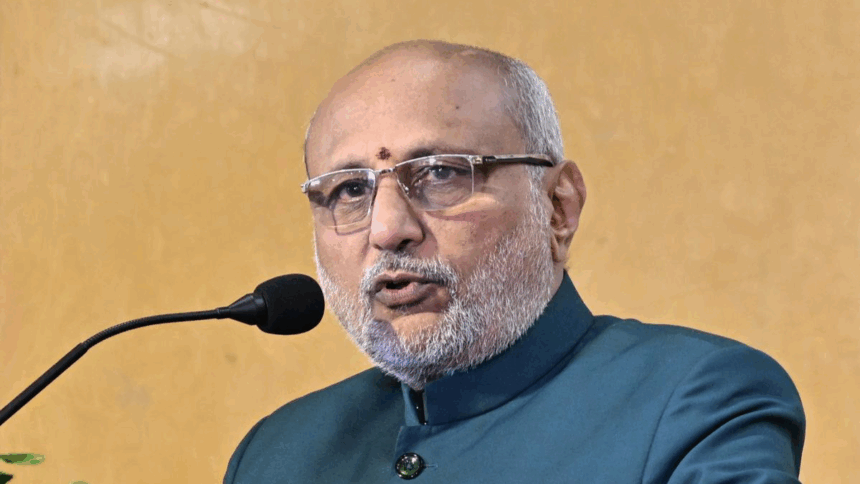
India witnessed a moment of constitutional importance on Friday as CP Radhakrishnan, the National Democratic Alliance’s (NDA) nominee, formally assumed office as the country’s Vice President. In a ceremony steeped in tradition and democratic symbolism, President Droupadi Murmu administered the oath of office, marking the beginning of CP Radhakrishnan’s tenure as the second-highest constitutional authority in India. His election and swearing-in not only reflect the arithmetic of parliamentary politics but also highlight the undercurrents of shifting alliances and cross-party voting, which fueled speculation in New Delhi’s political circles. For CP Radhakrishnan, who was declared the winner earlier this week after defeating opposition nominee and former Supreme Court judge B Sudershan Reddy, the occasion marked the pinnacle of a political journey rooted in ideology, perseverance, and steady leadership.
The swearing-in and its symbolism
The oath-taking ceremony was held with customary dignity and gravitas, drawing the presence of top political leaders, lawmakers, and dignitaries from across the spectrum. Among those in attendance was former Vice President Jagdeep Dhankhar, who made his first public appearance since stepping down from office. The presence of Dhankhar, who handed over the mantle of the Vice President’s role, lent continuity to the occasion, symbolizing the unbroken chain of constitutional responsibility.
CP Radhakrishnan’s elevation as the Vice President makes him the fifteenth individual to hold the prestigious office since India’s independence, a position that carries dual significance: not only as the second-highest authority in the constitutional hierarchy but also as the ex-officio Chairman of the Rajya Sabha, the Upper House of Parliament. The Vice President’s role, while ceremonial in some respects, plays a pivotal part in ensuring the smooth functioning of parliamentary democracy, especially in times of political turbulence.
CP Radhakrishnan’s journey to this moment reflects decades of political engagement and loyalty to the ideology of the Bharatiya Janata Party (BJP) and its larger coalition, the NDA. His victory in the election held earlier this week was resounding. Out of the total votes cast, CP Radhakrishnan secured 452, comfortably defeating the Opposition’s candidate, former Supreme Court judge B Sudershan Reddy, who managed to garner 300 votes. The scale of CP Radhakrishnan’s win underscored not only the numerical dominance of the NDA in Parliament but also revealed unexpected support that extended beyond official party lines.
The NDA, on paper, commanded the backing of 427 Members of Parliament, a comfortable margin to ensure victory. However, when the votes were tallied, CP Radhakrishnan had polled 14 votes more than expected. Reports suggested that 11 MPs from the Yuvajana Sramika Rythu Congress Party (YSRCP), a regional force with a significant presence in Andhra Pradesh, had chosen to support him. More intriguingly, the three additional votes sparked speculation of cross-voting from opposition ranks, pointing to possible fractures in the unity of the INDIA bloc, the coalition of opposition parties that had rallied behind B Sudershan Reddy. This cross-voting episode has become a talking point in the aftermath of the election, hinting at the fluid nature of India’s parliamentary dynamics.
Prime Minister Narendra Modi, who was among the first to congratulate the Vice President-elect after the results were declared, reiterated his confidence in CP Radhakrishnan’s ability to strengthen India’s constitutional values and democratic traditions. Modi’s words reflected both political endorsement and an expectation that CP Radhakrishnan, as the presiding officer of the Rajya Sabha, would play a constructive role in ensuring the Upper House remains a forum of debate, legislation, and consensus-building.
CP Radhakrishnan’s election and the political undertones
CP Radhakrishnan’s election to the Vice President’s office carries implications that extend beyond ceremonial prestige. In the immediate sense, his victory is a reaffirmation of the NDA’s legislative strength and its ability to push through critical elections in Parliament despite opposition mobilization. More subtly, it highlights the erosion of unanimity within the opposition bloc, a challenge that has dogged anti-BJP parties in recent years. The cross-voting incident, though numerically minor, carries symbolic weight, as it suggests that despite attempts at unity, fault lines persist among opposition lawmakers.
The choice of CP Radhakrishnan as the NDA candidate also reflects the ruling alliance’s strategy of projecting leaders who combine loyalty, experience, and the ability to command respect across political divides. Unlike some of the more polarizing figures in contemporary politics, CP Radhakrishnan has cultivated an image of being measured, accessible, and grounded in constitutional propriety—qualities that are essential for the office of Vice President, especially given the responsibility of moderating debates and ensuring order in the Rajya Sabha.
The political context of his election also deserves attention. India’s Parliament, in recent years, has witnessed frequent disruptions, heated confrontations, and a growing polarization between treasury benches and the opposition. In this environment, the role of the Rajya Sabha Chairman becomes all the more critical. CP Radhakrishnan will be tasked with balancing the need for robust debate with the imperative of maintaining decorum, a challenge that his predecessor Jagdeep Dhankhar also grappled with during his tenure.
In addition, his victory has reinforced the NDA’s narrative of stability and predictability in leadership choices. By fielding a candidate who was not only electorally viable but also symbolically resonant, the alliance sought to consolidate its hold on the narrative of governance. The opposition, despite putting up a respected figure in Sudershan Reddy, could not overcome the arithmetic of parliamentary politics, highlighting the structural disadvantage faced by non-NDA parties in electoral contests within the legislature.
CP Radhakrishnan’s assumption of office comes at a time when India is navigating complex domestic and international challenges. Domestically, the government faces the task of pushing through economic reforms, managing coalition politics in states, and responding to demands for greater inclusivity in governance. Internationally, India’s growing role on the world stage requires political stability at home and a robust parliamentary democracy that projects confidence and resilience. As Vice President, CP Radhakrishnan will contribute to this framework, not through executive power but through the institutional strength of the office he now occupies.
The presence of cross-voting in the election has also sparked a broader debate about the effectiveness of party whips and the ability of political alliances to maintain discipline. While the numbers did not alter the outcome, the episode has been interpreted by analysts as a sign of underlying discontent within opposition ranks. For the NDA, it has provided an opportunity to claim that its appeal extends beyond its formal allies, suggesting a degree of confidence in its ability to influence even adversarial spaces.
CP Radhakrishnan’s swearing-in thus represents more than just a constitutional ritual. It is a snapshot of India’s current political landscape—dominated by the NDA, challenged by a fragmented opposition, and shaped by the dynamics of parliamentary democracy. His tenure as Vice President will be closely watched not only for how he manages the affairs of the Rajya Sabha but also for the role he plays in upholding the delicate balance between government and opposition in one of the world’s most vibrant democracies.