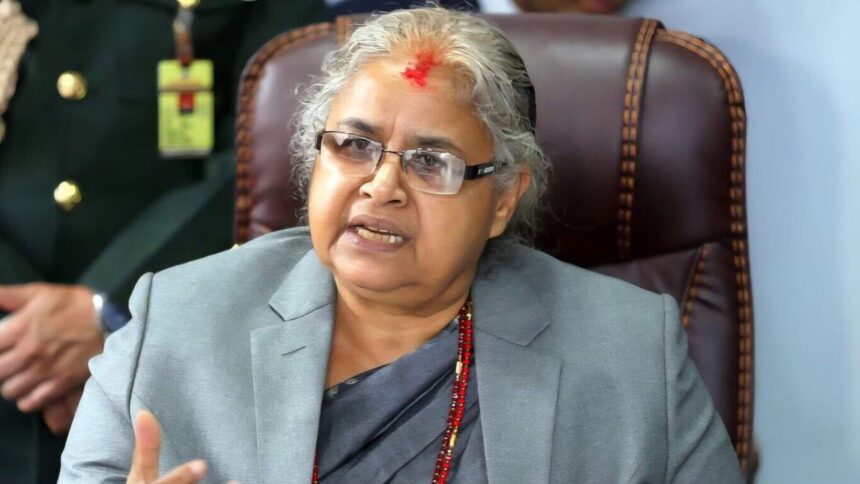
Minister KP Sharma Oli to resign, clearing the way for the possible appointment of former Chief Justice Sushila Karki as the country’s interim prime minister. Sushila Karki, who made history in 2016 as the first woman to lead Nepal’s Supreme Court, now stands at the center of the country’s rapidly evolving political crisis, backed by protesters who have made her their top choice to guide the nation through this uncertain transition. Her likely appointment is being hailed as not only a victory for democratic movements but also a symbolic moment in Nepal’s political history, one shaped by popular anger against the state and the assertive voice of the younger generation.
The situation in Nepal escalated earlier this week after the government introduced a controversial ban on major social media platforms, sparking outrage among students and young professionals. What began as scattered demonstrations soon transformed into a massive nationwide uprising, largely driven by Gen Z activists who used alternative channels and underground networks to mobilize support. Within hours, the protests grew violent, resulting in the deaths of at least 31 people and injuries to more than 1,033 others, according to reports. Despite the government’s swift reversal of the ban, the demonstrations did not stop; instead, they gathered momentum, targeting deeper political frustrations with corruption, lack of accountability, and a ruling elite seen as increasingly detached from public needs. The mounting pressure ultimately forced Oli to resign after protesters stormed government offices and set ablaze the residences of lawmakers.
Against this backdrop of turmoil, Sushila Karki’s name suddenly emerged as a consensus figure. According to sources cited by Reuters, Nepal’s President Ramchandra Paudel and army chief Ashok Raj Sigdel consulted constitutional experts and political leaders before settling on Sushila Karki as the frontrunner for the interim prime ministership. The decision is expected to be formalized following a crucial meeting at the President’s residence in Kathmandu. A source close to the youth movement said: “They want her. This will happen today,” underlining the decisive role played by Gen Z in shaping the choice of leadership.
A Judge Who Defied Political Pressure
Sushila Karki’s rise to this moment is marked by both controversy and resilience. Born on June 7, 1952, in Biratnagar, Morang district, she was educated in Nepal and India before rising through the ranks of Nepal’s judiciary. After graduating from Mahendra Morang College in Biratnagar, she earned a Master’s degree in Political Science from Banaras Hindu University in Varanasi, followed by a law degree from Tribhuvan University in Kathmandu. In 2016, she became the first woman to be appointed as Chief Justice of Nepal, a historic milestone that underscored her reputation as a strong and principled jurist.
Her tenure, however, was cut short under contentious circumstances. In 2017, just months before her scheduled retirement, Sushila Karki was removed from her position by then-Prime Minister Pushpa Kamal Dahal “Prachanda” and a large bloc of lawmakers. Critics at the time alleged that her removal was politically motivated, an attempt to silence a Chief Justice who had demonstrated an independent streak and refused to bow to party interests. The controversy left a lasting mark on Nepal’s judiciary and fueled debates about political interference in judicial institutions.
Today, that very history is being reinterpreted by the public and protesters as evidence of her integrity and willingness to stand against entrenched political powers. For many in Nepal, especially among the younger generation, Sushila Karki represents a figure of resistance and accountability, qualities seen as crucial in the current climate of anger toward the ruling class. Her education in India, particularly at Banaras Hindu University, also adds an element of cross-border familiarity that resonates with many Nepalis who share cultural and educational ties with India. In a recent interview, she nostalgically recalled her student days, saying she still remembers her late teachers, friends, and the river Ganga flowing near her hostel, a reflection of her longstanding connection to India.
In a symbolic twist, the woman who was once ousted by the political establishment is now being called upon to take charge of the very system that tried to marginalize her. If appointed, Sushila Karki would not only be the first woman to hold the office of Nepal’s prime minister but also a leader chosen directly in response to a popular uprising, rather than through the usual partisan negotiations.
The Power of Gen Z in Nepal’s Political Transition
The momentum behind Sushila Karki’s candidacy cannot be understood without examining the extraordinary role played by Nepal’s younger generation. The protests that erupted on Monday were triggered by a ban on social media sites, but they quickly became about far more than internet access. For Gen Z activists, who make up a significant portion of Nepal’s population, the government’s decision symbolized the larger failures of leadership: corruption, unemployment, lack of opportunities, and suppression of free expression.
Protesters demonstrated remarkable organization and resilience despite violent crackdowns. Videos circulating online showed groups of young people shielding each other from police batons, chanting slogans calling for accountability, and using encrypted communication apps to coordinate movements. Government buildings were set ablaze in symbolic defiance, and the homes of prominent lawmakers were attacked, underscoring the depth of public anger.
Faced with unrelenting pressure, KP Sharma Oli’s resignation became inevitable. His leadership, already tarnished by accusations of authoritarian tendencies and mishandling of past crises, could no longer withstand the groundswell of opposition. In this vacuum, the protesters began searching for a figure who could represent both moral authority and neutrality. The secretary of the Supreme Court Bar Association was consulted, and in a nearly four-hour virtual meeting, protesters debated potential candidates. Kathmandu’s mayor, Balen Shah, known for his populist style and independent streak, was initially considered. Yet when votes were counted, it was Sushila Karki who emerged as the clear choice, seen as someone above the fray of party politics and with the credibility to oversee a transitional government.
For many observers, this marks an extraordinary shift in Nepal’s political culture. Traditionally, the prime ministership has been dominated by figures from established political parties, often chosen through opaque backroom deals. The rise of Sushila Karki as a frontrunner, propelled by a youth-led movement, reflects a grassroots demand for change that transcends party lines. It also highlights the increasing political agency of Gen Z in South Asia, where youthful populations are becoming vocal about governance and accountability.
The appointment of Sushila Karki, if finalized, is expected to usher in a period of cautious optimism. Yet challenges remain immense. Nepal is still grappling with economic instability, unemployment, and lingering political rivalries among its major parties. The interim government will have to navigate the delicate task of restoring stability while also responding to the demands of protesters who want more than just symbolic change. Nonetheless, the symbolism of Sushila Karki’s potential appointment—a former chief justice ousted by political powers, now returning as prime minister with the backing of the people—marks an unprecedented chapter in Nepal’s democratic journey.