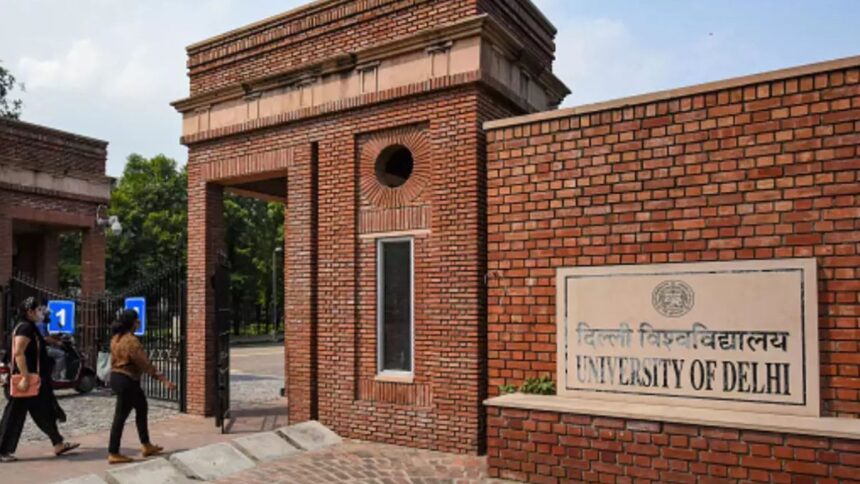
The recent decision to name a new Delhi University (DU) college in Najafgarh after Veer Savarkar, a prominent Hindutva ideologue, has sparked intense controversy. The controversy traces back to a 2021 decision by the DU Executive Council, which proposed naming the college after Veer Savarkar, along with other suggestions. The matter has become a flashpoint for political debate and public discourse, particularly in light of Veer Savarkar’s divisive role in Indian politics.
On January 3, as Prime Minister Narendra Modi was set to lay the foundation stone for the Veer Savarkar College, political tensions flared up. The National Students Union of India (NSUI), the student wing of the Congress, raised a demand to rename the college after former Prime Minister Manmohan Singh, who passed away the previous month. This move further fueled the debate and polarized opinions across political and social circles.
The decision to name the college after Veer Savarkar has been called into question by various teachers and members of the university community, some of whom claim that the decision was made without proper consultation. Seema Das, a political science teacher at Hindu College and a member of the DU Executive Council in 2021, stated that the decision was taken with little discussion. She claimed that the majority of council members agreed to the name without addressing the concerns raised by those who felt that the name of an educational institution should be apolitical and ideally associated with figures who contributed significantly to education. She also mentioned that members had protested the naming decision, advocating for the inclusion of educationists rather than political figures like Veer Savarkar.
However, the acting Vice-Chancellor at the time, PC Joshi, who had the final say on the matter, denied any significant protests and asserted that any dissent was not recorded in the minutes of the meeting. He emphasized that, during the council meeting in August 2021, four names were presented and given in-principle approval: Sushma Swaraj, Arun Jaitley, Swami Vivekananda, and Veer Savarkar. Joshi explained that the decision to choose these names came after discussions about creating facilitation centers in various parts of Delhi, with the goal of providing administrative support for students living in far-flung areas. He added that Veer Savarkar’s name was chosen alongside other figures who had left a significant impact on Indian politics and society.
While some members of the council voiced opposition to Veer Savarkar’s inclusion, Joshi maintained that the decision was a collective one. Prof. Abha D Habib, secretary of the Democratic Teacher’s Front, criticized the decision, saying that Veer Savarkar was a controversial figure who was not a national leader or a reformer. She argued that an educational institution’s name should reflect the contributions of thinkers and educators who inspired future generations, not political figures with divisive legacies.
The naming controversy is not the only issue facing the project. The college, estimated to cost Rs 140 crore, will be built on 16.35 acres of land in Najafgarh and will feature classrooms, faculty rooms, and other amenities aimed at serving students from the outskirts of Delhi. Along with the Najafgarh campus, Prime Minister Modi also laid the foundation stones for two other DU campuses in East and West Delhi, further emphasizing the need for greater accessibility to higher education for students in Delhi’s suburban areas.
Despite the political ramifications, the construction of the Veer Savarkar College is set to continue. However, the ongoing debates surrounding the naming of the college are expected to persist, as the issue touches upon broader questions of educational values, political affiliations, and the influence of historical figures on modern institutions. As the controversy unfolds, the university community, political parties, and the public continue to express their opinions, and the final resolution of the naming dispute remains uncertain.