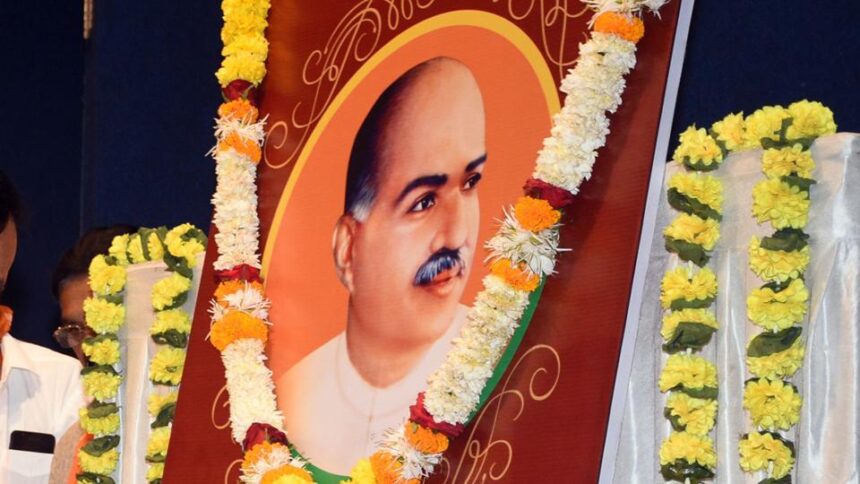
On the 71st death anniversary of Syama Prasad Mookerjee, tributes poured in from across the political spectrum, led by Prime Minister Narendra Modi, who lauded the late leader’s courage and commitment to national integrity. Syama Prasad Mookerjee, the founder of the Bharatiya Jana Sangh and a vocal critic of Article 370, remains a deeply symbolic figure in the BJP’s ideological history. His death in custody in 1953, following his arrest during a protest against Kashmir’s special status, is remembered as a moment that galvanized nationalist sentiment in post-independence India.
National Tributes for a Symbol of Unity
Prime Minister Modi took to X (formerly Twitter) to honour Dr Mookerjee, calling his contribution to India’s unity “invaluable” and his courage “incomparable.” “He displayed unmatched commitment to safeguarding the country’s integrity. His contribution to nation-building will always be remembered,” the PM wrote.
Echoing similar sentiments, BJP National President and Union Minister J.P. Nadda described Syama Prasad Mookerjee as a “blessed son of Mother India” and praised him for keeping the flames of cultural nationalism alive. Nadda highlighted Syama Prasad Mookerjee’s ideological battle to ensure Jammu & Kashmir and West Bengal remained integral parts of India, and for offering a new political vision through the formation of the Bharatiya Jana Sangh.
Union Minister Nitin Gadkari also shared his homage, calling Syama Prasad Mookerjee’s life a story of sacrifice. “He gave up power for the unity of the nation. His sacrifice will always be honoured,” Gadkari posted.
Uttar Pradesh Chief Minister Yogi Adityanath recalled Syama Prasad Mookerjee’s famous slogan: “Nahi chalengey ek desh mein do Vidhan, do Pradhan aur do Nishan” (There cannot be two constitutions, two prime ministers, and two flags in one country). He hailed Syama Prasad Mookerjee’s death as an eternal inspiration for all Indians.
Legacy Rooted in Kashmir Movement
Dr Mookerjee’s arrest on May 11, 1953, came as part of a Satyagraha campaign opposing Article 370, which at the time required Indian citizens to obtain a permit to enter Jammu and Kashmir. Syama Prasad Mookerjee defied the law to enter the state without a permit, leading to his arrest and eventual death in custody on June 23. His demise led to nationwide outrage and remains a focal point in the BJP’s historical narrative.
Syama Prasad Mookerjee’s opposition to Article 370 was both political and ideological. He equated the provision with what he described as the “Balkanisation of India” and compared it to the divisive “three-nation theory” propagated by Sheikh Abdullah. According to BJP’s official account, Syama Prasad Mookerjee’s death solidified the party’s commitment to full integration of Jammu and Kashmir with the rest of India.
The slogan “Nahi chalengey do Vidhan, do Pradhan, do Nishan” became a rallying cry in BJP and RSS circles for decades, culminating in the eventual abrogation of Article 370 in 2019 under the PM Modi government.
Multiple political leaders used this occasion not only to remember Mookerjee’s personal sacrifice but also to highlight the ideological continuity from his legacy to the BJP’s present-day policies. His life, marked by intellectual activism and a refusal to compromise on national issues, continues to be referenced as foundational to the party’s identity and national discourse.