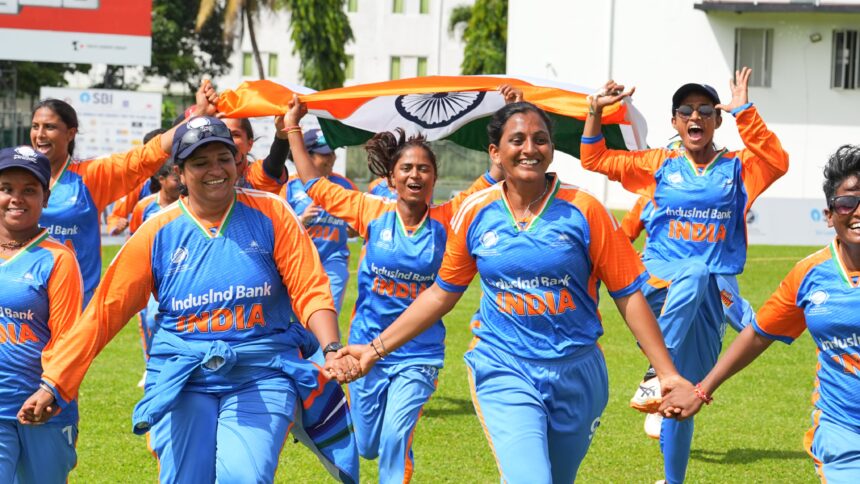
India’s blind women’s cricket team has scripted a historic chapter in international sport by winning the inaugural Women’s T20 World Cup for the blind after defeating Nepal by seven wickets in a commanding final in Colombo. Their victory, achieved through an unbeaten run across the tournament, reflects not only their technical superiority and discipline but also the rising stature of women’s blind cricket in India and across the world. The triumph marks a moment of national pride and signifies the transformative impact of structured investment, inclusive training models and enhanced competitive exposure for blind women athletes.
India’s Commanding Performance and the Journey to an Unbeaten Championship Victory
India entered the historic tournament with confidence, but what unfolded over the following matches was a level of dominance rarely seen in newly established world events. From their opening fixture to the knockout rounds, the Indian team displayed absolute clarity of purpose, technical composure and a powerful understanding of their roles within the squad. Every match became a demonstration of their tactical awareness, as they comfortably outperformed teams such as Sri Lanka, Australia, the United States and Pakistan. Their group-stage journey was built upon control, sharp decision-making and an acute mastery of blind-cricket fundamentals.
The final in Colombo amplified this dominance. Tasked with bowling first, India approached the innings with exceptional discipline, maintaining tight lines and ensuring that Nepal’s batters were denied momentum. Their fielding unit, often the defining strength in blind cricket, showcased agility and coordinated movement, enabling them to restrict Nepal to 114 for 5 in 20 overs. Every over demonstrated the team’s collective understanding of situational cricket. They mixed defensive containment with calculated aggression, allowing no space for Nepal to engineer partnerships that could have altered the rhythm of the game. The field placements were precise, the communication among the players was immaculate, and the bowling strategy combined consistency with tactical variation. It was evident that India had entered the final with a clear plan shaped by analysis and experience gained through the earlier stages of the tournament.
Chasing the target, India revealed yet another facet of their cricketing maturity. Their batting approach was assertive without being reckless. The top order adapted to the pace of the pitch quickly and played with intent, focusing on early boundaries, intelligent running and exploitation of Nepal’s field restrictions. The chase was completed in slightly more than 12 overs, with only three wickets lost, reflecting complete control and unwavering confidence. The innings did not rely on individual brilliance alone but on a collective understanding of pressure management, scoring patterns and strategic pacing. Batters showcased excellent judgment of lengths, anticipation of deliveries and the ability to maintain flow even when Nepal attempted to create pressure through field adjustments.
Throughout the tournament, India’s athletes displayed a sense of unity and resilience that strengthened their tactical edge. Their unbeaten campaign was shaped by structured preparation, exposure to competitive simulation, and a steady focus on mental conditioning. Blind cricket, by nature, demands impeccable auditory awareness, communication and coordination—areas where India excelled consistently. Their approach blended skill with instinct, resulting in performances that remained steady under pressure and adaptable to changing game conditions.
The win over Nepal, a rising force in blind women’s cricket, further highlighted India’s composure in high-stakes situations. Even against a team that had shown considerable improvement, India maintained its rhythm and executed every phase of the game with superior discipline. Their ability to manage expectations, handle nerves and convert opportunities was evident in every department, reinforcing the notion that this Indian side represents a new global benchmark for women’s blind cricket. The victory ultimately reflected years of developmental effort, rigorous training environments and the athletes’ relentless pursuit of excellence.
Significance of the Victory, Its Broader Impact, and the New Roadmap for Women’s Blind Cricket
India’s triumph is more than a landmark sporting achievement; it is a milestone in the evolution of disabled sports and inclusivity-focused athletics within the country. Winning the world title positions India not merely as a strong competitor but as the emerging global leader in women’s blind cricket. The success reflects the effectiveness of sports programs designed for visually impaired athletes and the increasing emphasis on creating a professional ecosystem that allows them to thrive.
In recent years, India has significantly strengthened its support structures for blind sportspersons, mirroring the advancements seen in para-sports. Enhanced access to trained coaches, specialised equipment, dedicated training grounds and structured selection pathways has expanded opportunities for talented blind athletes, particularly women, who often face social and infrastructural barriers to participation. The World Cup victory validates these investments and showcases how systematic nurturing of talent can generate world-class performance on the global stage.
The win also arrives at a crucial time when global attention towards inclusivity in sports is rising. India’s success in the tournament is likely to influence policymaking, funding models and grassroots initiatives, both domestically and internationally. With their flawless campaign, the team has demonstrated that blind women athletes are entirely capable of producing high-quality competitive cricket when provided with a supportive environment. This performance challenges outdated assumptions, shifts narratives, and broadens the definition of elite sports achievement.
On the global front, India’s triumph sends a strong message to other cricketing nations about the expanding scope of blind women’s cricket. Nepal’s presence in the final indicates that new cricketing nations are increasingly competitive, and India’s emphatic victory will push others to strengthen their training systems. As more countries attempt to elevate their standards, the sport is likely to gain international visibility, attract sponsors, and draw broader media attention. India’s win, therefore, contributes to strengthening the foundation of a sport that is still in its formative global phase.
Domestically, the impact is expected to be multidimensional. The victory will inspire young blind girls across the country to pursue cricket as a serious sporting aspiration. Schools, rehabilitation centres and regional training academies are likely to witness a rise in interest. Federations may receive greater encouragement to initiate age-level tournaments, specialised coaching programs and scholarship schemes to widen the talent pool. Corporate and government bodies may step forward to support athletes with sponsorships, training infrastructure and long-term career pathways.
The win may also strengthen India’s case for hosting future international blind cricket tournaments, which would further enhance visibility and participation. More importantly, it may influence sports administrators to integrate blind women’s cricket more effectively into mainstream structures, ensuring parity of opportunities and representation.
From a technical perspective, the victory highlights the effectiveness of India’s training methods that combine strategic planning, situational awareness and performance consistency. Coaches have emphasised holistic development—physical fitness, communication drills, audio-based reflex training, strategic cricketing insight and match pressure simulations. These elements have contributed significantly to the athletes’ confidence, enabling them to approach global competitions with readiness and clarity.
The success also reinforces the value of leadership within the team—captains, senior players and support staff have created an environment in which mutual trust, shared responsibility and emotional resilience are central. Blind cricket demands high levels of interpersonal connection because auditory signals, verbal cues and spatial coordination drive gameplay. India’s athletes have internalised this collaborative framework, which clearly manifested in their on-field execution throughout the World Cup.
The unbeaten campaign further showcases the potential of women’s blind cricket to grow as a structured, professionalised sport. With increased visibility from this landmark win, expectations will naturally rise—but so will the momentum. Stakeholders across the sporting ecosystem will look toward India not only as champions but as model architects of blind-women’s cricket development. This victory represents the beginning of a long-term transformation, signaling that women’s blind cricket is ready for bigger global platforms, deeper institutional support and broader recognition as a competitive, high-impact sport.