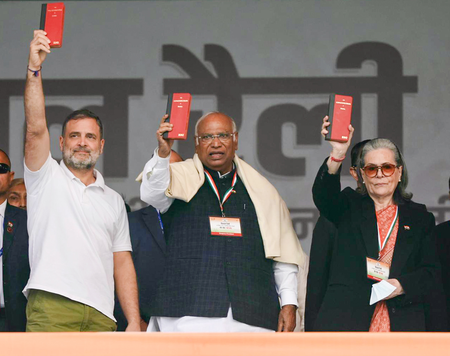
The Congress party staged a massive rally at Delhi’s Ramlila Maidan on Sunday to intensify its long-running “vote chori” campaign, with Rahul Gandhi accusing the BJP-led government of undermining constitutional democracy by allegedly manipulating electoral processes to retain power.
Taking his months-long political narrative to what he described as its decisive phase, Rahul Gandhi addressed a packed gathering in the national capital, raising sharp slogans against the ruling party and asserting that the Modi-led government survives not on popular mandate but on what he termed systematic theft of votes. The rally was organised to mark the culmination of the Congress party’s nationwide signature campaign on “vote chori”, and it brought together senior party leaders, chief ministers from Congress-ruled states, and thousands of party workers from across the country. The message from the stage was unambiguous: the Congress leadership believes the current electoral system is being compromised and that this alleged distortion of democracy will eventually lead to the removal of the BJP from power.
Rahul Gandhi framed the issue as a fundamental battle over the soul of Indian democracy. He claimed that the right to vote, enshrined in the Constitution drafted under the leadership of B.R. Ambedkar, was under direct attack. According to him, “vote chori” was not merely an election-related grievance but a deeper assault on constitutional values. Addressing the crowd, he asserted that while truth formed the ideological core of the Congress, vote theft had become part of the BJP’s political DNA. He also accused the Election Commission of India of acting under pressure from the ruling party, alleging that it was no longer functioning as an independent constitutional authority.
Rahul Gandhi’s attack on BJP, Election Commission, and the battle of ideas
In his speech, Rahul Gandhi sought to project confidence while simultaneously portraying the ruling leadership as defensive and insecure. He claimed that Prime Minister Narendra Modi had lost his confidence, arguing that this was visible in his expressions and public conduct. Rahul linked this perceived loss of confidence to the opposition’s repeated allegations of rigged elections, saying the BJP leadership knew that the truth about “vote chori” would eventually come out.
Referring to a recent confrontation in Parliament, Rahul recalled how he had challenged Home Minister Amit Shah to a debate over allegations of electoral manipulation raised in his press conferences. He alleged that Shah appeared visibly unsettled during that exchange in the Lok Sabha, interpreting it as a sign that the ruling party was uncomfortable with scrutiny. Rahul echoed comments made earlier by Priyanka Gandhi Vadra, claiming that the BJP’s anxiety stemmed from growing public awareness about alleged irregularities in elections.
The Congress leader placed the issue within a larger ideological framework, contrasting what he described as the BJP-RSS emphasis on power with the Congress’s emphasis on truth. He cited a reported statement by RSS chief Mohan Bhagwat, allegedly made during a visit to the Andaman and Nicobar Islands, that “the world recognises power, not truth.” Rahul used this claim to argue that the current political struggle in India was not merely electoral but philosophical, a contest between “satya and asatya”. Invoking phrases such as “Satyamev Jayate” and “Satyam Shivam Sundaram”, he sought to root the Congress’s argument in moral and cultural traditions, positioning his party as the defender of ethical politics.
Rahul argued that the BJP’s alleged manipulation of elections was driven by a desperation to win at any cost. According to him, the ruling party feared losing public support and therefore resorted to controlling institutions rather than convincing voters. He insisted that the Congress was prepared for a long struggle to protect democratic norms and restore faith in the electoral process. His speech repeatedly returned to the theme that power obtained through dishonest means could not be sustained indefinitely, and that the truth would ultimately prevail.
The rally also served as a platform to reinforce the Congress’s demand for accountability from the Election Commission. Rahul accused the poll body of selectively ignoring opposition complaints while acting swiftly on issues raised by the ruling party. He said that an institution meant to safeguard democracy had instead become, in his view, an enabler of unfair practices. These allegations drew loud applause from party workers, many of whom had travelled long distances to attend the rally.
Congress leadership united as party seeks to mobilise nationwide support
The scale and composition of the rally underscored the Congress party’s attempt to project unity and momentum ahead of future electoral battles. The dais at Ramlila Maidan featured a wide cross-section of the party’s leadership, including Congress president Mallikarjun Kharge and former party chief Sonia Gandhi. Chief ministers Siddaramaiah, Sukhwinder Sukhu, and Revanth Reddy were also present, signalling support from Congress-ruled states.
Several members of the Congress Working Committee and senior leaders, such as Ajay Maken, K.C. Venugopal, Sachin Pilot, Abhishek Singhvi, Gaurav Gogoi, and P. Chidambaram, attended the rally. Their presence was intended to convey organisational solidarity behind Rahul Gandhi’s campaign and to demonstrate that the “vote chori” narrative is not limited to one leader but has been adopted as a collective party position.
Mallikarjun Kharge, addressing the crowd earlier, praised Rahul Gandhi’s commitment to the campaign and highlighted personal sacrifices made by him in the course of political work. Kharge pointed out that Rahul had continued his political engagements even during personal family matters, portraying him as a dedicated leader fighting for democratic values. Other speakers echoed similar sentiments, accusing the BJP of betraying the nation’s democratic foundations and describing the ruling party as “gaddar” for allegedly undermining constitutional principles.
The rally was designed as both a show of strength and a symbolic conclusion to the Congress’s signature drive against alleged vote theft. Party leaders claimed that millions of citizens across the country had signed petitions expressing concern over electoral fairness. By bringing the campaign to the capital, the Congress sought to amplify its message nationally and attract greater media and public attention.
Throughout the event, speakers linked their allegations to broader concerns about institutional independence. They argued that democratic institutions, including the Election Commission, investigative agencies, and even sections of the judiciary, were under pressure from the executive. The Congress leadership maintained that the fight against “vote chori” was part of a wider struggle to preserve checks and balances within the system.
Rahul Gandhi concluded his address by reiterating that the opposition would continue to raise the issue relentlessly, both inside Parliament and on the streets. He asserted that the Congress was prepared for electoral battles at every level and would take its message directly to the people. According to him, public awareness and mobilisation were the only ways to counter what he described as the concentration of power and erosion of democratic norms under the current government.
The rally ended with chants of “vote chor, gaddi chhod”, echoing across Ramlila Maidan, as party workers waved flags and banners calling for the protection of democracy. For the Congress, the event marked a strategic moment in its political campaign, reinforcing its central accusation against the BJP while attempting to energise cadres ahead of upcoming political contests.