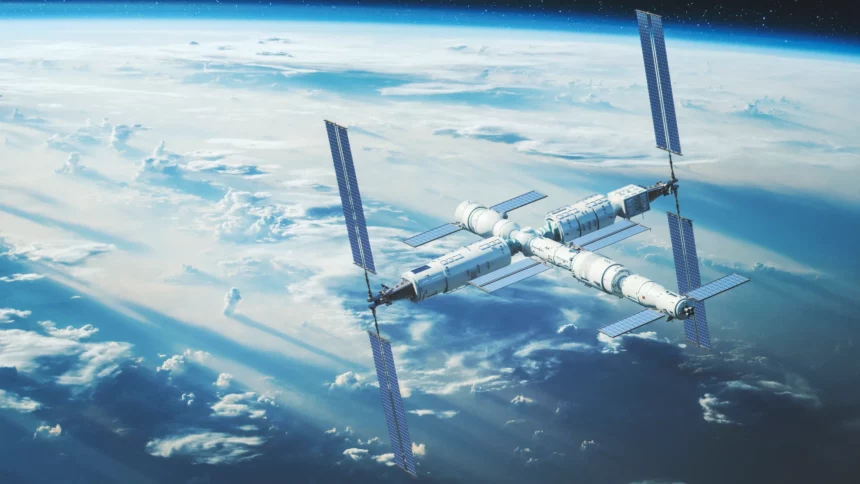
China has introduced a groundbreaking innovation aboard its Tiangong space station with the deployment of Wukong AI, the country’s first artificial intelligence chatbot designed to assist taikonauts in in-orbit missions. The AI system is intended to provide real-time support in navigation, tactical planning, and operational coordination, significantly enhancing the efficiency and safety of astronauts during their time in microgravity. The deployment of Wukong AI marks a key milestone in China’s manned space program, demonstrating its commitment to integrating advanced technology in human spaceflight. With international competition in space intensifying, especially from countries such as the United States and India, this step underscores China’s efforts to assert technological dominance in space exploration. According to Chinese media reports, the chatbot has already completed its first operational mission by assisting three taikonauts during a complex spacewalk, providing support in problem-solving, coordination, and real-time decision-making.
Wukong AI draws inspiration from the legendary Chinese character Sun Wukong, popularly known as the Monkey King, renowned for his intelligence, adaptability, endurance, and pursuit of knowledge. These traits are mirrored in the design philosophy of the AI system, which aims to anticipate challenges, adapt to mission-specific requirements, and provide critical guidance to the crew. The integration of Wukong AI represents a convergence of traditional Chinese cultural heritage with cutting-edge technology, emphasizing China’s distinctive approach to advancing its space program. Its arrival coincides with a period of heightened global activity in space, with the United States accelerating lunar projects, Russia advancing orbital infrastructure, and India developing indigenous capabilities, highlighting an increasingly competitive environment that necessitates innovation and precision in human spaceflight operations.
Wukong AI’s Design, Operational Capabilities, and Role in Space Missions
Wukong AI has been structured as a large language model (LLM) with dual modules designed to operate both onboard the space station and on Earth. The onboard module interacts directly with the crew, providing rapid guidance on technical challenges, operational procedures, and emergency protocols. Meanwhile, the ground module performs in-depth data analysis and supports mission control by continuously monitoring and interpreting the information relayed from the station. The integration of these two modules allows Wukong AI to function as an advanced AI assistant capable of offering comprehensive content and adaptive support tailored to each mission. According to Zou Pengfei of the taikonaut training center, the system not only improves operational efficiency but also enhances coordination between the space crew and ground teams, while providing in-orbit psychological support to taikonauts, a crucial factor in long-duration missions.
Wukong AI made its official debut aboard the Tiangong space station on July 15, 2025, following extensive training on aerospace flight data and fine-tuning by engineers specializing in space operations. The AI system’s training incorporated simulations of potential contingencies, ranging from navigation challenges to equipment malfunctions, ensuring that it could reliably assist crew members in real-time. Its first mission involved guiding three astronauts during a six-and-a-half-hour extravehicular activity (EVA), during which they installed protective devices against space debris and conducted routine inspections of the station. The AI’s ability to provide timely instructions and offer alternative solutions when unexpected situations arose was praised by the taikonauts, who noted its potential to reduce human error and enhance decision-making under pressure.
Beyond immediate operational support, Wukong AI is designed to assist in strategic mission planning and long-term operational management. By analyzing mission parameters, environmental conditions, and crew health indicators, the system can recommend optimal procedural adjustments to maximize efficiency and safety. Its real-time communication capabilities enable seamless interaction between the crew and ground control, ensuring that critical decisions can be made with full access to necessary data. Analysts suggest that the system represents a significant leap in China’s space technology, as it combines artificial intelligence, machine learning, and aerospace engineering into a single platform that actively augments human performance in extreme environments.
Strategic Implications for China’s Space Ambitions and Global Space Race
The deployment of Wukong AI aboard the Tiangong station is more than a technical milestone; it signals China’s strategic intent in the increasingly competitive landscape of space exploration. By integrating AI into human spaceflight, China enhances the safety, autonomy, and efficiency of its missions, positioning itself at the forefront of technological innovation in space operations. The Tiangong station, which functions as both a microgravity laboratory and a platform for in-orbit experimentation, now benefits from a digital crew member capable of assisting in both routine and emergency scenarios. The move highlights China’s broader ambitions to maintain sustained human presence in low Earth orbit, support long-duration missions, and develop infrastructure that can potentially serve as a hub for lunar or interplanetary missions in the future.
The introduction of Wukong AI comes amid a period of intensifying global space competition. NASA’s plans to build a nuclear reactor on the Moon, alongside Russia’s expansion of orbital capabilities and India’s growing manned space ambitions, reflect a regional and international race for technological supremacy. China’s emphasis on integrating AI into its space program provides a competitive edge by enhancing crew efficiency and decision-making capabilities while reducing reliance on constant ground intervention. Wukong AI exemplifies how artificial intelligence can serve as a force multiplier in space exploration, providing China with a strategic advantage in both manned and unmanned missions.
Additionally, Wukong AI’s presence demonstrates China’s focus on the human factors of spaceflight. The AI system contributes to in-orbit psychological support, helping taikonauts manage the mental stress associated with extended missions. Its ability to provide guidance, real-time updates, and situational awareness contributes to both mission success and the long-term health of crew members. Experts in space operations note that such AI-driven systems are likely to become indispensable for future exploration beyond low Earth orbit, where communication delays with Earth may hinder timely decision-making.
The Tiangong space station itself serves multiple functions, doubling as a laboratory for experiments that would be impossible under Earth’s gravity, providing logistics support for future missions, and serving as a training platform for astronauts. Wukong AI’s deployment ensures that the station can operate with greater efficiency, safety, and autonomy, potentially paving the way for more complex missions, including lunar orbital operations and interplanetary exploration. Analysts emphasize that China’s ability to combine AI with human spaceflight represents a transformative approach in space technology, reflecting the integration of computational intelligence with practical mission execution.
Wukong AI also sets a precedent for international collaboration and competition. Its operational success is likely to influence other spacefaring nations to incorporate similar AI systems in human missions, raising the technological bar for long-duration space operations. By demonstrating that AI can actively support astronauts during complex missions, China highlights a path for future exploration where artificial intelligence complements human capabilities, ensuring safer, more efficient, and more effective space operations. The strategic and operational lessons learned from Wukong AI are expected to inform China’s planning for lunar missions, deep-space exploration, and potential partnerships in international space programs.
The AI chatbot represents a confluence of technological innovation, cultural inspiration, and strategic foresight. Its naming after Sun Wukong symbolizes agility, intelligence, and resourcefulness, qualities essential for navigating the challenges of space missions. The deployment aboard Tiangong underscores China’s ability to integrate AI into critical infrastructure, demonstrating how artificial intelligence can enhance human performance in extreme environments. As global competition in space continues to escalate, Wukong AI provides China with a unique advantage in mission efficiency, crew safety, and operational capability, potentially reshaping the trajectory of human space exploration in the coming decade.