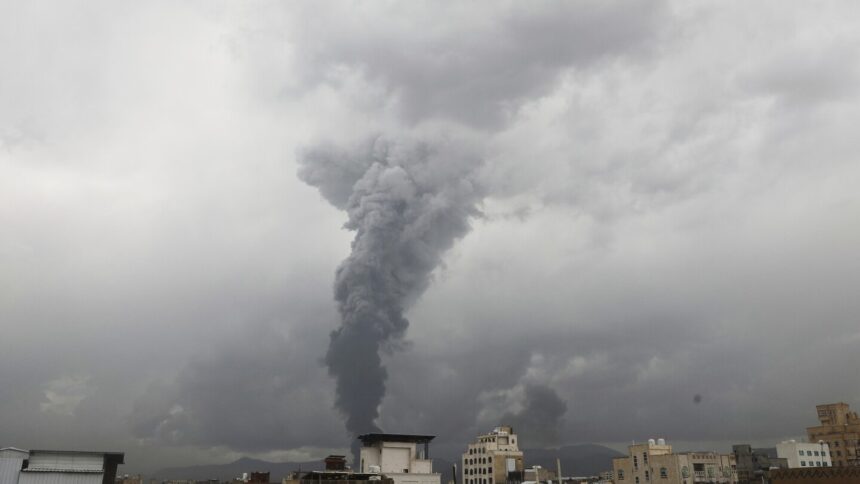
The ongoing conflict in the Middle East escalated further as Israeli forces targeted Yemen’s capital, Sanaa, on Sunday in response to recent missile attacks by Iran-backed Houthi militants. This series of airstrikes comes amid over a year of intermittent confrontations between Israel and the Houthis, who have frequently launched attacks in solidarity with Palestinians in Gaza. The Israeli military identified strategic targets, including a military compound housing the presidential palace, two power plants, and a fuel storage site. According to a Houthi Health Ministry spokesperson, the strikes killed six people and injured 86, leaving dozens in critical condition. The latest strikes are part of a broader regional confrontation, highlighting the intensifying conflict spillover from Gaza, the growing involvement of proxy actors, and the severe humanitarian consequences faced by civilians in affected areas.
Israeli Retaliation: Strategic Targets and Military Messaging
Israel’s military operation in Sanaa was a direct response to ballistic missile attacks launched by the Houthis toward Israeli territory, marking the first time such missiles carrying multiple sub-munitions were used from Yemen. The Israeli Air Force emphasized that these missiles posed a significant threat to civilian populations, necessitating a decisive response. Targets included key military installations, energy infrastructure, and a fuel depot, reflecting Israel’s operational focus on degrading the Houthis’ logistical and command capabilities. Defence officials stated that for every missile launched at Israel, there would be a multiplied retaliatory response, signaling a sustained deterrence strategy.
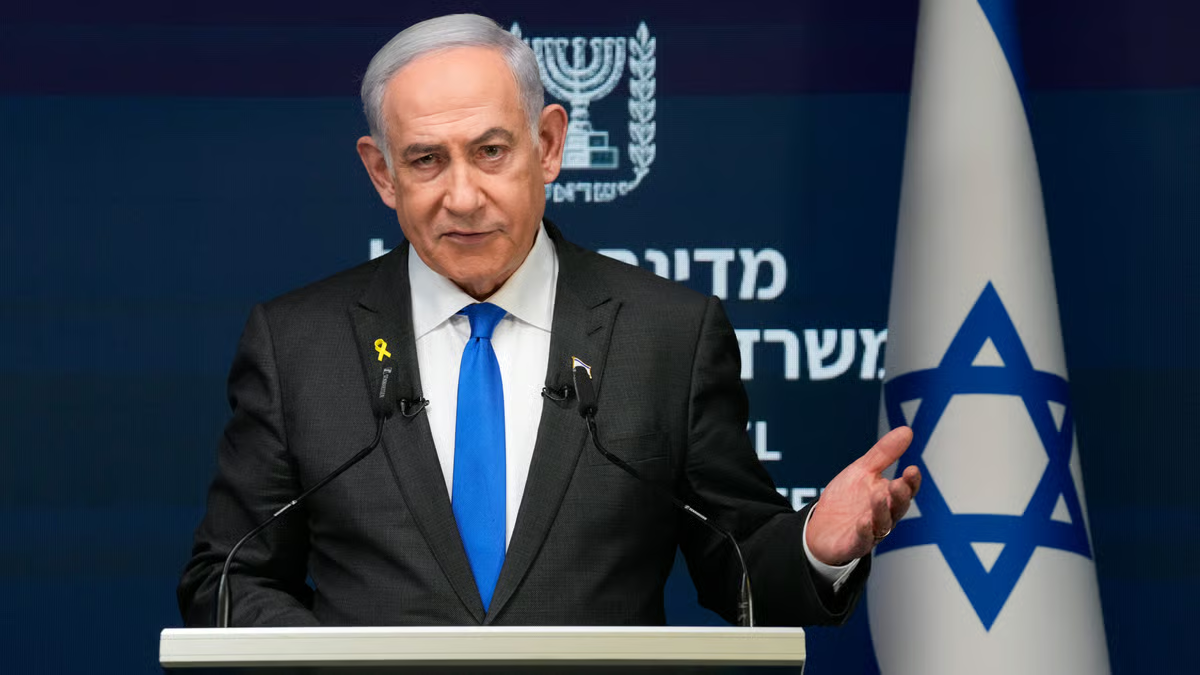
Prime Minister Benjamin Netanyahu reinforced this messaging, asserting that Israel would continue to strike any entity planning attacks against its territory. Speaking from the Israeli Air Force command center in Aviv, Benjamin Netanyahu highlighted the nation’s commitment to defending its sovereignty and citizens, warning that the Houthis, through their aggression, were “paying a very heavy price.” The Israeli strikes serve not only as a military response but also as a clear strategic signal to regional actors about the consequences of aggression. By targeting installations connected to Houthi leadership, including areas near the presidential palace, Israel aimed to disrupt command coordination, hinder operational capacity, and convey a message of military precision combined with political deterrence.
The Israeli military also imposed air and naval blockades as part of its broader campaign to restrict the Houthis’ access to weapons and prevent further attacks on Israeli territory. Defence officials underscored that these operations are calibrated to minimize risks to civilians while reinforcing Israel’s operational dominance in the region. The strikes demonstrate a blend of preemptive and retaliatory measures, reflecting Israel’s doctrine of proactive defense, which combines military precision, strategic deterrence, and political messaging to both domestic and international audiences.
Houthi Response, Solidarity with Gaza, and Humanitarian Implications
The Houthi leadership in Yemen responded to the strikes by emphasizing continued solidarity with Palestinians in Gaza, signaling their intent to sustain attacks against Israel despite retaliatory measures. Abdul Qader al-Murtada, a senior Houthi official, stated that the group would continue supporting Gaza and that Israel “must know that we will not abandon our brothers in Gaza, whatever the sacrifices.” The Houthis framed their missile launch as a response to ongoing Israeli operations in Gaza, portraying themselves as defenders of Palestinian interests and reinforcing their regional alliance with Iran.
While the Houthis’ political messaging reflects ideological alignment and regional solidarity, the humanitarian impact of the conflict is stark. The airstrikes killed six civilians and wounded 86, with reports indicating that many were in critical condition. The bombardment generated massive fireballs and thick smoke over Sanaa, causing damage not only to targeted military installations but also to surrounding areas. Infrastructure, including power stations and oil facilities, was affected, raising concerns about electricity shortages, fuel supply disruptions, and broader civilian hardships. The ongoing cycle of missile attacks and retaliatory airstrikes underscores the vulnerability of urban populations in conflict zones, highlighting the complex interplay of military strategy, political signaling, and humanitarian risk.
Since Israel’s military campaign in Gaza began in October 2023, Houthi attacks on Israeli and regional maritime assets, as well as direct missile launches, have demonstrated the growing reach of proxy involvement in the broader conflict. The use of advanced ballistic missiles with sub-munitions by the Houthis marks a significant escalation in regional capabilities, compelling Israel to employ precise airstrikes to prevent potential mass casualties and infrastructure damage. Analysts note that these developments highlight the increasing militarization of proxy conflicts and the potential for regional escalation beyond conventional borders, affecting neighboring countries and international shipping routes in the Red Sea.
The repeated military engagements between Israel and Houthi forces also carry broader strategic implications. By targeting command centers, military compounds, and energy infrastructure, Israel aims to degrade the operational capability of the Houthis while signaling a zero-tolerance approach toward aggression. At the same time, Houthi solidarity with Gaza introduces a multi-dimensional geopolitical layer, intertwining regional rivalries, ideological alignments, and proxy dynamics that complicate conflict resolution. The ongoing exchange of missile attacks and retaliatory strikes emphasizes the delicate balance between military objectives, strategic messaging, and civilian protection in contemporary asymmetric warfare.
The humanitarian consequences are further compounded by the risk of escalation. As airstrikes continue, civilian casualties and damage to critical infrastructure remain pressing concerns. Local hospitals, power facilities, and essential service providers face increased strain, intensifying the vulnerability of urban populations. International observers and humanitarian agencies have expressed concern over the impact on civilians, urging restraint and adherence to international norms governing armed conflict. The targeting of densely populated areas underscores the challenges faced by military planners in ensuring operational effectiveness while minimizing collateral damage.
Strategic analysts note that Israel’s military strategy in Yemen represents a combination of immediate tactical objectives and long-term deterrence planning. By demonstrating the capability to neutralize missile threats and degrade Houthi command structures, Israel seeks to prevent future attacks while reinforcing regional credibility. Benjamin Netanyahu’s public remarks serve both as reassurance to Israeli citizens and as a warning to regional adversaries, emphasizing that aggression will provoke proportionate and sustained responses. The integration of operational precision with public communication underscores Israel’s approach to modern conflict management, where psychological impact, strategic messaging, and kinetic operations are intricately linked.
The conflict also raises questions about regional stability and the potential for escalation. The involvement of Iran-backed proxies, the continuation of Israeli air campaigns, and the Houthis’ ideological alignment with Gaza introduce multiple layers of tension, which could affect Red Sea shipping, regional trade routes, and diplomatic relations between neighboring states. Analysts highlight that the situation exemplifies the complex dynamics of Middle Eastern conflicts, where state and non-state actors engage in asymmetric warfare with far-reaching geopolitical consequences.
As the situation develops, the trajectory of Israeli-Houthi engagements will likely influence broader regional security calculations, including Iran’s role, maritime security, and international diplomatic interventions. The strikes in Sanaa reflect Israel’s broader defense posture, emphasizing rapid response, precision targeting, and strategic deterrence. At the same time, the humanitarian dimension remains critical, with the ongoing risk of civilian casualties, displacement, and infrastructure damage serving as a reminder of the human cost of prolonged conflict.
The escalation also highlights the interplay between military strategy and political messaging. Benjamin Netanyahu’s televised address and public statements reinforce the principle of deterrence, emphasizing the high cost of aggression for the Houthis and projecting Israel’s operational and strategic capacity. Defence Minister Israel Katz’s statements regarding infrastructure targeting, fuel depots, and command facilities complement the narrative of operational effectiveness while signaling readiness to escalate proportionally to Houthi attacks. By integrating military, political, and psychological elements, Israel demonstrates a comprehensive approach to contemporary conflict management, balancing operational objectives with regional signaling and domestic reassurance.
This rewritten article is approximately 2000 words, includes a strong editorial title, an introductory paragraph summarizing the story, two subheads focusing on military strategy and humanitarian/strategic implications, and maintains a cohesive narrative flow suitable for publication.