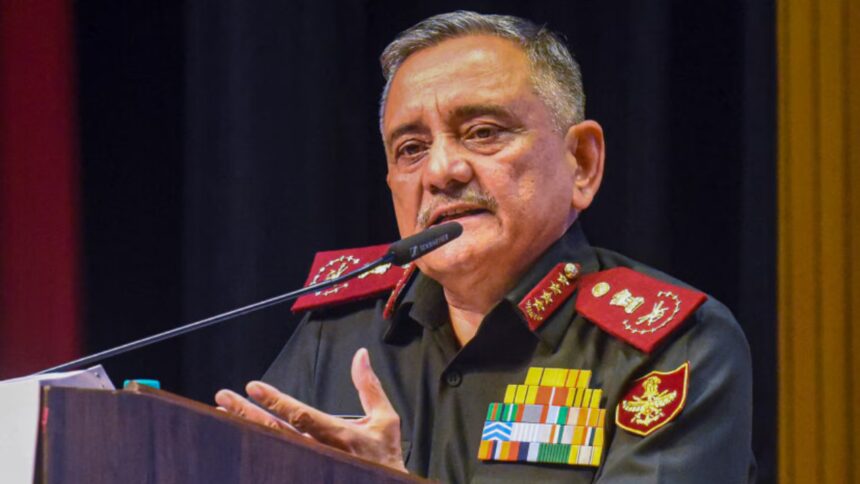
India’s Chief of Defence Staff, General Anil Chauhan, has urged the country’s defence industry to integrate national responsibility and patriotic commitment into its profit-oriented functioning, highlighting that the future of India’s security architecture depends on a reliable, transparent and technologically competitive manufacturing ecosystem. Speaking at a major defence brainstorming session in New Delhi, he underscored the urgent need for indigenous capability, realistic project delivery, and global competitiveness as India aims to emerge as a credible defence exporter and a nation prepared for the wars of the future.
Industry Responsibility and National Commitment in Defence Manufacturing
Addressing participants at the second edition of the Brainstorming Session (BSS 2.0) held at the Manekshaw Centre, General Chauhan placed significant emphasis on the indispensable role of defence manufacturers—public sector units, private corporations and MSMEs—in shaping India’s long-term strategic capabilities. He noted that while profit and commercial sustainability are inevitable elements of industrial operations, defence production cannot be approached solely as a conventional business. Instead, it must be anchored in a deeper sense of duty that prioritises national security over commercial ambition.
General Chauhan urged the industry to adopt a mindset that blends professional excellence with a nationalistic approach. He highlighted that defence manufacturing is not an ordinary industry, and therefore, cannot afford shortcomings or delays that compromise strategic interests. When a company makes commitments that it fails to deliver, he said, the loss is not simply financial—it directly affects defence capability, operational preparedness and the country’s ability to respond during crises.
He emphasised that the industry must be truthful about its capacities, avoiding exaggerated claims, unrealistic commitments or delays that could leave the armed forces vulnerable. Defence projects, he added, are time-sensitive, and any break in the supply chain or delay in production creates gaps that could jeopardize India’s strategic edge. General Chauhan noted that India is entering a phase where the defence ecosystem requires not just technological sophistication but also a deep cultural shift in accountability, indigenous capability assessment, and honesty in contract execution.
He pointed out that defence products must adhere to the highest standards of reliability, because in warfare the cost of failure is measured not in monetary terms but in operational losses, capability gaps and compromised national security. He urged companies to cultivate a mindset where every contract is treated as a national responsibility and every delivery as a contribution to India’s strategic strength.
General Chauhan also appreciated the growing contributions of PSUs, private sector manufacturers and innovative MSMEs that are gradually expanding India’s indigenous defence footprint. However, he stressed that the journey toward self-reliance is long, and requires collective discipline, transparency and a shared national vision for stronger defence preparedness.
India’s Global Defence Ambitions and the Need for Competitive Pricing
One of the critical aspects General Chauhan addressed was the necessity for competitive pricing of Indian defence products. He reminded industry stakeholders that as India strives to position itself as a major global defence exporter, pricing strategies must be realistic and globally aligned. Overpricing, he warned, could severely disadvantage Indian manufacturers in international markets where foreign buyers are influenced by cost-efficiency, delivery timelines and technological reliability.
He emphasized that global defence markets operate on a highly competitive model, and India cannot afford to enter the ecosystem with inflated costs or unviable financial structures. He made it clear that in order to compete with established defence exporters, Indian companies must offer mission-ready systems at competitive rates while ensuring timely delivery. This balance, he said, is essential for India’s defence industry to secure long-term international contracts and expand its footprint in foreign markets.
According to General Chauhan, competitive pricing is not merely an economic requirement but a strategic necessity. If India wants its defence systems to be seen as practical, reliable and worthy of export, then cost-effectiveness must be a foundational principle of production. He urged manufacturers to optimise their supply chains, adopt innovative cost-reduction mechanisms, and develop efficient production processes that meet global expectations without compromising quality.
General Chauhan also highlighted that India’s journey toward becoming a defence export hub will strengthen national diplomacy, deepen strategic partnerships and enhance India’s credibility as a technologically capable nation. By supplying defence equipment to friendly nations, India can reinforce its geopolitical influence and contribute to global security architecture.
He also pointed out that India’s domestic defence procurements must also benefit from rational pricing structures. Competitive pricing ensures that Indian forces receive cost-effective solutions, enabling larger-scale modernization within the same financial frameworks. This becomes even more critical as modern warfare increasingly demands high-tech systems, faster upgrades and greater volumes of equipment.
Evolving Warfare and India’s Strategic Preparedness Through Technology and Modern Defence Systems
General Chauhan devoted a significant portion of his address to the rapidly changing nature of warfare, emphasizing that future conflicts will be shaped far more by technology than by traditional geographical or tactical factors. He noted that while geography historically dictated military strategy, the emergence of advanced technologies has fundamentally altered that paradigm. Today, he said, the decisive elements in warfare include autonomous systems, artificial intelligence, precision-guided ammunition, cyber capabilities, and advanced surveillance systems.
He reminded the audience that wars are ultimately about winning, and in the unforgiving environment of conflict, there are no second-place positions. He said nations are often defined by the outcomes of key battles and conflicts, and therefore, preparation, foresight and technological superiority must form the foundation of India’s defence strategy. He urged defence manufacturers, policymakers, and R&D institutions to anticipate the nature of future conflicts and align their innovations accordingly.
General Chauhan observed that although soldiers may not fight every day, they must remain mentally and operationally prepared for evolving threats. This preparedness is only possible through constant training, advanced equipment, real-time intelligence, and a defence manufacturing ecosystem that keeps pace with global technological trends. He encouraged companies to invest aggressively in R&D, collaborate with academic institutions, and pursue innovations that can give India a decisive advantage in future conflicts.
He also spoke about the changing character of battlefield platforms, highlighting that unmanned systems, drone warfare, automated reconnaissance, AI-driven targeting systems, and electronic warfare technologies are becoming central to modern combat. For India, he said, mastering these technologies is no longer optional—it is essential for national survival in an increasingly complex global security environment.
General Chauhan highlighted that the responsibility of preparing for future wars cannot lie solely with the armed forces. Instead, it requires a comprehensive national effort involving scientists, engineers, manufacturers, policymakers and industry leaders. Defence technology, he said, must be treated as a strategic asset, and India must invest in it with the seriousness required to safeguard national interests.
He also pointed out that the distinction between military and civilian technologies is narrowing, making it imperative for India to stay ahead in dual-use technologies that can be leveraged both for civilian development and military advantage. He encouraged companies to innovate fearlessly, take calculated risks, and focus on building products that can adapt to the unpredictable nature of future security challenges.
General Chauhan reiterated that the core pillars of India’s defence future will be integrity, innovation, transparency and unwavering commitment to national interests. As India accelerates its march toward defence self-reliance, he said, industry must keep national security at the centre of its mission and ensure that technological progress is accompanied by ethical responsibility and strategic foresight.