Prayagraj:
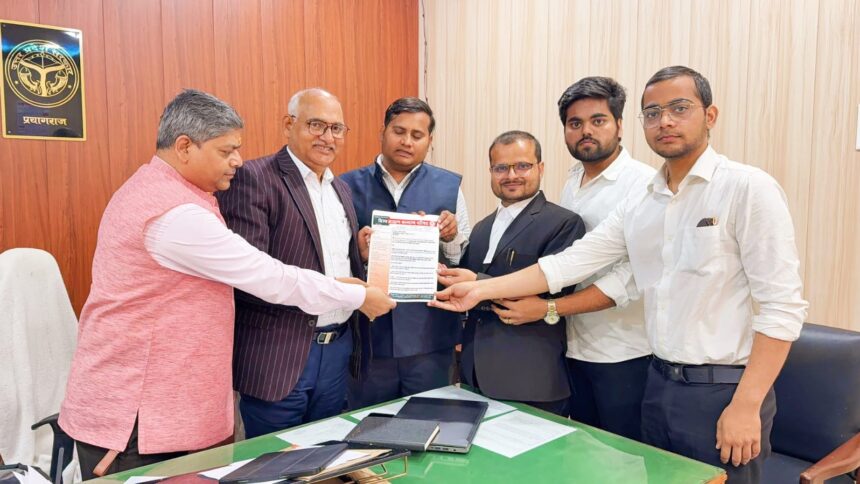
The World Brahmin Welfare Council on Tuesday submitted a memorandum opposing the University Grants Commission (Promotion of Equity in Higher Education Institutions) Regulations, 2026, expressing serious concerns over what it termed as discriminatory and one-sided provisions in the proposed rules. The memorandum was handed over to the City Magistrate of Prayagraj by a delegation led by Shivang Pandey, National President, Yuva Morcha, World Brahmin Welfare Council.
The memorandum was formally addressed to the President of India, the Prime Minister, the Union Home Minister and the Chairperson of the University Grants Commission. The council also informed that copies of the memorandum have been sent to all concerned authorities through registered post, reiterating its objections and demands regarding the proposed regulations.
According to the council, the UGC Regulations 2026, in their present form, introduce mechanisms that could lead to caste-based monitoring and punitive action, which, it argued, go against the principles of equality, fairness and natural justice. The delegation stated that while the objective of promoting equity in higher education institutions is important, the framework suggested under the new regulations raises serious constitutional and social concerns.
The delegation that met the City Magistrate included Shiv Shankar Pandey, Advocate and State President, Yuva Morcha, Advocate Cell; Manish Shukla, National Advisor; Mihir Pandey; Jayraj Mishra, along with several other office bearers and workers of the organization.
In its memorandum, the World Brahmin Welfare Council placed clear and specific demands before the authorities. It demanded that the UGC Regulations 2026 be withdrawn in their entirety with immediate effect. Alternatively, the council urged that all provisions related to caste-based surveillance, punitive measures and unilateral decision-making be completely removed from the regulations.
The council further stated that if a grievance redressal or complaint mechanism is deemed necessary in higher education institutions, it should be uniform, impartial and applicable equally to all sections of society. Such a mechanism, it emphasized, must be rooted in the principles of natural justice and ensure that no individual or group is targeted or prejudged.
Another key concern highlighted in the memorandum was the possibility of students being viewed through the lens of their caste or social identity. The council strongly opposed any system that, in its view, could promote a mindset where students are treated as potential offenders based on their background rather than their actions. It called for an end to any approach that may institutionalize prejudice or discrimination under the guise of regulation.
The World Brahmin Welfare Council clarified that it stands firmly against all forms of discrimination, harassment and injustice in society and in educational institutions. However, it asserted that justice cannot be selective or enforced in a manner that results in injustice to any particular community or group. The council maintained that true equity can only be achieved through balanced, fair and inclusive policies that protect the rights and dignity of all.
The organization indicated that it would continue to raise its concerns through democratic and constitutional means until appropriate changes are made. It also appealed to the central government and the UGC to engage in wider consultation with stakeholders before implementing regulations that have far-reaching implications for students and academic institutions across the country.
The memorandum submission in Prayagraj is part of the council’s broader effort to draw national attention to the issue and seek reconsideration of the proposed UGC Regulations 2026.