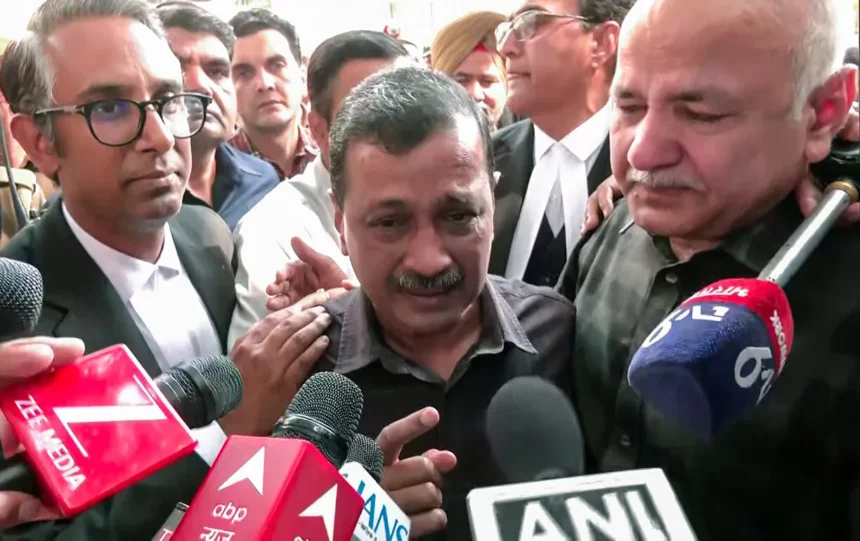
February 2026 ; New Delhi
The Central Bureau of Investigation has filed an appeal before the Delhi High Court challenging the trial court’s decision to discharge Arvind Kejriwal, Manish Sisodia and other accused in the alleged Delhi excise policy corruption case. The move was initiated shortly after the trial court pronounced its order.
The agency contended that the trial court overlooked crucial aspects of the investigation and did not adequately consider the material placed on record. According to the CBI, significant evidence was not properly appreciated while granting relief to the accused.
On 27 February 2026, the trial court discharged all 23 accused persons, including Kejriwal, Sisodia and K Kavitha. The list of discharged individuals also includes Kuldeep Singh, Narender Singh, Vijay Nair, Abhishek Boinpally, Arun Pillai, Mootha Gautam, Sameer Mahendru, Amandeep Singh Dhall, Arjun Pandey, Butchibabu Gorantla, Rajesh Joshi, Damodar Prasad Sharma, Prince Kumar, Arvind Kumar Singh, Chanpreet Singh, Durgesh Pathak, Amit Arora, Vinod Chauhan, Ashish Chand Mathur and Sarath Reddy.
In its order, the trial court made strong observations regarding investigative lapses, stating that the voluminous chargesheet contained several shortcomings and lacked adequate support from witnesses or documentary statements. The court held that no prima facie case was made out against Sisodia and observed that Kejriwal was implicated without cogent material.
For context, Sisodia remained in custody for approximately 530 days. Kejriwal spent around 156 days in jail across two separate periods and was released on 13 September 2024 after the Supreme Court of India granted him bail in the CBI case, following interim bail in proceedings initiated by the Enforcement Directorate.
The excise policy, introduced in 2021 by the Delhi Government to increase revenue and reform the liquor trade, was later withdrawn amid allegations of irregularities. Subsequently, Lieutenant-Governor Vinay Kumar Saxena ordered a CBI probe into its implementation.
The CBI and the Enforcement Directorate have alleged that the policy was structured to provide undue benefits to certain private entities at the expense of the public exchequer. With the appeal now before the Delhi High Court, the matter is set to undergo further judicial examination.