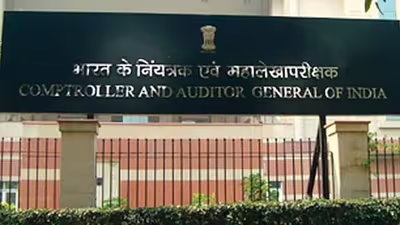
31 March 2023, New Delhi.
The Comptroller and Auditor General of India presented Report No. 4 of 2025 on the functioning of universities under the Government of the National Capital Territory of Delhi. The performance audit, conducted under the CAG Act, 1971 and submitted under Section 48 of the GNCTD Act, 1991, evaluates administrative, academic, financial, and governance aspects of higher education institutions. The audit covers the period from April 2018 to March 2023 and focuses on three major universities—Guru Gobind Singh Indraprastha University (GGSIPU), Delhi Technological University (DTU), and Delhi Pharmaceutical Sciences and Research University (DPSRU).
Scope and Structure of the Report
The report is organized into five chapters covering introduction, administrative and academic issues, accreditation and affiliation processes, financial and infrastructure management, and internal control systems. It examines the effectiveness of planning, monitoring, and implementation mechanisms across universities and their regulatory bodies, including the Directorate of Higher Education (DHE) and the Directorate of Training and Technical Education (DTTE).
The audit was conducted based on established standards and includes only those findings that emerged during the test audit process.
Policy and Governance Issues
The audit highlights the absence of a clear and comprehensive higher education policy framework at the departmental level. Both DHE and DTTE lacked structured planning and monitoring systems, leading to inconsistencies in decision-making.
A significant governance lapse was observed in the delay of constituting the Admission Regulatory Committee, which remained pending for nearly 16 years. This delay impacted transparency and standardization in admissions across institutions.
Accreditation and Affiliation Concerns
The report notes serious shortcomings in accreditation processes. Several universities continued to operate without mandatory accreditation from bodies such as NAAC or NBA.
In particular, GGSIPU functioned without accreditation during the audit period from 2018 to 2023, raising concerns about compliance with quality standards. The affiliation process for colleges also lacked robust monitoring mechanisms, resulting in gaps in oversight and quality assurance.
Infrastructure and Capacity Constraints
Infrastructure deficiencies were identified as a major constraint affecting academic delivery. The audit found significant shortfalls in seat capacity across institutions—approximately 26 percent in GGSIPU, 41 percent in DTU, and 59 percent in DPSRU.
These gaps indicate inadequate planning and expansion of facilities in line with demand. Additionally, several affiliated colleges were found to be operating with insufficient land and infrastructure, affecting compliance with regulatory norms.
Human Resource Shortages
A major issue highlighted in the report is the shortage of teaching and non-teaching staff. Faculty vacancies ranged from around 40 percent in GGSIPU to nearly 60 percent in DTU, while DPSRU faced shortages of up to 54 percent.
The reliance on outsourced staff further affected academic continuity and quality. Delays in recruitment processes and lack of workforce planning contributed to these shortages.
Academic Quality and Curriculum Issues
The audit identified significant delays in updating academic curricula. In several cases, syllabi had not been revised for periods ranging from three to sixteen years. Nearly 47 percent of courses were found to be outdated, impacting the relevance of education and employability of graduates.
Research output, patent generation, and academic collaborations were also found to be limited, indicating weak engagement with innovation and industry.
Examination and Result Delays
The report highlights inefficiencies in examination systems, with 54 percent of results declared after delays. In some instances, delays extended up to eight months, affecting students’ academic progression and career opportunities.
The absence of streamlined processes and digital systems contributed to these delays.
Financial Management Issues
Financial irregularities and inefficiencies were observed across institutions. Funds under centrally sponsored schemes such as RUSA remained underutilized, with ₹3.04 crore lying unused.
In addition, tax liabilities amounting to ₹25.59 crore were identified, indicating gaps in financial compliance and planning. The audit also pointed to weak monitoring of expenditure and lack of timely fund utilization.
Internal Control and Monitoring Weaknesses
The report notes deficiencies in internal control systems, including the absence of institutional committees and weak quality assurance mechanisms.
Management Information Systems (MIS) and automation processes were either inadequate or not fully implemented, limiting data-driven decision-making. Stock verification processes were also not conducted regularly, raising concerns about asset management.
Other Operational Issues
Additional concerns include a high percentage of vacant seats, ranging between 14 percent and 32 percent, indicating inefficiencies in admission planning and course demand assessment.
Scholarship disbursement delays and limited startup and placement activities further highlighted gaps in student support systems and industry linkage.
Conclusion and Recommendations
The audit concludes that Delhi’s public university system faces systemic challenges in governance, infrastructure, staffing, and academic quality. The absence of a cohesive policy framework and weak monitoring mechanisms have affected overall institutional performance.
The report recommends the formulation of a clear higher education policy, timely updating of curricula, strengthening of accreditation processes, and accelerated recruitment to address staff shortages. It also emphasizes improving infrastructure, ensuring timely declaration of results, and enhancing financial management practices.
Further, the adoption of digital systems, strengthening of internal controls, and improved coordination between regulatory bodies and universities are essential for ensuring transparency and efficiency.
Overall, the findings underline the need for comprehensive reforms to improve the quality and effectiveness of higher education in Delhi.