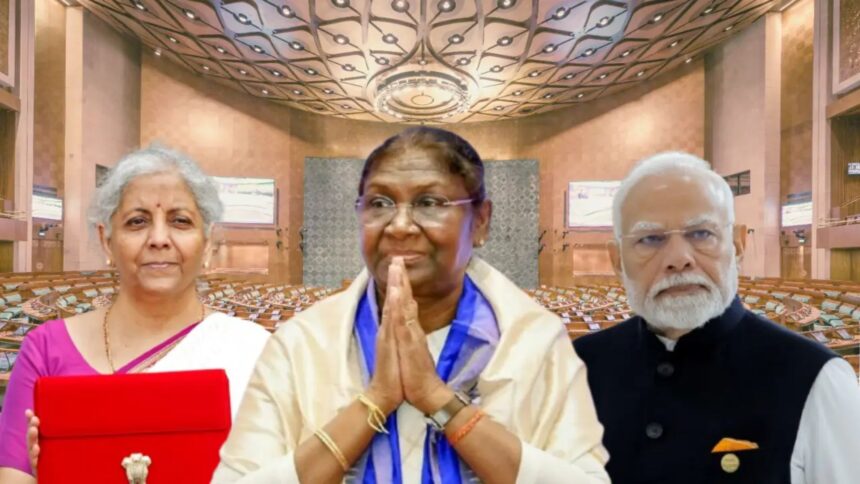
The first part of the 18th Lok Sabha’s Budget Session began with President Droupadi Murmu addressing a joint sitting of the Lok Sabha and the Rajya Sabha, setting the tone for the government’s priorities on national security, social justice, economic reform, and inclusive development, before both Houses were adjourned till January 29 amid opposition protests.
President Murmu’s address, delivered on the opening day of the Budget Session, highlighted the government’s achievements over the past decade and its roadmap for the coming years. She spoke at length about India’s internal and external security posture, welfare schemes aimed at the poor and marginalised, infrastructure expansion, technological self-reliance, and India’s growing role on the global stage. The speech also sparked political confrontation, particularly when she referred to the VB-G Ramji law, prompting protests and sloganeering by opposition members.
The Budget Session is scheduled to run from January 28 to April 2 in two phases, with the first part concluding on February 13 and the second resuming from March 9. A total of 30 sittings are planned, though Zero Hour was not observed on the opening day. Ahead of the session, an all-party meeting chaired by Defence Minister Rajnath Singh saw participation from MPs of more than 35 parties, underlining expectations of a stormy session marked by sharp political exchanges.
Security, operation sindoor, and india’s global posture
A key highlight of President Murmu’s address was her strong emphasis on national security and India’s response to terrorism. Invoking the words of Sri Guru Tegh Bahadur Ji on fearlessness, she said India has demonstrated that strength can be exercised responsibly and with wisdom. Referring to Operation Sindoor, the President said the operation showcased the valour of the Indian armed forces and sent a clear message that any attack on India would be met with resolute and decisive action.
She noted that through Operation Sindoor, India destroyed terror hotbeds using its own resources, reinforcing the country’s growing self-reliance in defence capabilities. According to the President, the government’s actions conveyed that national security would never be compromised and that India’s response to terrorism would be firm and unambiguous. She also mentioned that the Indus Water Treaty had been kept in abeyance as part of India’s broader fight against terrorism, reflecting a more assertive strategic posture.
President Murmu said work was underway on Mission Sudarshan Chakra to further strengthen the country’s security system. She added that India’s defence exports have crossed ₹23,000 crore, signalling the country’s emergence as a credible player in the global defence market. The rise in defence manufacturing and exports, she said, reflects growing confidence in the Made in India initiative, particularly in the aftermath of Operation Sindoor.
On global affairs, the President said India believes the objective of global politics should be the service of humanity. She stressed that India continues to advocate dialogue, cooperation, and peaceful solutions even amid global tensions. At the same time, she warned that new-age challenges such as deepfakes, misinformation, and fake content pose serious dangers to democracy and social harmony, calling for collective vigilance and responsible use of technology.
Murmu also highlighted India’s increasing engagement with the world, including the India–European Union Free Trade Agreement, which she said would boost manufacturing and services while creating employment opportunities for the youth. She underlined that India is entering the second stage of the twenty-first century with confidence, backed by stronger foundations built over the last 10 to 11 years.
Welfare, infrastructure, reforms, and economic transformation
A substantial portion of the President’s address focused on welfare initiatives and social justice. Murmu said her government remains committed to true social justice, noting that over the past decade, around 25 crore citizens have been lifted out of poverty. She said social security schemes that once reached only 25 crore people in 2014 now cover nearly 95 crore citizens, reflecting the expanded reach of government programmes.
She highlighted schemes such as Ayushman Bharat, MUDRA, SVANIDHI, and the Vishwakarma scheme, saying they have become lifelines for crores of poor and middle-class families. According to the President, insurance claims worth more than ₹24,000 crore have been settled under these initiatives, providing crucial support during times of crisis. She said the encouraging economic indicators show that youth, farmers, workers, and entrepreneurs are playing an increasingly important role in building a developed India.
Murmu emphasised women’s empowerment, stating that ‘nari shakti’ stands at the forefront of the country’s development journey. She referred to the historic milestone of the first batch of women cadets passing out from the National Defence Academy, saying it strengthened the belief that women are leading India’s progress across sectors. Welfare of backward communities, Dalits, and tribal groups, she said, remains a priority, guided by the vision of Sabka Saath, Sabka Vikas.
On infrastructure, the President said almost the entire rural population is now connected by roads, transforming access to markets, education, and healthcare. She noted that Indian Railways, which primarily serves the poor and middle class, is rapidly moving towards complete electrification. She highlighted the emotional moment when the Rajdhani Express reached Aizawl for the first time, directly connecting Mizoram’s capital with New Delhi and filling the nation with pride.
Murmu said India has become the second-largest mobile manufacturing country in the world, underlining the success of the Make in India programme. She added that post Operation Sindoor, confidence in the Made in India platform has further increased. The President also spoke about India’s progress in renewable energy, noting that two million rooftop solar systems have been installed and that the country is making rapid strides in the solar sector alongside nuclear energy.
In agriculture and allied sectors, she said efforts are being made to promote the Shri Ann scheme globally to enhance farmers’ incomes. Farmers, she said, are being encouraged to diversify beyond foodgrain production into animal husbandry, fisheries, and beekeeping. She also highlighted that India is now the second-largest fish-producing nation globally, reflecting growth in the blue economy.
On science and technology, Murmu lauded astronaut Subhanshu Shukla’s journey to the International Space Station, calling it the beginning of a historic phase. She said India is moving towards building its own space station and is progressing enthusiastically on the Gaganyaan mission. She also mentioned that one million youth are being trained in artificial intelligence and 60,000 in semiconductor technologies, preparing the workforce for future industries.
The President said the government is changing outdated rules through a ‘Reform Express’ to align governance with future needs. However, her mention of the VB-G Ramji Bill, which replaces the MGNREGA scheme, triggered uproar in Parliament, with opposition members demanding its repeal. The speech also recalled Dr B. R. Ambedkar’s emphasis on equality and social justice, framing reforms within a constitutional and moral context.
Following the address, President Murmu and Prime Minister Narendra Modi departed Parliament, marking the conclusion of the first day’s proceedings. Both Houses were adjourned till 11 am on January 29, even as opposition parties signalled continued confrontation over issues such as unemployment, electoral revisions, foreign policy, and contentious legislation.