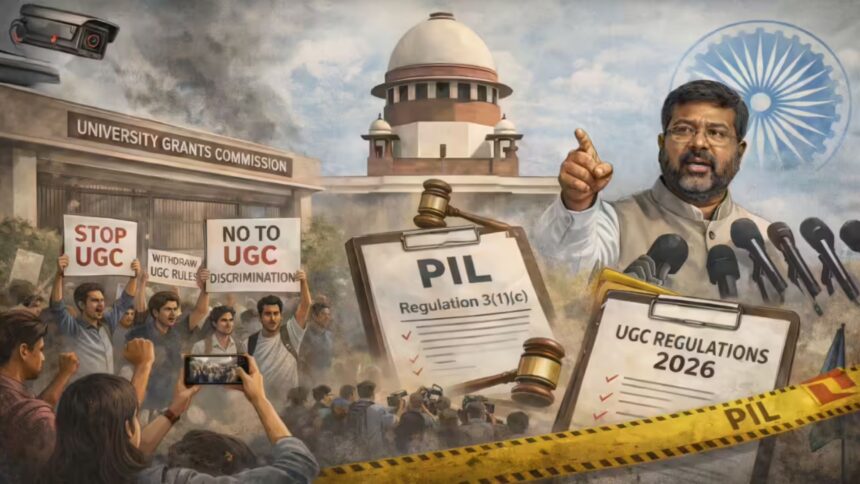
A wave of intense protests has spread across several states after the University Grants Commission introduced new equity-related regulations, with young people resorting to symbolic acts such as shaving their heads to express anger, even as the Supreme Court prepares to examine the constitutional validity of the controversial rules.
The protests against the University Grants Commission’s latest regulations have taken a dramatic turn, drawing national attention as students and youth groups in Uttar Pradesh and other regions staged demonstrations marked by shaved heads, black armbands, and public sit-ins. Protesters argue that the new UGC framework, officially titled the Promotion of Equity in Higher Education Institutions Regulations, has created deep anxiety among students, particularly those from the general category, who fear the rules could alter academic environments in ways they see as unfair or divisive. As demonstrations grow louder and more symbolic, the issue has also reached the judiciary, with the Supreme Court of India agreeing to hear petitions challenging the regulations, adding legal weight to an already heated public debate.
The controversy comes at a time when higher education reforms are already under close scrutiny, and emotions around access, fairness, and representation remain highly charged. For many protesters, shaving their heads has become a powerful visual statement of dissent, meant to convey sacrifice, frustration, and a sense of being unheard. The unfolding events have sparked discussions not only about the content of the UGC rules, but also about how equity and equality should be interpreted and implemented in India’s vast and diverse education system.
Protests intensify as youth challenge ugc equity regulations
The protests gained momentum in parts of Uttar Pradesh, where groups of students, young professionals, and members of civil society gathered in public spaces to oppose the new regulations issued by the University Grants Commission. In cities such as Pilibhit, Lucknow, Prayagraj, Varanasi, and Kanpur, demonstrators shaved their heads, applied black tilaks, and wore black ribbons as symbols of protest. These acts were accompanied by slogans demanding the immediate withdrawal of the rules and memorandums submitted to district administrations.
According to protesters, the new UGC regulations mandate the creation of equity committees and mechanisms within higher education institutions to address discrimination and promote inclusion. While the stated objective of the rules is to ensure fairness and protect marginalised communities, critics argue that the framework is vaguely worded and open to misuse. Many fear that the absence of clear safeguards could lead to false complaints, administrative overreach, and an atmosphere of mistrust on campuses.
Protesters from the general category have been particularly vocal, claiming that the regulations unfairly target them and undermine the principle of equality before the law. They argue that instead of fostering harmony, the rules risk deepening divisions among students along social and caste lines. Several demonstrators have said that merit-based evaluation and academic freedom could be compromised if institutions are burdened with excessive regulatory mechanisms without adequate checks and balances.
Lawyers, student leaders, and youth organisations have joined the protests, lending them both visibility and organisational strength. In some areas, legal professionals participated in demonstrations, shaving their heads to express solidarity and to underline the seriousness of the issue. Public meetings and rallies have focused on the demand that the UGC reconsider or suspend the regulations until wider consultations are held with stakeholders, including students, teachers, and academic administrators.
The symbolic nature of the protests has amplified their impact. Shaving one’s head is traditionally associated with mourning or penance, and protesters have used it to convey what they describe as the erosion of fairness in higher education. Social media platforms have been flooded with images and videos of these demonstrations, helping the movement gain national traction and prompting debates across political and academic circles.
Supporters of the regulations, however, argue that the protests misrepresent the intent of the UGC rules. They maintain that the framework is designed to address long-standing issues of discrimination and exclusion in educational institutions, and that fears of misuse are exaggerated. According to this view, equity mechanisms are essential to ensure that campuses are safe and inclusive spaces for all students, particularly those from historically disadvantaged backgrounds.
Supreme court hearing and the larger debate on equity in education
As protests continued on the streets, the legal challenge to the UGC regulations moved into focus with the Supreme Court agreeing to hear petitions questioning their constitutional validity. Petitioners have argued that certain provisions of the regulations are non-inclusive and discriminatory in nature, alleging that they violate fundamental rights guaranteed under the Constitution. The court’s decision to take up the matter has raised expectations among protesters that their concerns will receive a fair and impartial hearing.
The legal challenge centres on how discrimination is defined and addressed under the new rules. Critics claim that the regulations focus narrowly on specific forms of discrimination while failing to provide equal protection to all groups. They argue that equity, as envisioned in the Constitution, must be balanced with equality, and that any regulatory framework must avoid creating new forms of exclusion while addressing old ones.
The Supreme Court’s involvement has added a new dimension to the debate, shifting part of the discourse from the streets to the courtroom. Legal experts note that the case could have far-reaching implications for higher education governance, as it may clarify the limits of regulatory authority and the interpretation of equity in academic settings. Universities and colleges across the country are closely watching the proceedings, aware that the outcome could shape institutional policies for years to come.
Meanwhile, the UGC has defended its regulations, stating that they are aligned with constitutional values and international best practices. The commission has argued that equity committees and grievance redressal mechanisms are necessary to address systemic issues and to ensure that all students have equal opportunities to succeed. It has also indicated that the regulations are not meant to target any particular group, but to create a more just and inclusive academic environment.
The broader debate has highlighted the complexity of implementing social justice measures in a diverse society. While there is widespread agreement on the need to eliminate discrimination, opinions differ sharply on how this should be achieved. For some, strong regulatory frameworks are essential to protect vulnerable groups, while others believe that overregulation can undermine trust and meritocracy.
Political reactions to the protests and the court case have also varied. Some leaders have expressed support for the demonstrators, calling for a review of the regulations and greater transparency in policy-making. Others have urged patience, arguing that reforms should be allowed to take effect before being judged. The issue has thus become part of a larger national conversation about governance, rights, and the future of education in India.
As the Supreme Court prepares to hear arguments from both sides, the protests show no signs of abating. Youth groups have vowed to continue their demonstrations until their demands are addressed, insisting that their actions are driven by concern for fairness and the long-term health of the education system. At the same time, supporters of the regulations hope that judicial scrutiny will reaffirm the need for strong equity measures and dispel what they see as misinformation surrounding the rules.
The unfolding events reflect a critical moment for Indian higher education, where questions of equity, equality, and justice intersect with policy, law, and public sentiment. The outcome of the legal proceedings and the government’s response to the protests are likely to influence not only the fate of the UGC regulations, but also the broader direction of educational reform in the country.