India’s growing stature in global politics and its evolving partnership with the European Union were strongly underlined during a high-profile state dinner at Rashtrapati Bhavan, where European leaders praised New Delhi’s role as a stabilising and influential force in an uncertain world.
European Commission President Ursula von der Leyen described India as a leading force in global politics while addressing a distinguished gathering at Rashtrapati Bhavan, where senior Indian leadership hosted European Union delegates for a state dinner. The evening marked a symbolic and substantive moment in India–EU relations, coming on the heels of intensive diplomatic engagements earlier in the day. The presence of India’s top political, judicial, and security leadership reflected the importance New Delhi places on its strategic partnership with Europe, while the remarks from European leaders highlighted a shared vision for cooperation in a rapidly changing global landscape.
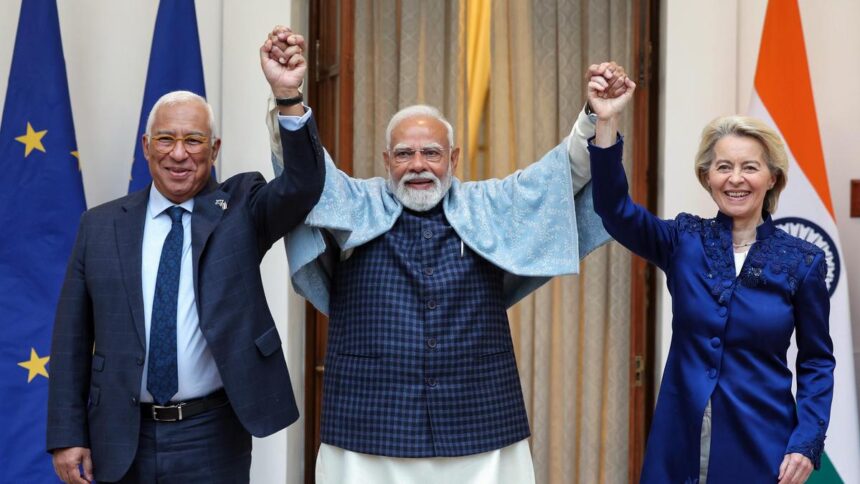
The dinner was organised in honour of European Council President Antonio Costa and Ursula von der Leyen, signalling the growing momentum in India–EU ties. Against the backdrop of geopolitical uncertainty, economic realignments, and global security challenges, the gathering served as a platform to reaffirm mutual trust and long-term commitment. It also reinforced the message that India and Europe see each other not merely as economic partners, but as strategic allies capable of shaping global outcomes through dialogue and collaboration.
India’s rising global role and shared strategic vision
Addressing the gathering, Ursula von der Leyen said Europe was closely watching India’s expanding influence on the global stage and welcomed its emergence as a key actor in international affairs. She emphasised that at a time when the world is witnessing fragmentation, conflict, and economic anxiety, India and the European Union are consciously choosing cooperation over confrontation. According to her, this shared commitment to dialogue, coordination, and partnership is essential for strengthening global stability and rebuilding trust in international systems.
Von der Leyen highlighted that India’s voice carries growing weight in global decision-making, not only because of its economic size and demographic strength, but also due to its consistent advocacy of multilateralism and rules-based order. She noted that Europe sees India as a partner with whom it can work closely on issues ranging from trade and technology to climate action and global security. Her remarks reflected a broader European recognition that India’s role in shaping the twenty-first century global order is becoming increasingly central.
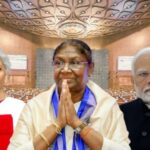
President Droupadi Murmu, who hosted the evening, echoed similar sentiments in her address. She said India and Europe share a common outlook at a time when the world is grappling with conflicts, economic volatility, and climate-related challenges. According to her, the complexity of today’s global problems demands collective action and sustained multilateral cooperation rather than unilateral approaches. She stressed that no single nation can address such challenges alone, reinforcing India’s long-standing belief in dialogue-driven solutions.
Murmu underlined India’s commitment to working with like-minded partners to uphold peace, stability, and sustainable development. She noted that India’s engagement with the European Union is rooted in shared democratic values, respect for international law, and a belief in inclusive growth. Her remarks positioned India–EU relations within a broader framework of global responsibility, where cooperation is seen not only as beneficial but necessary for addressing shared concerns.
The presence of Prime Minister Narendra Modi at the dinner further underscored the political importance of the occasion. Modi’s participation signalled that India views its partnership with the European Union as a priority at the highest level of government. Alongside him were Chief Justice of India D. Y. Chandrachud, National Security Adviser Ajit Doval, Vice President C. P. Radhakrishnan, and several senior ministers, diplomats, and officials. Their collective presence reflected a whole-of-government approach to strengthening ties with Europe, encompassing political leadership, judicial authority, and national security institutions.
European Council President Antonio Costa, in his remarks, said the India–EU strategic partnership is acquiring increasing economic and geopolitical relevance in a rapidly evolving world. He expressed satisfaction with the outcomes of the day’s summit-level discussions and highlighted progress across multiple areas of cooperation. According to Costa, initiatives such as the proposed Free Trade Agreement, enhanced security and defence collaboration, and the joint strategic agenda for 2030 demonstrate the depth and ambition of the partnership. He described these efforts as examples of cooperative leadership, where two major democratic entities work together to address global challenges.
Costa noted that as global power dynamics shift, partnerships based on shared values and mutual respect become even more important. He said India and the European Union are well placed to contribute to global stability by promoting open markets, resilient supply chains, and a rules-based international system. His comments reinforced the idea that India–EU ties are no longer limited to trade or diplomacy alone, but encompass a broader strategic vision.
Cultural diplomacy and the expanding scope of India–EU relations
Beyond formal diplomacy and strategic discussions, the state dinner also highlighted the role of cultural exchange in strengthening international relationships. The evening at Rashtrapati Bhavan offered European delegates an immersive experience of India’s cultural diversity through its cuisine, reflecting the idea that diplomacy is as much about people and traditions as it is about policy.
The specially curated menu showcased Himalayan and hill traditions, introducing guests to ingredients and flavours that are deeply rooted in regional Indian cultures. Dishes featured elements such as yak cheese, Gucchi mushrooms, and Himachali Swarnu rice, offering a culinary narrative that went beyond familiar Indian fare. The menu was prepared in collaboration with chefs Prateek Sadhu and Kamlesh Negi, who are known for their focus on regional ingredients and indigenous cooking techniques. Through this carefully designed dining experience, India presented its cultural richness as an integral part of its global identity.
The emphasis on regional cuisine served as a reminder that India’s diversity is one of its greatest strengths. By highlighting lesser-known culinary traditions, the dinner conveyed a message of inclusivity and respect for local cultures, aligning with India’s broader diplomatic narrative of unity in diversity. For European delegates, the experience offered not just a meal, but an insight into India’s civilisational depth and its ability to blend tradition with modernity.
The state dinner symbolised the expanding scope of India–EU relations, where strategic dialogue is complemented by cultural diplomacy. As both sides look to deepen cooperation across economic, political, and security domains, such engagements help build mutual understanding and trust at a human level. The blending of high-level political participation with cultural presentation reflected a holistic approach to diplomacy, one that recognises the importance of shared experiences in strengthening long-term partnerships.
With Europe signalling readiness to deepen engagement and India asserting its role as a responsible global actor, the Rashtrapati Bhavan dinner stood as a reflection of a partnership that is evolving in scale and substance. The convergence of leadership, shared values, and cultural exchange during the evening illustrated how India and the European Union are shaping a relationship designed to navigate uncertainty, foster stability, and contribute meaningfully to global governance.