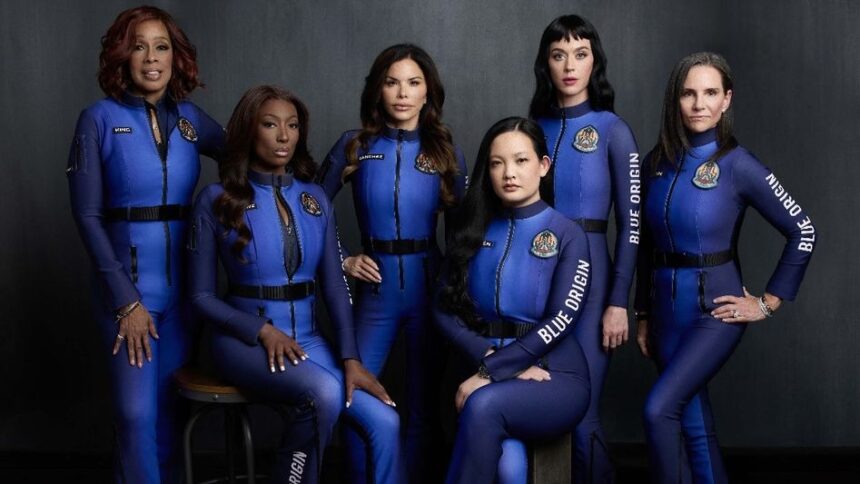
Blue Origin’s recent all-female spaceflight, which took place on April 14, 2025, has made history by sending a team of six women, including pop star Katy Perry, journalist Lauren Sánchez, and CBS presenter Gayle King, to the edge of space. The New Shepard rocket completed a brief 11-minute journey, allowing the passengers to experience weightlessness before returning to Earth. This marks the first time in over 60 years that an all-female crew has traveled to space, with the last such flight occurring in 1963.
Despite the attention this flight has garnered, space tourism continues to be a subject of intense debate. While the flight attracted media headlines, questions around the exorbitant cost and environmental impact of such ventures remain a significant concern. In this explainer, we examine both the appeal and the criticisms of space tourism, particularly in light of Blue Origin’s recent flight.
What is Space Tourism?
Space tourism refers to private individuals paying to travel to space for recreational purposes. The primary destination for space tourists is the Kármán line, which lies 100 kilometers above sea level and is globally recognized as the boundary of space. Blue Origin’s recent sub-orbital flight with its all-female crew crossed this line, allowing passengers a few minutes of weightlessness.
While space tourism has gained significant attention, it differs greatly from space exploration. The latter is focused on scientific research and advancing human knowledge of space, typically conducted by government space agencies like NASA. Space tourism, on the other hand, is primarily aimed at providing wealthy individuals with a brief and thrilling space experience, and its commercial aspect has led to partnerships with major private companies such as SpaceX, Virgin Galactic, and Blue Origin.
The Growing Industry of Space Tourism
The all-female flight of Blue Origin, while symbolic, reflects a larger trend of growing interest in space tourism. In 2023, the industry was valued at $848 million, and it is projected to reach $6.7 billion by 2030, with a growth rate of 31.6% annually. Supporters argue that space tourism will fuel investment in space exploration, lead to technological advancements, and help make space travel more affordable and accessible in the future.
Advocates point out that the innovations born from space tourism could lead to breakthroughs in fields like fuel development, with potential discoveries in hydrogen fuel systems that might even benefit industries like aviation. Additionally, space tourism experiments, such as studying the effects of microgravity on human health and plant growth, could provide insights beneficial to Earth-bound industries.
Jeff Bezos, the founder of Blue Origin, defended space tourism, framing it as part of a larger mission to “build a road to space” for future generations. According to Bezos, such initiatives would help solve problems on Earth by advancing technology that can be used for a variety of global challenges.
Why Space Tourism Faces Criticism
However, space tourism is not without its critics. The biggest concern is the staggering cost of participation. A ticket on a Virgin Galactic flight costs around $450,000, while a seat on Blue Origin’s spacecraft remains undisclosed, but it is known to be in a similar range. These high prices make space tourism accessible only to the ultra-wealthy, leading to accusations of wastefulness and elitism.
Actress Olivia Munn voiced her criticism of the concept, questioning the value of such trips. She pointed out the disparity between the billions spent on these missions and the struggles faced by many people around the world who can’t afford basic necessities. She also raised concerns about the lack of direct benefits for humanity, asking what these space tourists could possibly contribute to solving Earth’s problems from space.
The environmental impact of space tourism is another major point of criticism. Rocket launches, while awe-inspiring, are known to contribute to pollution. Rockets release nitrogen oxides into the upper layers of the atmosphere, which can deplete the ozone layer that protects us from harmful UV radiation. This could have long-term consequences for climate change, as each launch produces carbon dioxide and other pollutants.
Experts warn that the environmental impact of space tourism could grow significantly if the industry expands as projected. A single suborbital flight, such as those by Virgin Galactic, could produce as much pollution as a 10-hour transatlantic flight. While current space tourism operations are small in scale, their carbon footprint is disproportionately large compared to other forms of travel.
The Way Forward: Is Space Travel Really Worth the Hype?
Despite its controversies, space tourism is likely to continue its growth trajectory. However, the question remains whether it’s worth the high cost and environmental toll. While it is true that the industry brings excitement and new technological possibilities, it remains clear that its benefits for the greater good are still unclear.
Critics argue that while space tourism has the potential to contribute to technological advancements, it needs to become far more sustainable and inclusive before it can be considered a true success. Without a tangible and beneficial return for society, the high costs and environmental damages associated with space tourism may continue to outweigh its positive aspects.
In the future, as the industry evolves, it will need to balance its commercial ambitions with greater social responsibility, and possibly reframe its goals to ensure that space travel can truly benefit all of humanity — not just the wealthy few.