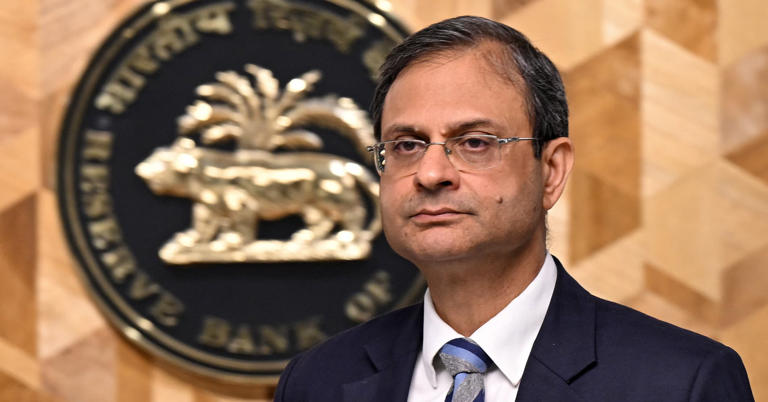
The Reserve Bank of India is likely to cut its benchmark interest rates for the first time in nearly five years as it concludes its policy meeting on Friday. With inflation easing and economic growth slowing, analysts expect the central bank to lower the repo rate by 25 basis points to 6.25%, signaling the start of a “shallow rate cut cycle,” according to Taimur Baig, chief economist at DBS Bank.
Indian bonds have rallied in recent weeks as traders anticipate a rate cut, with the 10-year benchmark yield falling by 16.5 basis points to 6.664% over three weeks, according to London Stock Exchange Group data. If implemented, this would be the first rate cut since May 2020, when the Reserve Bank of India reduced rates to mitigate the economic impact of the Covid-19 pandemic.
Investors will closely scrutinize the policy statement from newly appointed Governor Sanjay Malhotra, who took charge in December. Analysts at Goldman Sachs anticipate a 25-basis-point rate cut this week, alongside a shift in the Reserve Bank of India’s stance from neutral to accommodative. They also forecast another 25-basis-point cut in April.
The benchmark repo rate has remained at 6.5% for two years, as inflation stayed above the central bank’s medium-term target of 4% and exceeded the upper tolerance limit of 6% in October. However, India’s consumer price inflation has since eased, coming in at 5.48% in November and 5.22% in December, giving the central bank room to lower rates.
The Reserve Bank of India’s rate decision comes at a time when India’s economic growth is slowing. The Indian government recently lowered its full-year gross domestic product forecast to 6.4% from 7.2%, marking its weakest expansion in four years. Economic growth for the quarter ending in September slowed to 5.4%, its lowest level in nearly two years. Meanwhile, inflation projections were revised upwards to 4.8% from 4.5%.
A weakening rupee has added another layer of complexity to the central bank’s policy decisions. The rupee has declined 3.6% against the dollar since November, raising concerns that further rate cuts could weaken it further, stoking inflation and triggering capital outflows. The Reserve Bank of India has reportedly intervened in the foreign exchange market to cushion volatility.
Meanwhile, external factors such as the trade policies of United States President Donald Trump pose additional challenges. His proposed universal tariffs have heightened scrutiny of India, which had a $43 billion trade surplus with the United States in 2023. Indian Prime Minister Narendra Modi is expected to meet with Donald Trump next week in an effort to strengthen trade relations and avoid potential tariff disputes.